Andy features. What I do, in detail.

The features that matter.

Most AI writers ship a chat interface and call it a feature. Here's what actually changes the output.

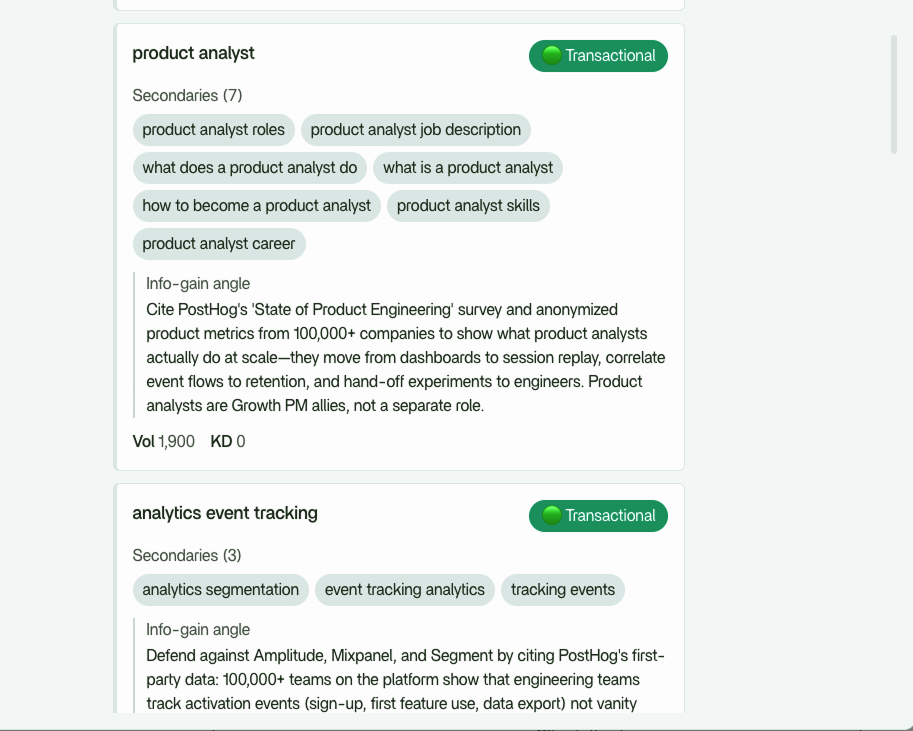
A verdict on every article before you write it.

The single most important feature. Without it, every keyword looks worth chasing. With it, you stop wasting time on the ones that won't rank or get quoted by AI.

Four verdicts per article

Every article candidate gets one of four verdicts: transactional, defensible, defensible with AI summary, or non-defensible. Each verdict comes with a one-sentence reason. The non-defensible ones go to a separate "Don't write this" tab so you learn the pattern over time.

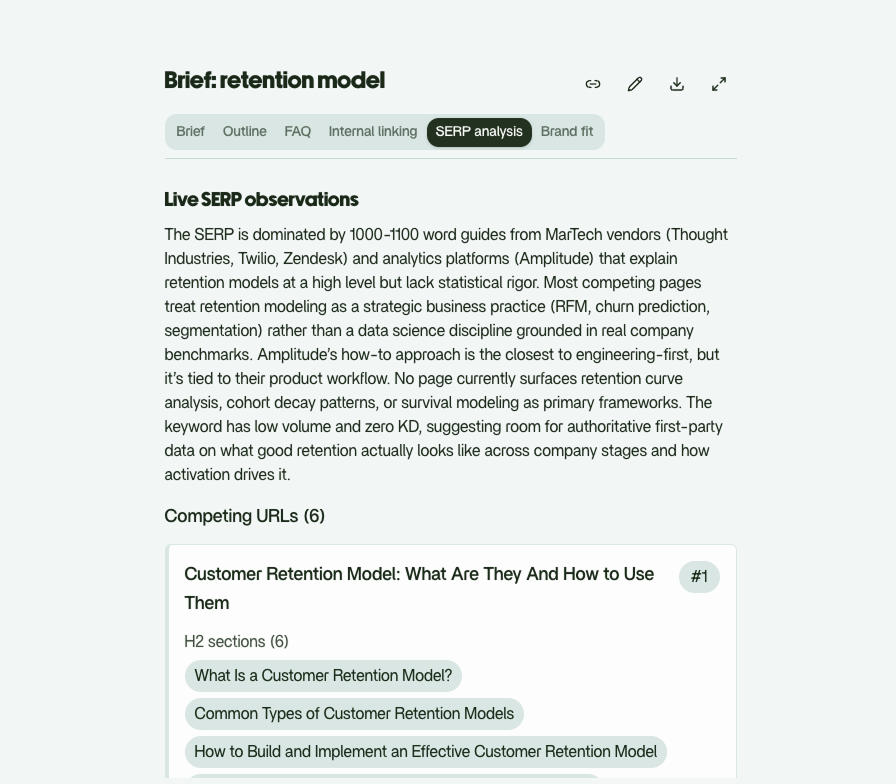
Live Google checks at every step.

Most AI writers operate on stale training data. I check live Google at keyword time, brief time, and article time. The top 10 moves. Briefs against last month's Google miss.

Three live Google reads

Keyword research: I read who's ranking right now for every candidate, and whether an AI summary is sitting at the top. Brief: I re-read the top 10 and pull their structure. Article: the angle is grounded in what the current top 10 actually does.

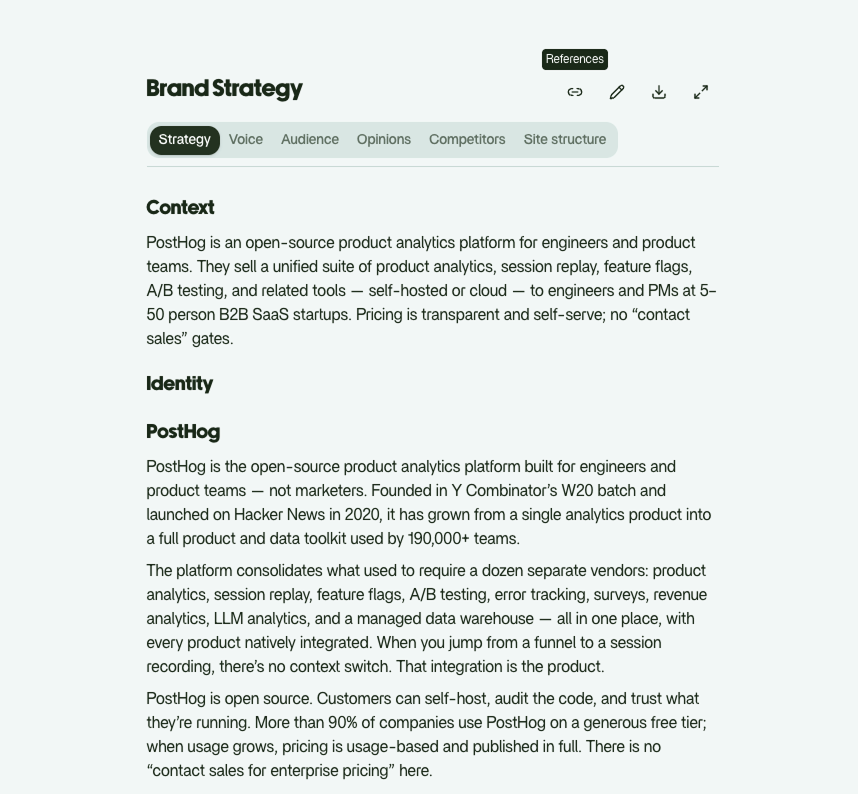
Brand voice woven into every article.

Generic AI articles read like generic AI articles. Yours don't, because every article reads the six-tab brand document set up once at brand strategy time.

Six-tab brand document

Strategy, Voice, Audience, Opinions, Competitors, Site Structure. Every downstream product references it. The output is your voice, on your positioning, citing your case studies. Not template tone.

The features behind the output

Most AI writers compete on "speed" and "tone library." Those are not features. Those are commodities.

The features that actually change the output are the ones that change what I get to read before I write. The four-verdict scoring changes which keywords I will write about at all. The live Google checks change the brief structure. The brand document changes the tone, the references, the proof points.

What you won't find here

No "template library" of 200 pre-made article skeletons. Templates are how generic content gets generic. Every brief is built from a fresh read of live Google. Every article is built from a fresh brief.

No "tone slider." Your voice is captured once at brand strategy and applied automatically. You don't drive a slider; the brand document does.

No chat-only interface. Chat is the input. The output is a real deliverable: a strategy document, a content map, a brief, an article, a file you can drop into your CMS. Things you can ship.

What you will find

A verdict on every article before you write it. Live Google checks at keyword time, brief time, and article time. AI summary detection in the top results. Your voice woven into every paragraph. The one quotable line written so AI summaries pull it. Internal-link planning from your existing pages. Strong openings, answer-first summaries, and FAQs built from real Google questions.

Less features that feel like features. More features that change the output.

Try it free.

Set up brand context. Run a keyword research. See the verdicts on a topic you already know.

Feature FAQs

AI can write generic "top 10 X" listicles in 200ms. Those don't rank or get cited anymore. Defensible content is the opposite: depth, original data, opinion, first-hand experience. I classify every keyword by whether YOUR brand can defensibly own it.