How to Build a Content Marketing Strategy for SEO (Brand-First)
By Ben — Founder
A content marketing strategy for SEO starts with your brand positioning and content pillars, then layers in keyword research (flipping the typical keyword-first process). This brand-first approach cuts wasted content, improves attribution, and grounds your efforts in conversion-driving topics instead of low-intent long-tail volume. Ben’s methodology, synthesized from Backlinko and Reforge frameworks, teaches the step-by-step system.
You’ve probably written content that went nowhere. You picked a topic that felt related to your business, published it, and watched it sit there. The problem usually isn’t the writing. It’s the order you did things in. Most guides tell you to start with keyword research and a branded search strategy bolted on later. I’m going to show you the reverse, because the reverse is what actually works in 2026.
Why Most Content Strategies Fail (And How Andy’s Approach Fixes It)
Keyword-first thinking is the default, and it’s why so much content underperforms. You open a keyword tool, sort by volume, and start writing about whatever has the biggest number next to it. That number pulls you toward low-intent long-tail queries that have nothing to do with what you sell. You rank, maybe. Then nobody converts.
Here’s the attribution trap. Traffic from low-intent SERPs looks like a win in your analytics. Page views go up. But those readers never signed up, never bought, never came back. When your boss asks which content drove revenue, you can’t answer, because the traffic was never qualified in the first place.
Brand-first methodology inverts this. You start with what you own. You decide the territory, then research keywords inside it. The order matters: brand positioning and content pillars should precede keyword research, not follow it. This isn’t my personal hunch. Backlinko’s canonical 7-step program and Reforge’s 2026 strategic frame both teach brand-first strategy now. Most content guides haven’t caught up.
Step 1: Define Your Brand Positioning and Content Pillars
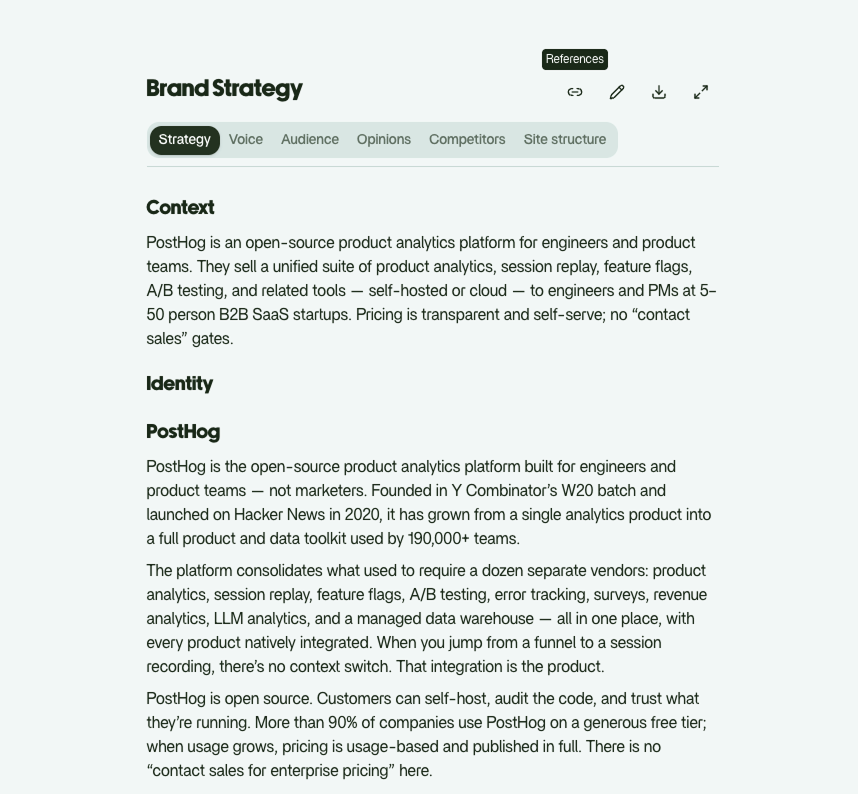
Start with your brand. Have a very global understanding first of your brand before you touch a keyword tool. Brand positioning is what your company believes and what it stands for in your market. It’s the strong opinion you hold and the key differences between you and your competitors. Write that down first, because it sets the boundary of the topic territory you’re allowed to own.
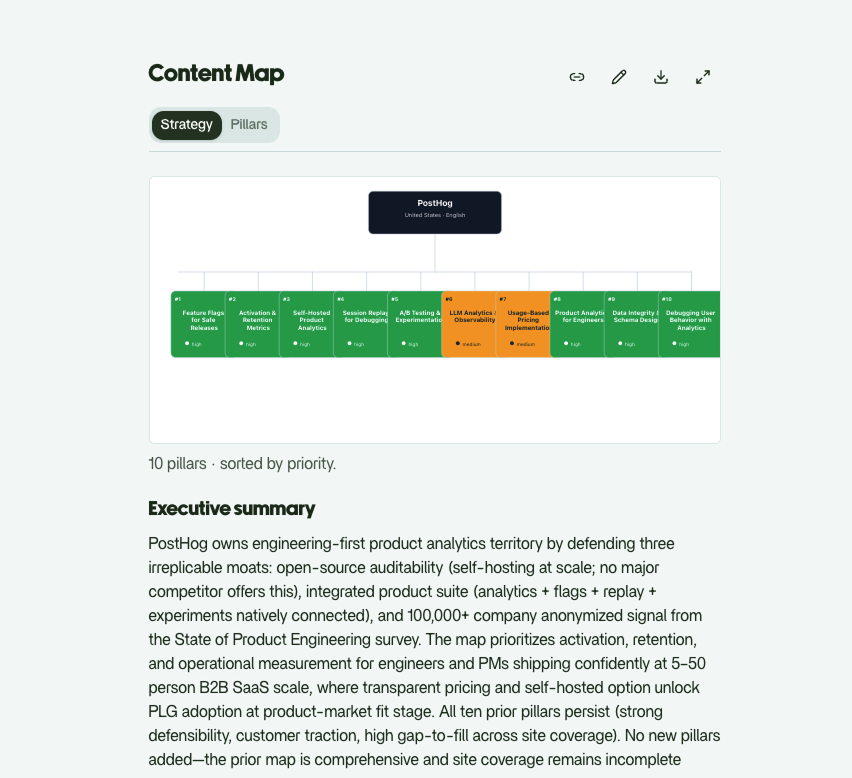
Then build your pillars. Think in clusters and content pillars: 3 to 5 broad topics that sit under your positioning. These pillars become your editorial filter. Every future keyword either fits inside a pillar or gets discarded. Take Andy. One pillar is “brand-first SEO workflow.” That single pillar instantly filters out keyword research about paid ads, enterprise crawl auditing, or anything outside the territory. The filter does the hard work of saying no.
Document each pillar with a one or two sentence description of what articles under it will teach. Vague pillars produce vague content. Specific pillars produce a plan. If you’re stuck between branded and non-branded angles, our guide on deciding between branded and non-branded keywords walks through the trade-off.
One test before you commit. Scan your top 20 ideal customers. Do they all care about these topics? If a pillar only matters to a handful of edge-case buyers, cut it. Your pillars should map to the people who actually pay you, not to the people who happen to be searching.
This matters more than it used to. If you do not have a strong opinion, your content is going to be replaced by AI, because AI can easily create and generate generic content. Your positioning is the thing AI can’t copy. It’s the reason a pillar built on your point of view will outlast a pillar built on search volume.
Step 2: Run Keyword Research Inside Your Pillars
Now you research keywords, and only now. The rule is simple: research inside your pillars and discard anything outside them. A keyword with 40,000 searches a month is worthless to you if it sits outside your territory. Volume is a tempting number. It’s also the number that pulls people off their strategy. You cannot change what people are typing, but you can choose which searches you’re going to compete for.
Prioritize branded search first. These are searches that contain your brand name or your product category. They convert higher because the person already has intent close to a decision. Andy’s own goals reflect this: we prioritize branded search volume and organic signup attribution over chasing long-tail volume. We follow our own advice here, because brand-first SEO workflow design is the core thing we do.
Then layer in long-tail keywords that support your pillars. Think “how to do X using our product” or “X for [your category].” These earn their place because they reinforce a pillar instead of wandering off into unrelated territory. Everything starts by the search intent, so match each keyword to what the searcher actually wants before you add it to the plan.
Two filters keep this clean:
- Defensibility. Skip commodity topics where you can’t say anything different. If every competitor already ranks with the same answer, you’re writing filler.
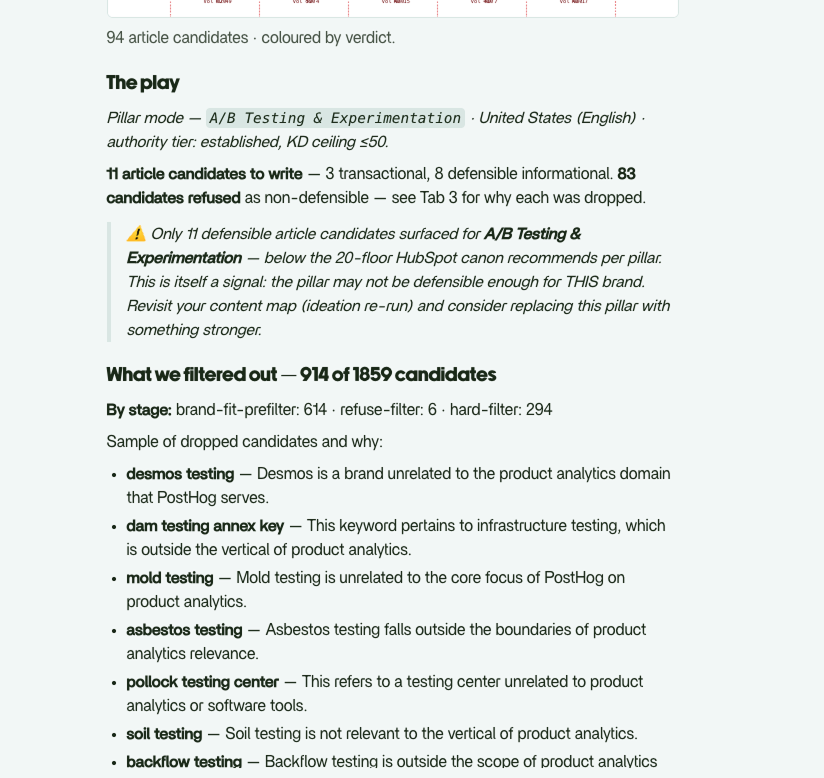
- Information gain. This is Backlinko’s principle. Only target a keyword where you can say something competitors don’t. Original data and first-party experience are the only informational content worth investing in. A generic “what is X” explainer gets absorbed by AI Overviews the day you publish it. Don’t write those. Prune the ones you already have.
The output of this step isn’t a spreadsheet of numbers. It’s a list of articles that you want to write and a list of articles that you do not want to write. The second list is just as valuable as the first.
Step 3: Map Articles to Pillars and Build Your Content Plan
You have pillars. You have keywords inside them. Now you connect the two into a plan. For each content pillar, list the articles and keywords that will make you an authority in that space. This is the moment your strategy becomes a publishing schedule instead of a theory.
Decide the shape of each pillar. A pillar page is a broad overview that links out to subtopics. Cluster articles are the deep-dives on specific keywords that link back up. Together they form your internal linking spine, the structure that tells Google what you own. This is how you signal to Google and to LLMs that you are an expert in a topic, not a tourist passing through it.
Sequence the articles deliberately. Publish introductory pieces first to establish the pillar, then move to advanced articles that hold attention and build authority over time. Branded keywords belong early in this sequence because they carry the most intent. If you want the mechanics, read how brand keywords drive conversions and how to spot branded search intent signals inside your keyword list. Those signals tell you which queries to lead with.
Set a publishing cadence you can actually keep. One solid article a week beats five rushed ones and then silence. Consistency beats perfection. A content plan that you abandon in month two was never a plan.
Measure Strategy Success: Branded Search and Attribution
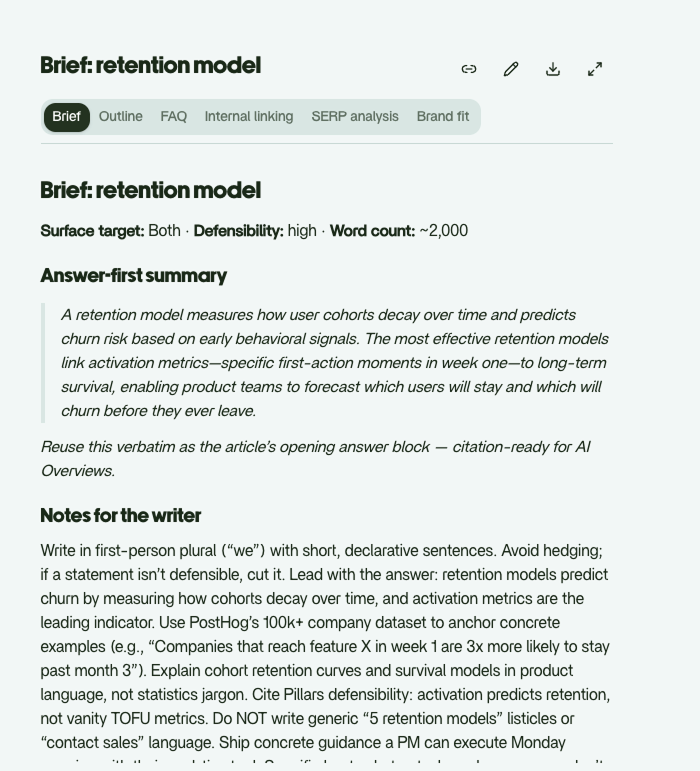
Don’t measure your strategy by total organic traffic. Total traffic is the metric that feels good and tells you nothing about money. A brand-first strategy is measured by branded search volume and organic signups. Those two numbers move when your content is doing its job.
Track what actually matters. Which articles drive qualified leads? Which pillar produces signups versus the one that produces only page views? Vanity metrics hide this. Attribution reveals it. The whole point of starting brand-first was to make this question answerable, so don’t slip back into counting clicks.
Here’s what we watch at Andy. Branded search volume for terms like “Andy SEO” and “AI SEO tool.” Organic signup attribution. LLM citation count, because LLM citations are the new rank, and most cited sources don’t even crack Google’s top 20. These tell us whether people are discovering us, remembering us, and searching for us by name.
Give it 6 to 12 months. A good content strategy increases branded search volume over that window as readers discover you, trust you, and start typing your name into Google and ChatGPT directly. That curve is the real scoreboard.
Stay strategic, not reactive. If readers care about a topic you didn’t prioritize, adjust your pillars on purpose. Don’t chase every spike. Update the plan because the evidence changed, not because a single post got lucky.
FAQ
What is a content strategy for SEO?
It’s a strategic plan that starts with your brand positioning and content pillars, then uses keyword research to find queries inside those pillars. It is not keyword-first. The pillars come first and act as the filter that decides which keywords are worth your time and which ones to throw out.
How do I know if my content strategy is working?
Track branded search volume and conversion attribution, not raw traffic. Most guides measure vanity metrics like total page views, which tell you nothing about revenue. Our KPI is organic signups driven by branded and category keywords. If those climb over 6 to 12 months, the strategy is working.
What types of content should my strategy include?
Content types follow from your content pillars, not from keyword volume. Product guides, thought leadership grounded in your strong opinion, and category education are common formats. Never chase a low-intent keyword just because the volume is high. The pillar decides the type, and the type serves the pillar.
Do I need a content strategy template to get started?
Templates help, but they’re secondary. Start with your brand positioning, define 3 to 5 content pillars, then let keyword research fill them in. Structure comes after strategy. A template applied before you know your pillars just organizes the wrong content faster.