First-Party Data Examples: Why Proprietary Sources Win
Ben, Founder at Andy
First-party data is information you collect directly from your own audience: website behavior, purchase history, survey responses, customer interviews, and live SERP signals from your own research. For SEO, the examples that matter most are proprietary: data no competitor has, like original survey findings or real-time search-intent snapshots. That exclusivity is what makes content defensible against AI Overviews and worth citing.
You write content. It cites the same aggregated stat every competitor cites. It doesn’t rank, and now you’re watching AI Overviews swallow generic articles before they earn a single click. The fix is not better writing. It’s better evidence: data only you have. This piece names the specific first-party data examples that build SEO authority, and shows what to do with them. If you want the framework behind why this works, start with E-E-A-T signals that Google and LLMs actually reward.
The Standard First-Party Data Examples (and Why Most Brands Stop Here)
Most teams know the four standard buckets. Behavioral data: what people click, scroll, and abandon on your site or app. Transactional data: purchase history, order value, repeat-buy patterns. Feedback data: survey answers, reviews, support-ticket themes. And CRM or email engagement: open rates, list segments, who replied to what.
These matter. You need them to understand your audience. But they will not make your content stand out, because every competitor in your space has the exact same categories. A CRM segment is not a differentiator when the brand next to you runs the identical CRM.
Here’s the split that actually decides SEO value. Passively collected behavioral data tells you what happened. Actively generated insight data tells you something nobody else knows: a survey you designed, an interview you ran, original research you commissioned. The first type is table stakes. The second type is rare, and rare is the whole point.
First-Party Data Examples That Build SEO Authority
Four sources move the needle. Each one produces evidence a competitor cannot copy.
Original research. Run a survey or study with your own audience and you produce numbers that exist nowhere else. A poll of 200 of your customers is a finding only you can publish. That is the difference between contributing to the conversation and repeating it.
Customer interviews and onboarding data. Structured conversations surface the exact pain points and the exact words your buyers use. This is proprietary founder insight: the strong opinion you hold that an aggregator never captures. It is also the raw material for content that sounds like a practitioner, not a content mill.
Proprietary SERP analysis. Not a keyword database everyone subscribes to. Live search-intent snapshots tied to your specific keywords, captured at the moment you research them: real volume, real difficulty, real intent. Because everything starts by the search intent, owning that snapshot is owning the foundation.
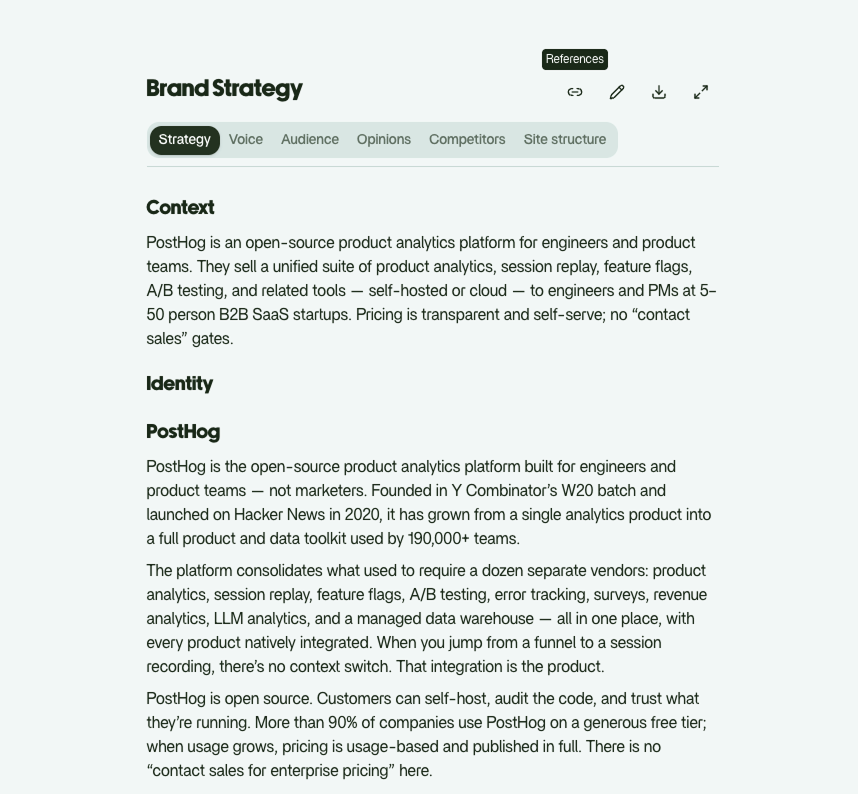
This is exactly how my own product collects evidence. Andy collects two types of first-party data at onboarding: live SERP snapshots for real-time search intent and brand interviews that surface proprietary founder insight no aggregator has. The SERP crawl runs in real time for each keyword research run. The brand interview comes from your live website crawl and onboarding session. Andy collects both types automatically during onboarding.
Why does this build authority? Because original evidence is how you signal to Google and to LLMs that you are an expert. Recycled stats signal the opposite.
If you’re ready to go deeper on the highest-value source here, read why original research is the most defensible content asset you can publish.
First-Party Data vs. Third-Party Data: The Defensibility Gap
Third-party data is data you buy. Audience segments from a broker. An industry report from a research firm. The problem is structural: anyone with a budget buys the identical dataset. The moment you cite it, three other articles cite it too. It is commoditized the day it ships.
First-party data is exclusive by definition. You collected it, so only you have it. That exclusivity is why Google and LLMs prefer citing it: a citation is worth more when it points to evidence the reader cannot find anywhere else.
Picture two articles on the same topic. Article A cites a Statista figure. So do forty other pages, word for word. Article B cites its own survey of 200 customers, with a finding that contradicts the conventional number. Which one earns the link? Which one gets quoted in an AI Overview? Article B, every time, because it added something to the index instead of echoing it.
This is information gain in practice. Search engines reward the page that contributes new evidence, not the page that summarizes existing evidence. Proprietary data is the substrate of content that gets cited rather than absorbed. Third-party data is the substrate of content that gets replaced. If you do not have a strong opinion, your content is going to be replaced by AI, and the same is true of your data: borrowed evidence makes a borrowed article.
How to Turn First-Party Data Into SEO Content
You already sit on more proprietary data than you think. Here’s the process to publish it.
Step 1: Inventory what you already collect. Customer interviews. Sales-call recordings. Support tickets. Onboarding notes. Internal product analytics. Each of these holds a finding no competitor can replicate. Write down the ones with a clear pattern.
Step 2: Extract one quotable finding. Pull a single, specific, citation-ready claim out of that data. Not “customers like fast onboarding.” Instead: “62% of new accounts that finished setup in under ten minutes renewed at month twelve.” A number with a noun and a result. That is what gets quoted.
Step 3: Build the article around that finding as the lead claim. Open with the proprietary fact, then support it with your behavioral data and your strong opinion. The finding is the spine. Everything else defends it. This is where your content and your strong opinion do the work that generic explainers cannot.
For the full picture of how Google weighs source authority once you’ve published, the E-E-A-T signals that Google and LLMs actually reward framework covers it.
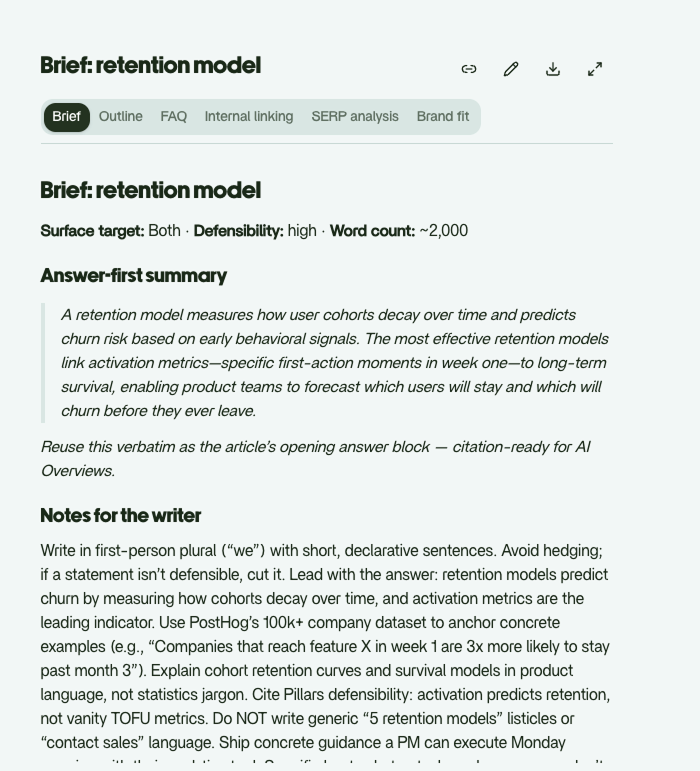
Steps 1 and 2 are the slow part, so I automated them. Andy runs the brand interview and the real-time SERP collection at onboarding, then surfaces the quotable finding inside the content brief. The methodology behind it synthesizes Backlinko’s 7-step SEO program with Reforge’s 2026 strategic frame, built from years of hands-on SEO work across client engagements and my own businesses. The point of the automation is simple: get you from data you own to a brief you can write against, without the manual extraction.
This is also where data collection broadens into something bigger. Proprietary evidence is one authority signal. To see the rest of what tells search engines you own your topic, read content expertise signals that tell Google you own your topic. Start with your brand, build the evidence, then publish the opinion only you can hold.
FAQ: First-Party Data Examples
What is the first-party data approach?
It means collecting data directly from your own owned sources, with no intermediary between you and the audience. That covers behavioral data from your site, interview and survey feedback, and transactional records like purchase history. The defining trait is ownership: you gathered it, so it is yours alone.
What is the difference between first-party data and third-party data?
First-party data is data you collect yourself, such as a survey of your customers. Third-party data is data you buy from an aggregator, such as a purchased audience segment. First-party data is exclusive to you; third-party data is commoditized because anyone can buy the same set.
How does first-party data help with SEO?
Proprietary data produces information gain, which is the one thing search engines reward over recycled content. Google and LLMs cite sources with unique evidence, not articles that repeat the same industry stat. An original survey finding earns citations; a borrowed Statista number gets ignored.
What counts as first-party data for content marketing?
Customer surveys, original research, brand interviews, proprietary SERP analysis, and internal product usage data all count. The common thread is that you generated the data through your own audience and tools. A study you ran with 200 of your customers is the cleanest example.
How do small businesses collect first-party data without a large team?
Start with the conversations you already have: customer interviews, post-purchase surveys, and onboarding calls. Each one produces quotable, proprietary evidence with no extra headcount. Andy automates the SERP and brand-interview collection at setup, so a founder gets first-party data without building a research function.