Build a Branded Keywords Strategy That Converts
Ben — Founder
Branded keywords are search terms that include your brand name. Most branded keyword strategies fail because they treat the keywords as generic. Smart strategy starts with your actual brand voice: identify what you uniquely stand for, map those attributes to search terms your audience uses, then own those positions. Branded search converts 5-10x better than non-branded.
Most branded keyword advice you read is wrong. It hands you a checklist: add your brand name to title tags, bid on your own name, track impressions. That produces traffic. It does not produce conversions, because the traffic does not match what your brand actually stands for. If you are a founder building organic without a dedicated SEO hire, you have felt this gap. The fix is not another tactic. It is a different starting point. For the bigger picture on why this matters now, see how AI and brand strategy reshape modern SEO.
Why Branded Keywords Matter More Than Generic Search
Branded search converts 5-10x better than non-branded. The reason is simple: someone typing your name has already decided. They are not comparing twelve options. They want you. That single difference rewrites the economics of the channel.
Three things follow. First, cost per acquisition drops, hard. You are not paying to introduce yourself to a cold audience the way paid search forces you to. Second, attribution gets clean. A branded query maps to a known intent, so you can actually measure ROI instead of guessing. Third, you own the message. When someone searches your name, the page they land on is yours to control, top to bottom.
Here is the part most guides skip. A branded keyword is only worth owning if the page behind it reflects what you believe. This is what makes your content defensible. Branded keywords are defensible only when they reflect your actual brand voice. Generic branded search strategies waste traffic to low-intent visitors. If you do not have a strong opinion, your content is going to be replaced by AI. Your brand name is the one term AI cannot generate for you. Use it.
How to Identify Your Brand Keywords Using Brand Voice
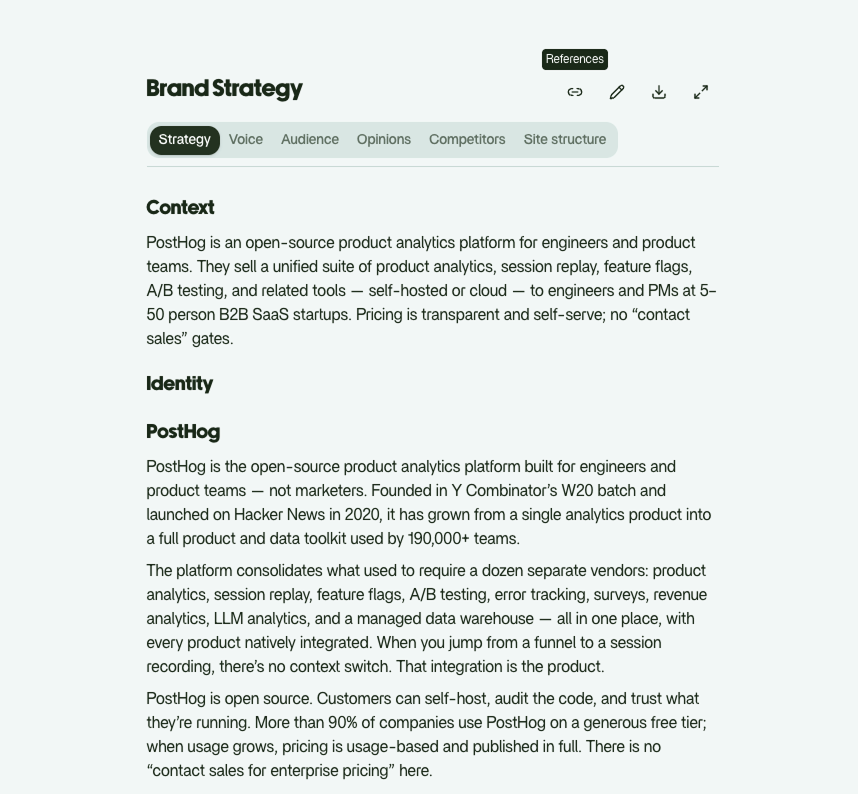
Start with your brand. Not with a keyword tool. Have a very global understanding first of your brand: what does it do, what is the strong opinion it holds, what are the key differences versus competitors. That understanding is the raw material every branded keyword comes from. Skip it and you get a list of variations nobody you want is actually typing.
This is the brand-first workflow, built from Backlinko’s 7-step program and Reforge’s 2026 strategic update. It treats branded keywords as a strategic output of brand interview and voice analysis, not as generic best practices that every competitor pushes. The order matters. Positioning first, then attributes, then the search terms those attributes attract.
Map it in three moves:
- Name what you uniquely stand for. Write the one opinion your brand holds that competitors won’t say out loud. That opinion is your keyword seed.
- Translate attributes into language your audience uses. You cannot change what people are typing. So pull the real phrases: Google autocomplete, Google Trends, your internal site search, and actual customer interviews. Interviews beat tools here, because they surface the words buyers use, not the words marketers wish they used.
- Validate against voice, not volume. For each candidate, ask the only question that counts: does this match what we believe, or just what’s popular? Search volume tells you a keyword is big. It never tells you whether it’s yours.
When I run keyword research inside Andy, this is exactly the split I optimize for. The product fetches live SERP data in real time for each run, and it pulls brand interview data from your website crawl and onboarding. The point is to tell you why this keyword is good or why this keyword is not good for your specific brand, not to dump a list of numbers. A tool that only shows you data without telling you what to do with it is not enough.
Branded keywords don’t live alone. They feed a wider plan. Once you have your core variations, the next step is building a content marketing strategy aligned with your brand so each term sits inside a cluster instead of floating as a one-off page.
Optimizing Pages for Branded Search Traffic
You have your branded keywords. Now match each one to the right page. Branded variations usually point to bottom-of-funnel pages: your homepage, your product pages, comparison pages, pricing. Put the keyword where the intent already lives. A query like “andy seo pricing” should never land on a blog post.
Write the keyword in naturally. The H1, the title tag, and the meta description should reflect your brand voice first and the keyword second. Read the title back to yourself. If it sounds like a robot stuffed your name into a slot, rewrite it. Readers should recognize your voice, not your keyword density.
Do not overstuff. Repeating your brand name eight times on a page does nothing for ranking and quietly damages trust. One natural mention in the H1, one in the opening, one in the meta. That’s plenty. The goal is to signal to Google and to LLMs that you are an expert on your own name, and you do that with a page that is genuinely about you, not a page that mentions you a lot.
This is where most founders get the balance right by accident and wrong on purpose. The accidental win: your homepage already sounds like you. The purposeful loss: you “optimize” it into something generic chasing a volume number. Protect the voice. It is the only thing on the page a competitor cannot copy.
Measuring Branded Keyword Performance and ROI
Track the right things, not the loud things. In Google Search Console, watch branded search volume and click-through rate over time. Rising branded volume is one of the strongest signals you have, because it means more people are leaving the category and asking for you by name. In 2026 I’d argue branded search volume is a more honest KPI than raw traffic.
Then break it down. Measure conversion rate by branded keyword variant, not just in aggregate. Some variations pull buyers. Some pull researchers. You want to know which is which so you can put your best page behind your highest-intent term. This is the kind of attribution that makes branded search worth defending, and it connects directly to measuring SEO impact and ROI across the rest of your program.
Two more numbers close the loop. First, watch competitive bidding: is anyone running ads on your brand name? If they are, you have a decision to make on the paid side. Second, calculate what you are saving. Take the cost per acquisition you’d pay in paid search for the same buyer, multiply by your branded conversions, and you have the dollar value of owning these positions organically. That number is usually large enough to end the debate about whether brand-first SEO is worth the effort.
One caution. Don’t chase branded volume by writing thin pages around every possible variation. Think in clusters and content pillars instead, so your branded terms reinforce a topic you genuinely own rather than scatter across pages that compete with each other. Quality of position beats quantity of keywords every time.
FAQ
What is the difference between branded and non-branded keywords?
Branded keywords include your brand name. Non-branded keywords are generic category terms with no name attached, like “ai seo tool.” The practical difference is intent: branded searchers already know you and convert 5-10x higher than non-branded searchers who are still comparing options.
How do I find my brand’s keywords?
Start with your brand voice and positioning, then go find the language your audience actually uses. Pull from Google autocomplete, your internal site search data, and real customer interviews. Interviews matter most, because they reveal the exact variations people type instead of the ones you assume they type.
How many branded keywords should I target?
It depends on your size and how crowded your space is. Small brands should focus on 3-5 core variations and own them completely. Larger brands can carry 10-20 or more. Either way, pick quality over quantity: a few owned positions beat a long list of half-optimized ones.
Should I bid on my own branded keywords in Google Ads?
Bid if competitors are bidding on your brand name, since you don’t want them intercepting buyers who are already looking for you. If nobody is bidding, strong organic rankings usually do the job for free. Prioritize organic SEO first, then add paid defense only where you see a real threat.
What’s the ROI of branded search traffic versus non-branded?
Branded search converts 5-10x higher than non-branded. The acquisition cost is lower, the intent is higher, and the attribution is cleaner, which makes the ROI both bigger and easier to prove. That combination is why branded positions are worth owning before you spend a dollar chasing cold, generic terms.