Topic Cluster Strategy: How to Build Defensible Topical Authority
By Ben — Founder
Topic cluster strategy is the process of deciding when and how to organize related content around a central pillar page, using internal linking to signal topical authority to search engines. Only create a cluster when keyword research, content overlap, and audience intent justify it. Don’t assume clusters are always the answer. When executed correctly, clusters drive higher rankings, better LLM citations, and defensible topical authority.
If you manage SEO for multiple clients, you already feel the pain: a client asks why their last twelve articles didn’t move rankings, and the honest answer is that twelve isolated articles never build topical authority. Single-article SEO produces one ranking attempt, not a strategy. This guide gives you a repeatable workflow to decide which topics deserve a cluster, how to architect one, and how to prove it worked.
What Is a Topic Cluster Strategy?
A topic cluster strategy is a decision framework, not a tactic you bolt onto every topic. Most guides skip that part. They tell you to cluster everything, which is how agencies waste a week building a hub of five articles that should have stayed independent.
Here is the better way. Before you write anything, you validate. You use keyword research to decide whether a set of subtopics actually belongs together or whether each one stands alone. This is the discipline Andy’s workflow forces: every keyword research run is scoped to a content pillar, so the cluster decision happens before article generation, not after.
The architecture itself is simple. A pillar page covers the broad topic. Cluster pages go deep on the subtopics. Strategic internal linking ties them together so the relationship is legible. Cluster architecture is the mechanism that signals topical authority to both Google and LLM citation systems. That single sentence is the whole reason this matters in 2026, because the most cited sources in ChatGPT and Perplexity often don’t even rank in Google’s top 20.
When to Cluster: Validating Cluster Architecture
This is the gap almost every guide ignores. They assume the cluster is justified. The real strategic question is whether the topic warrants a cluster at all.
Ask three questions before you commit:
- Do the subtopics share a common audience intent?
- Is there meaningful keyword overlap between them?
- Can you link them coherently without forcing it?
If the answer is no to any one of those, don’t cluster. Keep the topics independent. Clustering with weak linkage wastes effort and confuses the signal you are trying to send. A pillar surrounded by loosely related pages reads, to Google and to an LLM, like a pile of articles. Not authority.
Reforge’s 2026 strategic framework, which Andy’s methodology synthesizes, explains how cluster structure and internal linking signal topical authority to search engines. Use it to validate topic relationships before you build anything. Everything starts with the search intent. You cannot change what people are typing into Google or ChatGPT. You can only check whether the things they type cluster around one center of gravity, or pull in different directions toward different audiences.
Ben’s hands-on experience across multiple client brands shows the pattern: the clusters that rank are the ones where the validation said yes three times. The ones that flopped were forced.
How to Architect a Cluster: Pillar, Subtopics, and Linking
Once validation says yes, the architecture has three parts.
The pillar page covers the broad topic and targets the head keyword. It links out to every cluster page. Think of it as the index and the argument at the same time. It frames the topic and your strong opinion on it.
Cluster pages are the subtopic deep-dives. Each one targets long-tail and question-based keywords, the specific things people actually type. Every cluster page links back to the pillar. That back-link is not decoration. It is the vote that tells Google these pages belong to one body of work.
Cross-cluster linking is where most people overdo it. You link contextually relevant cluster pages to each other. You do not link every cluster to every other cluster. A mesh of indiscriminate links dilutes the signal instead of sharpening it. If two cluster pages don’t genuinely relate, leave them unlinked.
This linking topology is what signals topical coherence to Google’s topical authority evaluation and to LLM citation systems. Backlinko’s canonical 7-step SEO program establishes cluster architecture as foundational to topical authority strategy, and this is why. For a deeper breakdown of how pillar pages and clusters connect, and some pillar page examples you can model, start there before you draft a single outline.
Implementing Cluster Strategy: From Research to Publication
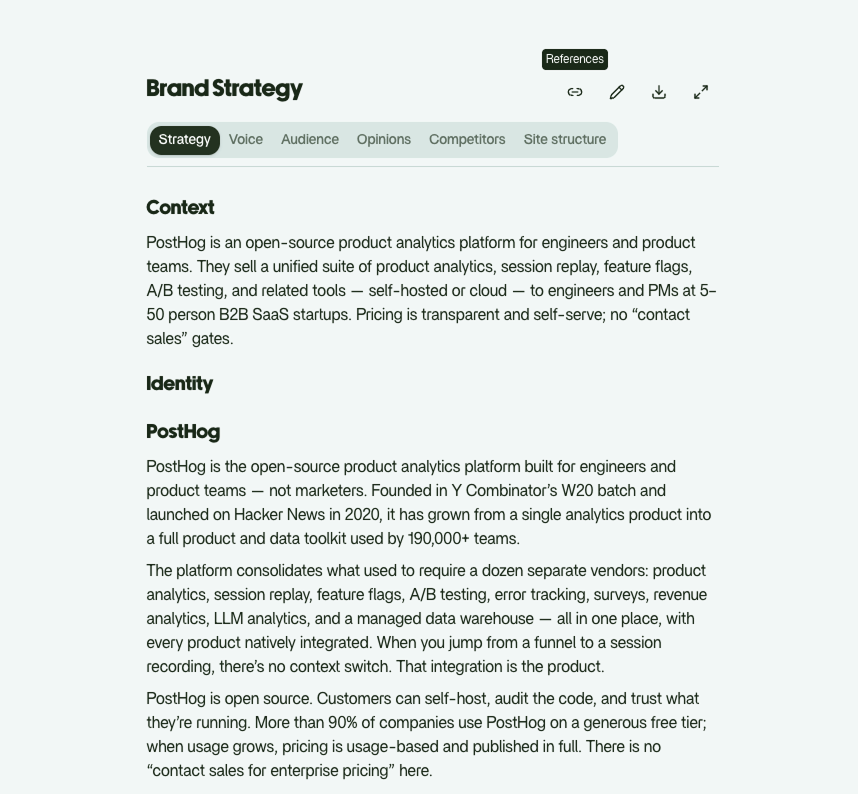
Here is the workflow I run, in order. It maps to how Andy works: brand strategy, then content pillars, then keyword research, then the cluster decision, then articles.
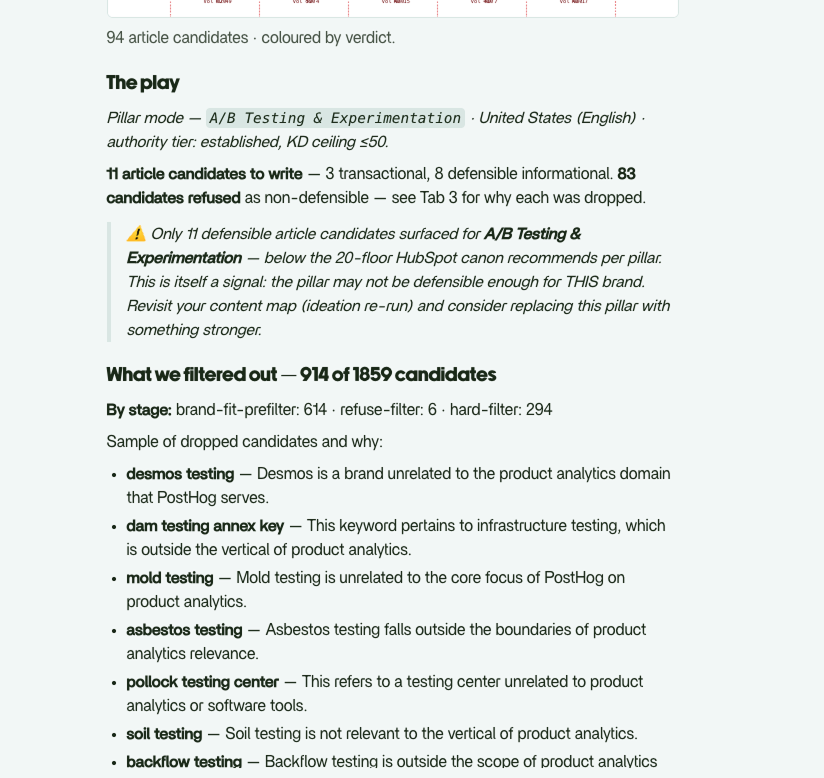
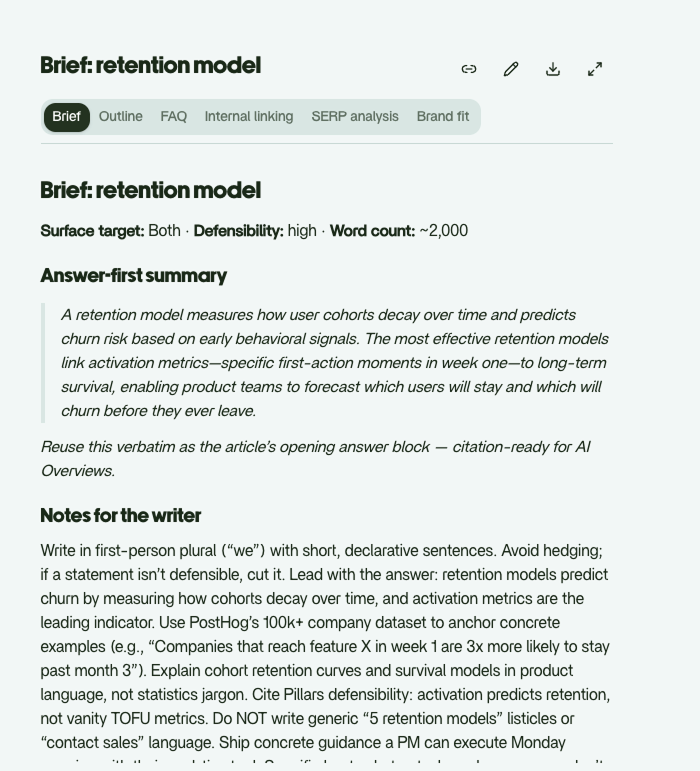
Step 1: Validate the cluster via keyword research. Pull volume, check intent match, confirm audience overlap. This is where you decide go or no-go. Andy tells you why this keyword is good or why this keyword is not good, which is the difference between a keyword list and a strategy. Keyword research without brand context is isolated work. It produces one article, not a cluster.
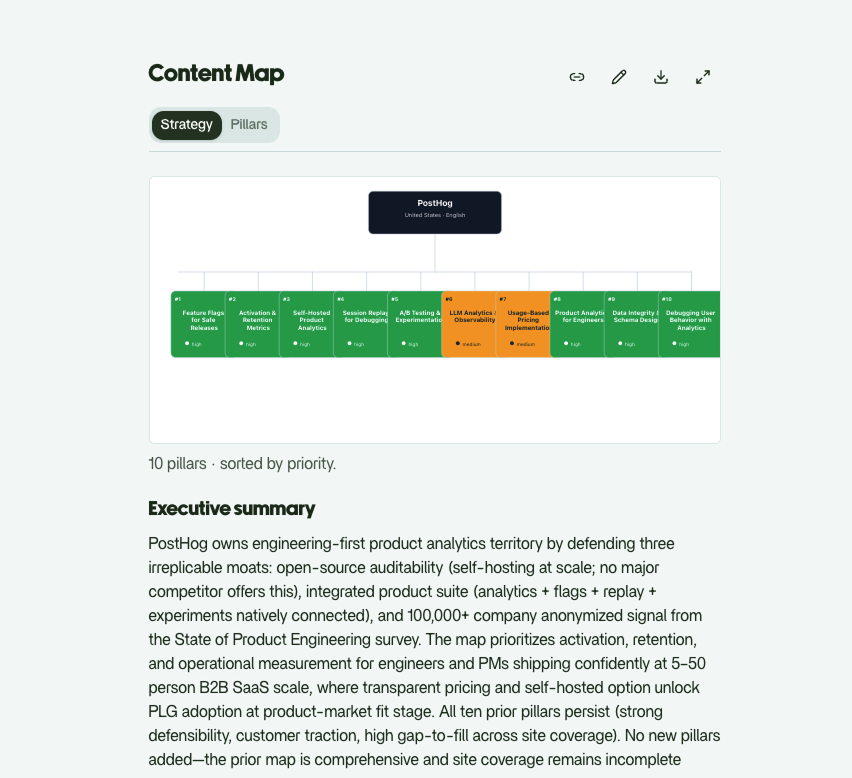
Step 2: Map the cluster architecture. Identify the pillar. Define five to eight cluster pages. Plan the internal linking topology on paper before you write. You should end the step with a list of articles that you want to write and a list of articles that you do not want to write. The second list matters as much as the first.
Step 3: Write the pillar content first. The pillar establishes the topical frame. Everything else hangs off it, so it goes first. Put your content and your strong opinion in it, because if you do not have a strong opinion, your content is going to be replaced by AI. AI can generate generic explainers faster than you can. Your opinion is the part it cannot copy.
Step 4: Build the internal links. Back-links from every cluster page to the pillar. Cross-cluster links only where contextually relevant. Get the details right by reviewing strategic internal linking in clusters before you publish, because the linking is the part people rush and regret.
Do these four in sequence. Skipping step one to get to step three faster is how you end up with a beautiful cluster nobody searches for.
Measuring Cluster Success: Topical Authority Signals
Track rankings as a cluster, not as individual pages. This is the mental shift. Topical authority means the whole set of keywords climbing together, not one lucky article spiking. If three cluster pages move and the rest sit still, the cluster is half-built, not failing.
Monitor pillar page citations in LLM outputs. Structured clusters get cited more frequently in AI Overviews and Perplexity, because the architecture makes the relationship between sources explicit and easy to extract. LLM citations are the new rank. Watching them is no longer optional.
Watch branded search and topical query lift. When people start typing your brand alongside the topic, Google is recognizing your authority. Branded search volume and LLM citation count are more important KPIs than raw traffic in 2026. For the full list of what signals topical authority success, use those indicators instead of obsessing over a single keyword’s position.
One thing to set expectations on with clients: Ben’s implementations show a three-month lag before topical authority visibility peaks. Tell the client that up front. A cluster that looks flat at week six is usually working exactly on schedule.
FAQ
What is the difference between a topic cluster and a pillar page?
The pillar page is the broad topic page on its own. The cluster is the pillar plus its linked subtopic pages working as one unit. A pillar without clusters is incomplete, because the linking is what creates the authority signal in the first place.
When should you create a topic cluster versus keep topics independent?
Cluster when the subtopics share audience intent and the keyword overlap justifies a central hub. Don’t cluster if the topics serve different audiences, even when they sound related. Forced clusters dilute the signal and waste the effort you spend building them.
How do you structure internal linking in a topic cluster?
The pillar links out to every cluster page, and each cluster page links back to the pillar. Add cross-cluster links only where two pages are genuinely contextually relevant. Avoid overcrowding the cluster with links that don’t reflect a real relationship.
How do you measure if a topic cluster is working?
Track keyword rankings as a cluster unit, not page by page, so you can see the whole set rising together. Monitor LLM citations alongside rankings. Structured clusters get cited more, and that citation count is one of the clearest signs the architecture is doing its job.