Linking Strategy for Topical Authority: A Cluster-Based Framework
By Ben, Founder
An internal linking strategy is a plan for connecting related pages on your website to build topical authority and communicate expertise to search engines and LLMs. Cluster-based linking, where articles within a content pillar link to each other and back to the pillar hub, signals to Google and AI systems that you own this topic. Effective linking decisions flow from your content defensibility rationale: you link pages that defend the same keywords against the same competitors.
If you run client accounts, you already know the problem. Linking advice online is mechanical. Add links, spread authority, fix orphan pages, repeat. None of it tells you which pages should connect or why, and none of it survives contact with a client who asks what the links are actually proving. This article reframes linking as a topical authority signal and shows how the decisions come straight from your content strategy, not from a link quota.
Why Cluster-Based Linking Is the Defensible Approach
Most linking guides stop at crawlability and authority flow. They treat a link as plumbing: a way to move PageRank around the site and help Google find pages. That advice is not wrong. It is just finished, solved, and worth almost nothing in 2026.
The job now is harder. You have to prove topical authority, and a link is one of the few on-page signals that does it. When you connect a set of pages that all cover one topic, you tell Google and LLMs that these pages form a cohesive knowledge base. A single article says you wrote about something once. A cluster says you own it.
This is where defensibility comes in. You link pages that defend the same keywords against the same competitors. That is the test. If two pages fight for overlapping search intent against the same rival in the SERP, connecting them compounds their authority on that shared ground. If they have nothing in common, a link between them dilutes the signal and confuses the topic boundary. Your competitive defensibility rationale decides which pages belong in the same cluster, and the cluster decides the links.
Cluster-based linking signals expertise coherence to Google and LLMs, proving you own a topic comprehensively. That coherence is the whole point. Scattered links across unrelated content read as noise.
Understanding Cluster-Based Linking Structure
Think in clusters and content pillars. A cluster has three parts, and each link type does a different job.
The pillar page is the hub. It targets the broad keyword, the head term that defines the topic. The articles are the spokes. Each one targets a long-tail keyword, a specific question or use case inside the topic. The links between them are the cohesion that turns a pile of pages into a structure Google can read as one expert body of work.
Three link directions matter:
- Pillar-to-article links point outward from the hub. The pillar references each supporting article in context, signaling that these spokes belong to it.
- Article-to-article links run sideways within the cluster. When two spokes cover related sub-topics, connecting them shows depth and proves the topic has internal structure, not just breadth.
- Back-to-pillar links point upward. Every spoke links to the hub, so authority concentrates on the page meant to rank for the broad term.
Each link type reinforces topical authority by grouping related content and signaling expertise depth. Sideways links are the ones agencies skip, and they are the ones that carry the most weight, because they prove the cluster has a real shape rather than a hub with isolated satellites.
This structure is part of how you build E-E-A-T signals for your cluster. Experience, expertise, authority, and trust are not just author bios and citations. The link graph itself is evidence. A tight, coherent cluster shows Google a site that organized its knowledge the way an expert would.
Designing Linking Strategy From Your Content Brief
Linking strategy should never be a separate task you do after publishing. It lives in the content brief, decided before a word is written, alongside the keyword and the defensibility call from your pillar strategy.
A useful brief specifies four things for every internal link: the target page, the anchor text, the placement location, and the defensibility rationale. The first three are mechanics. The fourth is the part everyone drops, and it is the part that survives a client conversation.
Here is what a single linking spec looks like inside a brief:
- Target page: /cluster-content-strategy
- Anchor text: building a content cluster
- Placement: after Section 2, Implementation
- Rationale: Link Article A to Article B because both defend the keyword “content cluster” against Competitor Y, who currently owns the SERP with a thin guide. Connecting them concentrates our cluster’s authority on that exact term.
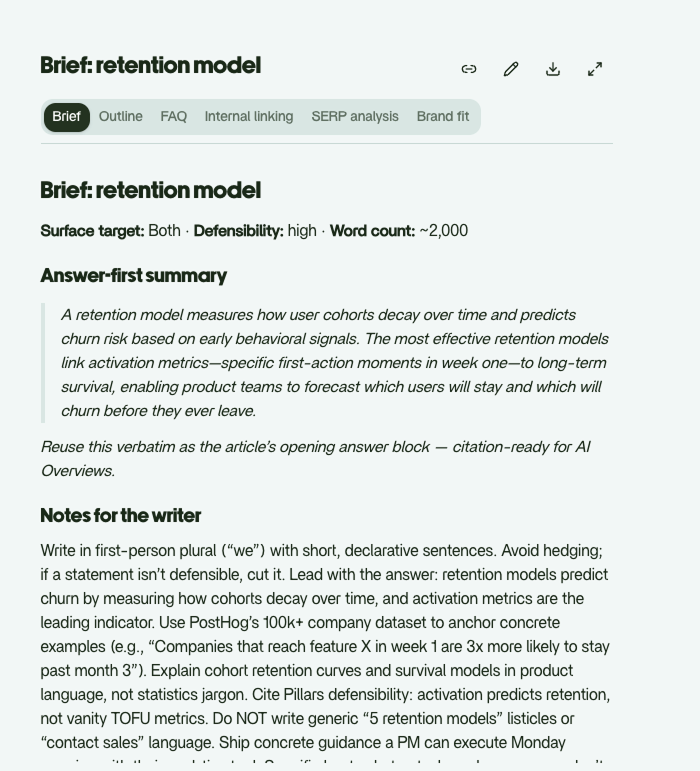
That rationale line is the difference between a link table and a strategy. It tells the client why the link exists, tells the writer where it goes, and ties the decision back to a real competitor in a real SERP. You can see a content brief in action to watch how these specs sit next to the keyword and the outline rather than getting bolted on later.
Linking strategy bridges two things that otherwise drift apart: the content defensibility calls made at the pillar level, and the on-page optimization done at the brief level. When the brief carries the linking spec, there is no isolation. The link defends the same keyword the article was built to win. The real strategy brief examples show how this plays out across a full cluster, where each brief knows which siblings it links to and why before any of them publish.
This matters most when you manage many clients with different brand voices. A systematic linking plan that lives in the brief is repeatable. One that lives in your head, or in a spreadsheet you update after launch, is not.
Making Linking Decisions: Defensibility-First Approach
Every internal link should answer one question: why does this link defend my topical authority against this competitor? If you cannot answer it, the link is decoration. Cut it.
This reframes three decisions that agencies usually make on autopilot.
Placement comes from relevance, not from a rule about links-per-thousand-words. A link belongs where the surrounding copy already discusses the target’s topic, because that context is what tells Google the two pages share meaning. Dropping a link into an unrelated paragraph to hit a count teaches Google nothing.
Target selection comes from the cluster, not from whatever page needs traffic this month. You link siblings that defend shared keywords. A high-priority page that has nothing to do with the current article does not earn a link just because it is important.
Anchor text varies because real expertise describes a topic from several angles. Exact-match anchors on every link look engineered. Natural variation around the target keyword reads like a writer who knows the subject, which is exactly the signal you want.
The pages you link together tell Google what you’re an expert in. Cluster-based linking is how you prove topical authority in 2026.
Avoid overlinking as a tactic. A page stuffed with internal links to satisfy a quota dilutes the signal of the few links that actually defend the topic. Fewer, defensible links beat many random ones every time.
Measure the right thing. The metric is not “links added.” It is whether your cluster articles rank together. When the pillar and its spokes climb as a group, that is topical authority cohesion showing up in the SERP. When one page ranks and the rest sit on page four, the cluster is not coherent yet, and the link graph is the first place to look. This is also why branded search and LLM citation count matter more than raw link totals: most cited sources don’t even rank in Google’s top 20, and a tight cluster is what gets you cited.
One more reason to take the strong-opinion path seriously. If you do not have a strong opinion, your content is going to be replaced by AI, and a cluster of opinionated, interlinked articles is far harder to replace than ten generic explainers with no connective tissue between them.
Linking strategy is not an afterthought you tack on once the writing is done. It belongs inside the content brief structure, decided with the keyword and the defensibility call, so every link defends the topic the article was built to win.
FAQ
What is a linking strategy?
A linking strategy is a structured plan for connecting related pages so you signal topical expertise to search engines and LLMs. The modern version is cluster-based: you group articles under a content pillar and link them to each other and back to the hub, which proves you cover the topic comprehensively rather than once.
What are different types of internal linking?
Three types matter in a cluster. Pillar-to-article links run from the hub out to its spokes. Article-to-article links connect siblings that cover related sub-topics. Back-to-pillar links point every spoke up to the hub. The pillar-based cluster structure is what turns these into a topical authority signal instead of plumbing.
What is an internal linking strategy example?
A content brief that specifies, for each link, the target page, the anchor text, the placement location, and the defensibility rationale. For example: link Article A to Article B, anchor “building a content cluster,” placed after the implementation section, because both pages defend the keyword “content cluster” against the same competitor.
How does internal linking help with topical authority?
Cluster-based internal links tell Google and LLMs that your interlinked articles form a cohesive knowledge base on one topic. The pages you connect define the boundary of what you are an expert in, so a tight, defensible cluster signals to Google and to LLMs that you are an expert, while scattered links across unrelated content signal nothing.