How to Build a Topical Authority Cluster: A Real Example
By Ben, Founder. Multiple years of hands-on SEO across client engagements and my own businesses. Andy’s clustering methodology synthesizes Backlinko’s canonical 7-step SEO program with Reforge’s 2026 strategic framework.
A topical authority cluster is a pillar page on a broad topic linked to 5-8 cluster articles targeting related keywords. The cluster works because it signals to Google and LLMs that you’ve covered a topic comprehensively through internal linking, expertise signals, and original data. Andy’s E-E-A-T Signals pillar exemplifies this: a hub article linking to secondaries on author credentials, expertise signals, and first-party data, structured to demonstrate topical authority.
You have a spreadsheet with 50 or 100 keywords and no idea how to turn it into something Google rewards. That’s the real problem, and most cluster guides answer it with theory instead of a working example. So I’ll show you the exact cluster we built for our own E-E-A-T signals topic: the pillar, the cluster articles, the linking spine, and the reason each piece earns its place.
Why Topical Authority Clusters Matter (More Than Ever)
Google stopped rewarding sites for ranking on one keyword at a time. It rewards sites that prove they own a topic. A single high-intent article can still rank, but it sits alone. A cluster tells the algorithm you’ve gone deep, covered the angles, and have something to say across the whole subject.
LLMs raised the stakes. They cite primary sources with clear expertise and original data, and most cited sources don’t even rank in Google’s top 20. A cluster is how you think in clusters and content pillars to signal to Google and to LLMs that you are an expert, not a content farm summarizing what already exists.
Internal linking is the multiplier. When your pillar links to eight articles and they link back, the authority compounds in both directions. The pillar gets stronger because it sits on top of real depth, and each cluster article borrows credibility from the hub.
Here’s the line worth keeping: topical authority clusters work because they signal to Google and LLMs that you’ve covered a topic comprehensively through internal linking, expertise signals, and original data. That’s the whole mechanism. Commodity SEO gets absorbed and summarized by AI Overviews. A defensible cluster gets cited.
A Real Topical Authority Cluster: Andy’s E-E-A-T Signals Example
Let me show you ours instead of inventing a CRM example nobody actually built.
The pillar is “E-E-A-T Signals for Search and Citations.” It covers the broad topic: how experience, expertise, authoritativeness, and trustworthiness drive ranking and LLM citations in 2026. Broad enough to host a cluster. Specific enough that we have a strong opinion about it.
Then the cluster articles, each owning a distinct keyword and a distinct slice of E-E-A-T:
- “Author Bio Examples” and “Author Bio Credibility Examples,” covering author credentials within a cluster and how a real byline strengthens the architecture
- “Content Expertise Signals Meaning,” our deep dive on what expertise signals are and how they make a cluster defensible
- “First-Party Data Examples” and “Why Original Research Matters,” covering the original-data angle
The linking structure is deliberate. The pillar links down to every cluster article. Each cluster article links back up to the pillar and sideways to the siblings that actually relate. The author-bio article links to the expertise-signals article because credentials and expertise reinforce each other. It does not link to first-party data for the sake of it.
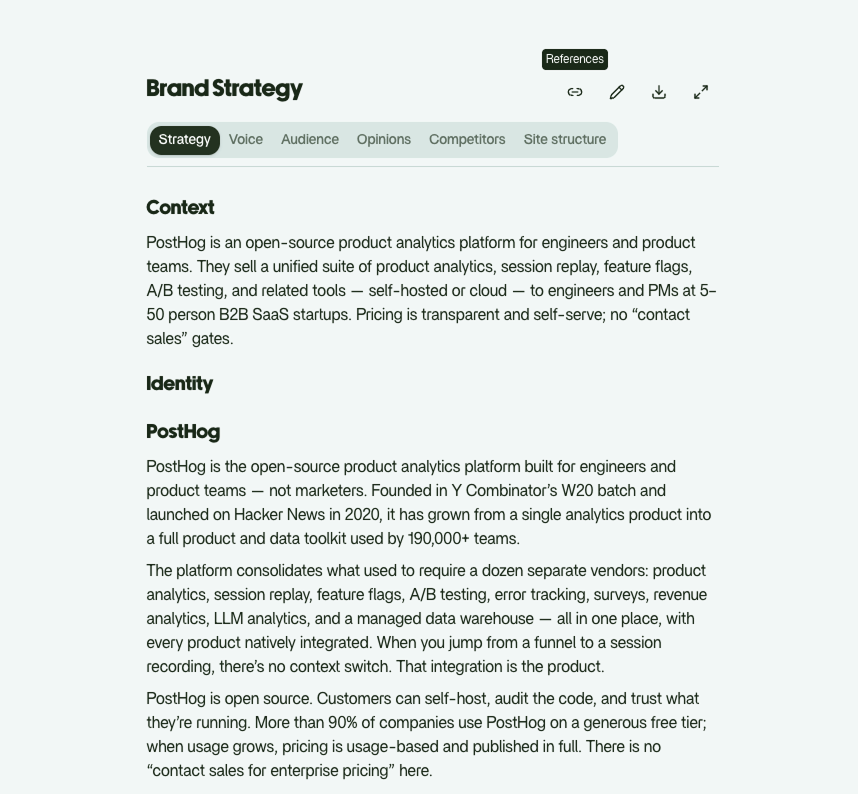
Why is this cluster defensible? Because it’s rooted in real SEO experience, the Backlinko and Reforge frameworks behind our methodology, and brand interview data we collect from every user’s live website crawl and onboarding session. We saw the same founder pain point repeat across those interviews: people know E-E-A-T matters but can’t name the concrete signals. That gap is what the cluster fills.
How to Build Your Own Topical Authority Cluster in 4 Steps
Step 1: Pick a topic you can actually defend
Start with your brand. Choose a broad topic where you have real expertise, first-party data, or a distinct perspective. Not commodity SEO. If ten major publishers already own “what is SEO,” you will not out-rank them, and an AI Overview will summarize all of you in two sentences.
Run the test bluntly: if you do not have a strong opinion, your content is going to be replaced by AI. We picked E-E-A-T because we have years of hands-on experience to draw from and a contrarian take on which signals matter. That’s defensible. A generic 101 explainer is not.
Step 2: Map the keywords that deepen the topic
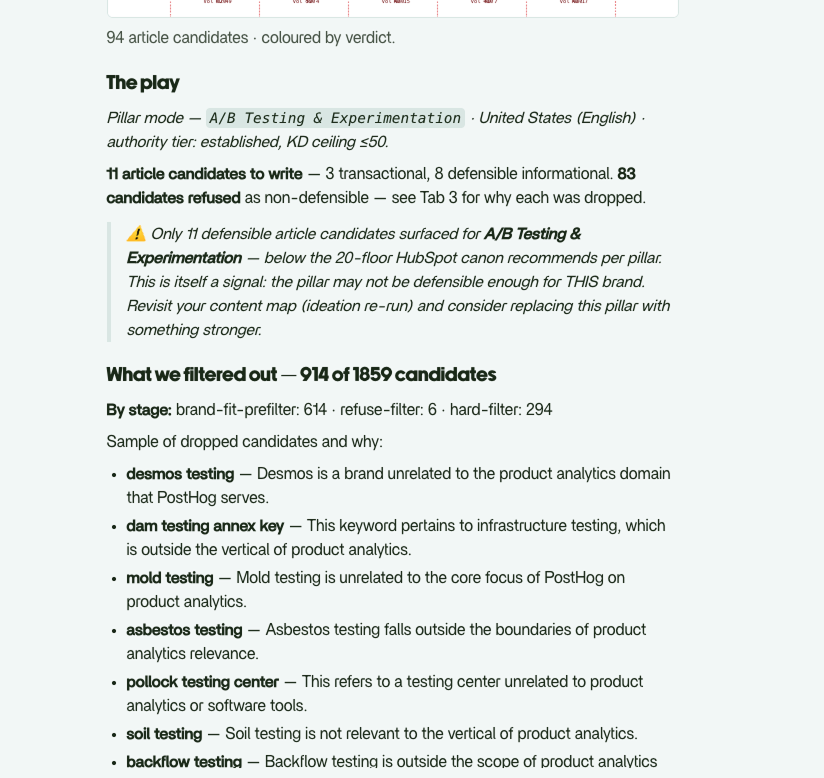
Now research the related keywords that support and extend the pillar. You want terms that add depth, not duplicates. We pull live SERP data in real time for every keyword in a run, which shows what’s actually competitive before you commit a single article.
Watch for cannibalization here. Two articles chasing the same keyword fight each other and split the authority. Each cluster article owns exactly one primary keyword. If two ideas collapse into the same search intent, merge them into one stronger piece.
Step 3: Design the architecture
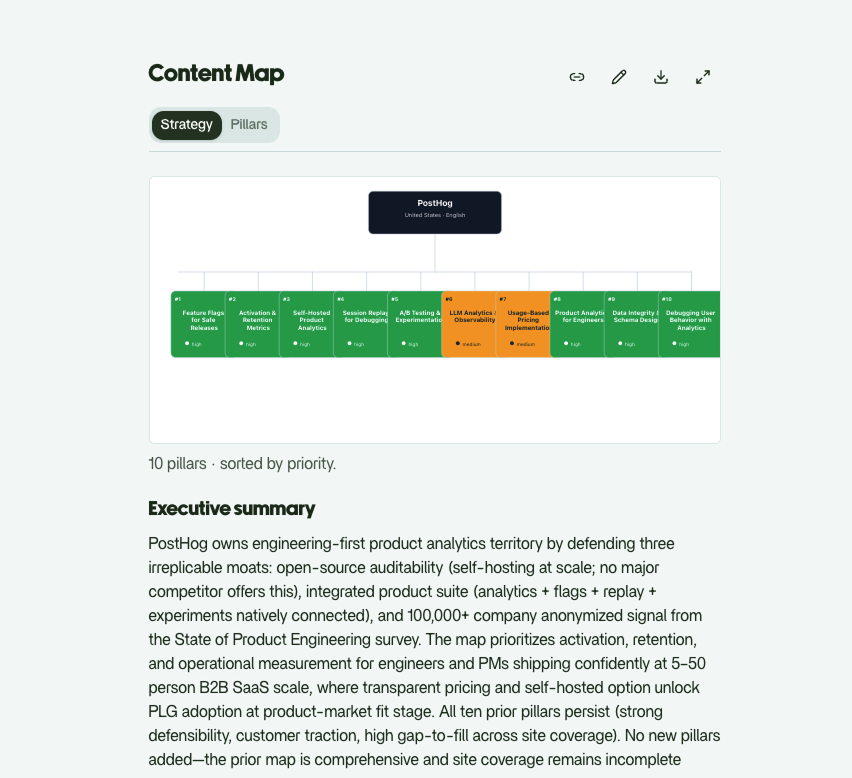
One pillar page. Five to eight cluster articles. Each cluster article gets its own primary keyword and its own slice of the topic. This is where you decide the shape before you write a word.
Sketch it on paper. Pillar in the middle, cluster articles around it, and a line drawn for every link you intend to create. If a planned article doesn’t connect cleanly to the pillar, it belongs in a different cluster or nowhere.
Step 4: Plan internal links before you write
This is the step people skip, and it’s the one that makes the cluster a cluster. The pillar links to all cluster articles. Each cluster article links back to the pillar and sideways to the siblings that are genuinely relevant.
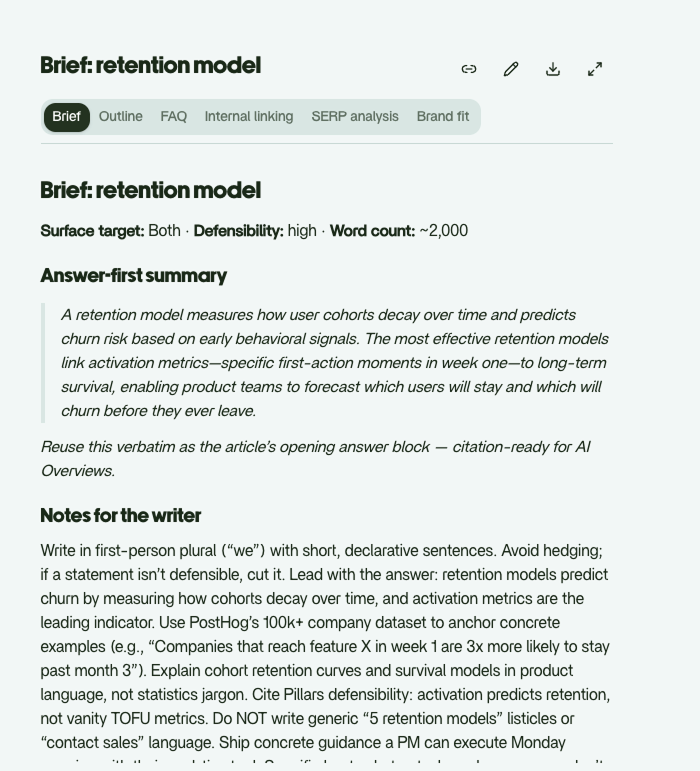
Decide these links during planning, not after publishing. When you write each article already knowing its place in the spine, the anchor text comes out natural and the structure holds. Validate defensibility the same way we do, by checking whether the topic is backed by original data and research in clusters or just opinion dressed up as insight.
How to Know If Your Cluster Is Working
Track the cluster, not single articles. Watch the average ranking position across the pillar plus all cluster keywords, search visibility growth for the topic, and traffic landing on the pillar page itself. One article moving up is noise. The whole set drifting up is the authority signal.
Be honest about the timeline. Expect 3-6 months for initial signals and 6-12 months for meaningful ranking improvements. How fast depends on your domain authority, the competition, and how defensible the cluster actually is. A weak cluster on a crowded topic will sit flat no matter how long you wait.
The strongest signal isn’t a ranking at all. If an AI Overview cites your cluster article, or a high-authority site links to it, the cluster is sending exactly the message you wanted. That’s LLM citation as the new rank, and it’s a better KPI than raw traffic in 2026.
One rule on expansion. Add articles when you have new expertise or first-party data to support them. Never add an article just to hit some round number. A focused cluster of five real pieces beats a padded cluster of ten thin ones, every time.
Frequently Asked Questions
What is the difference between keyword clustering and topical authority clustering?
Keyword clustering groups keywords by theme. That’s mechanical. Topical authority clustering organizes your content by expertise, internal linking, and defensibility, which is strategic architecture. One sorts a spreadsheet. The other decides what you should and shouldn’t write.
How many cluster articles do I need for a pillar page?
Five to eight, each targeting a related keyword. Fewer than five and you miss the depth that signals authority. More than eight and you dilute the focus. Start with five and expand only when you have new expertise or data to add.
How long does it take to see topical authority benefits from a cluster?
Plan for 3-6 months before you see initial signals and 6-12 months for meaningful ranking improvements. The exact timeline moves with your domain authority, the competition on the topic, and how defensible your cluster is. Defensible clusters move faster.
Can I have multiple clusters on the same broad topic?
Yes, as long as each cluster targets a distinct aspect backed by different expertise or data. The hard rule lives inside a single cluster: prevent keyword cannibalization, and make each article own one primary keyword. Two articles chasing the same term will compete with each other.
What makes a topic defensible for topical authority clustering?
You have real expertise, first-party data, or a distinct perspective on it. That’s defensible. A commodity topic already covered by ten or more major publishers is not, because there’s nothing you can say that they haven’t, and AI Overviews will summarize all of you at once.