Content Pillar Examples That Actually Attract Your Audience
By Ben — Founder
Content pillar examples vary by business type, but the strongest ones emerge from keyword research and audience pain keywords, not generic templates. Successful B2B SaaS pillars cluster around problem-solution keywords; service businesses structure pillars around location and service-type keywords; creators organize around audience interests tied to subscriber pain points. The key: pillars map to real search demand, not arbitrary content buckets.
You are a founder or CMO. You know you need content pillars. But every guide hands you the same five generic buckets and calls it a strategy. That approach fails because it ignores what people actually type into Google. This article shows real pillar examples tied to keyword data, how to tell if a pillar is defensible, and how to build the whole thing around your audience’s pain instead of a template. Everything starts with the search intent, so we start there too. Your pillars are the output of keyword research strategy, not the input.
Why Your Content Pillars Should Start With Keyword Research
A generic template gives you “tips,” “trends,” “behind the scenes,” and “product news.” None of those map to a real search query. So none of them rank. You cannot change what people are typing. You can only build pillars around the words they already use.
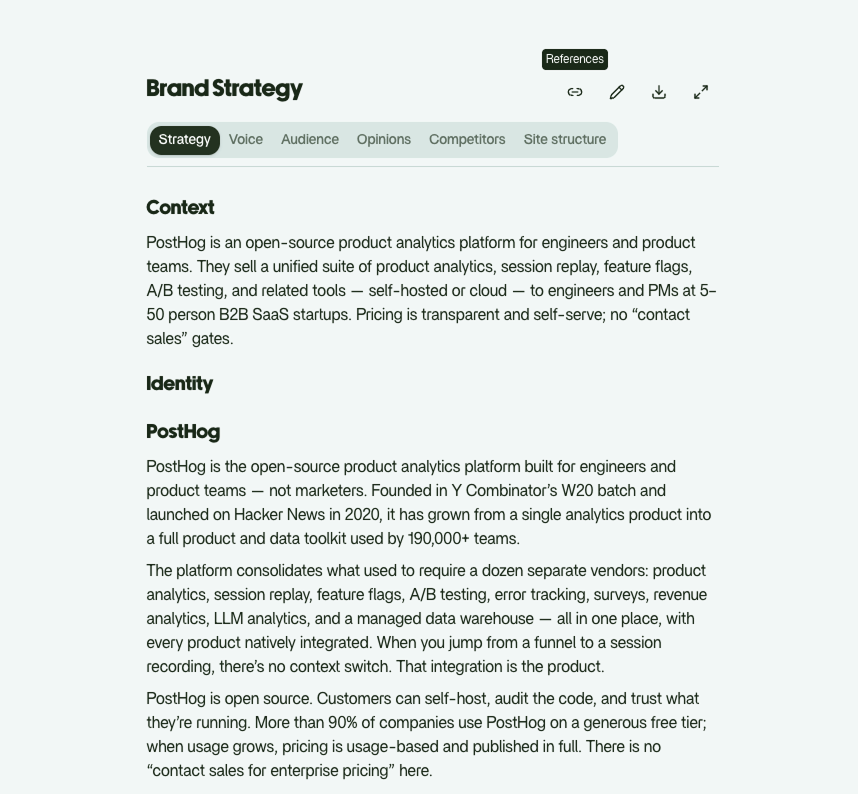
Keyword research is the foundation, and it begins with your own brand. Brand keywords tell you what you already rank for and what people associate with you. Then you widen out to the problems your audience searches for. This is where defensibility comes in. The Reforge 4-bucket taxonomy splits content into defensible and non-defensible work, and most templates push you straight into the non-defensible pile: commodity “what is X” explainers that AI Overviews absorb and competitors already own.
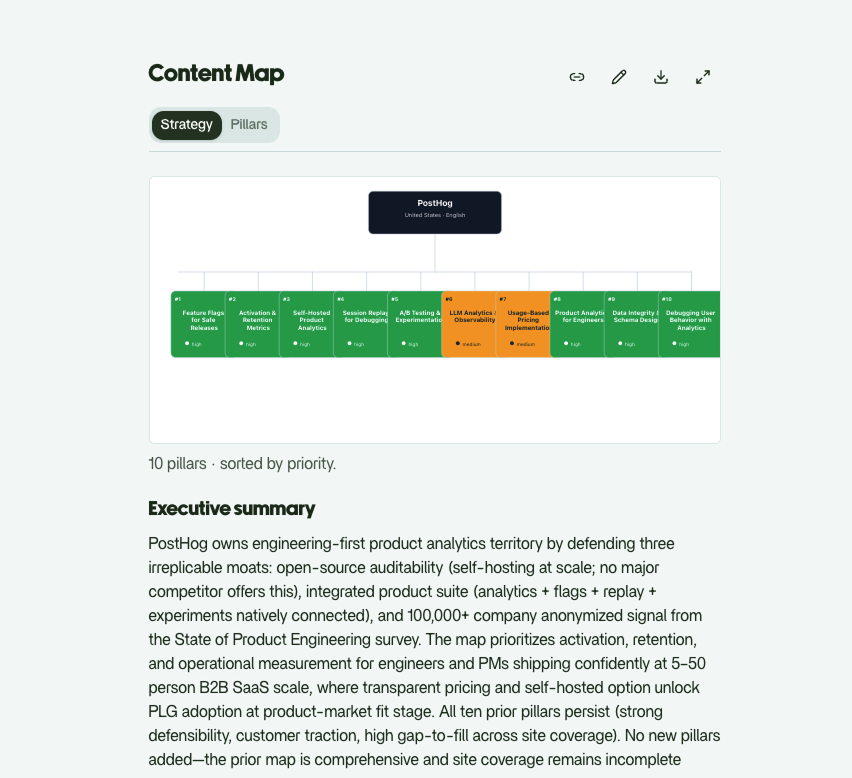
Successful content pillars emerge from keyword research and audience pain keywords, not generic templates. That single rule kills the template habit. A pillar earns its place when it sits on real search demand, addresses a problem your reader actually has, and gives you room to say something competitors won’t.
Real Content Pillar Examples From Different Business Types
Here is what defensible pillars look like once you stop copying templates and how to create content pillars becomes a keyword decision instead of a brainstorm. Each example below is built from a real search-intent bucket, not a vibe.
B2B SaaS. Group your keywords by buying stage. One pillar for the problem (“why is my onboarding retention dropping”), one for the solution category (“user onboarding tools”), one for use-cases tied to specific roles. The problem pillar is your most defensible because you can answer it with first-party experience nobody else has. The solution pillar is more competitive, so you only commit if you can add original data.
Service businesses. Structure pillars around service type crossed with location, then layer audience pain on top. A plumbing company builds a pillar per service (“emergency drain repair”), each grounded in the local query, and a separate pillar around the panic moment a customer feels at 2am. Location keywords are defensible because national competitors can’t beat your geographic intent.
Creators and media. Organize around audience interest tied to subscriber pain. Not “content about cooking,” but “30-minute dinners for parents who hate meal prep.” The pain is the pillar. The recipes are the cluster underneath.
E-commerce. Build pillars by product category and buyer-journey stage. A category pillar (“running shoes”) sits at the top; intent-stage pillars (“running shoes for flat feet,” “how to break in running shoes”) catch buyers mid-decision. The mid-funnel pillars convert because they answer a real question before the sale.
Four business types, four different structures. Not one template fits all of them, because each audience types different words.
How to Evaluate If Your Pillars Are Defensible
A pillar idea is not a pillar yet. It has to survive a defensibility check first. This is the strategic fit evaluation: a trade-off between your brand moat and the keyword opportunity in front of you.
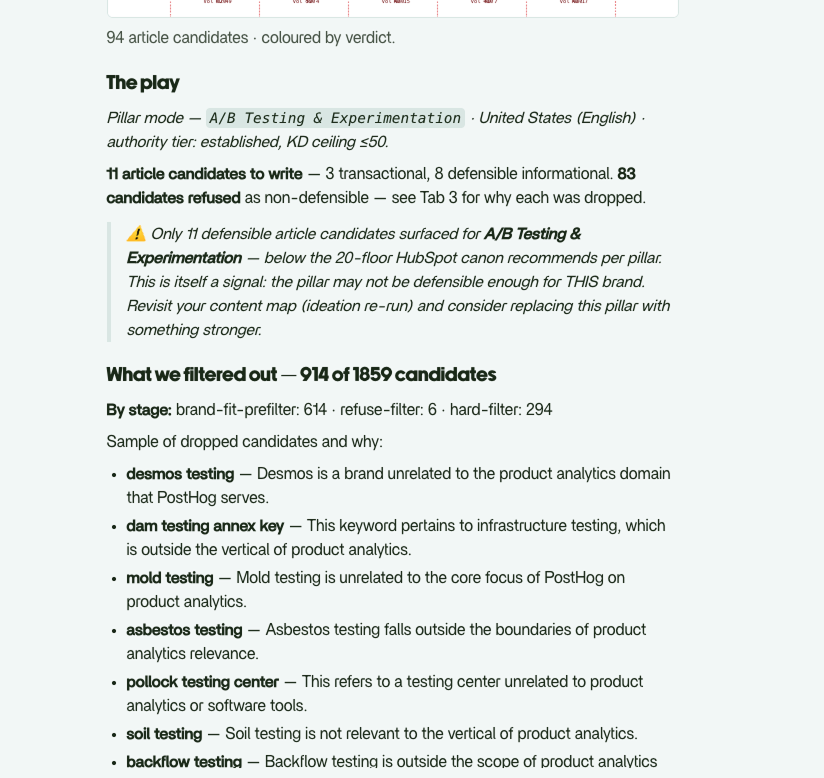
Score each candidate pillar on two axes. First, how much room do you have to say something only you can say? Your content and your strong opinion are the moat. If you do not have a strong opinion, your content is going to be replaced by AI, because AI can easily generate the generic version. Second, how crowded is the keyword? Live SERP data fetched in real-time for each keyword research run tells you who already ranks and how strong they are.
Now the hard call. Skip the pillar when competitors own it and you bring nothing new. A “what is content marketing” pillar is a waste: it is a commodity keyword, AI Overviews answer it instantly, and a hundred sites rank above you. That is non-defensible content. Stop it, don’t write it.
Keep the pillar when it is AI-overview-proof. Original data and first-party experience are the only informational content worth investing in. A pillar built on your own numbers, your own client results, or a contrarian position you can defend has topical authority potential, because it signals to Google and to LLMs that you are an expert. LLM citations are the new rank. Most cited sources don’t even appear in Google’s top 20, and they win on opinion and data, not on rehashed definitions.
So the test is short. Strong opinion plus real data plus beatable SERP equals a pillar. Miss any one and you have a commodity topic competitors already dominate.
Building Pillars Around Your Audience’s Pain Keywords
The most defensible pillars sit on top of pain. Your reader has a problem, types it into Google in their own words, and that exact phrasing is your audience pain keywords map. Find those phrases first.
The methodology is simple to run. Pull the questions your audience actually asks. Pull them from your own onboarding, support tickets, and the brand interview data collected from each user’s live website crawl and onboarding session. Then match each pain to the keyword that expresses it. “I can’t get my team to use the tool” becomes “how to drive software adoption internally.” The pain is the pillar theme. The specific keyword variations are the articles under it.
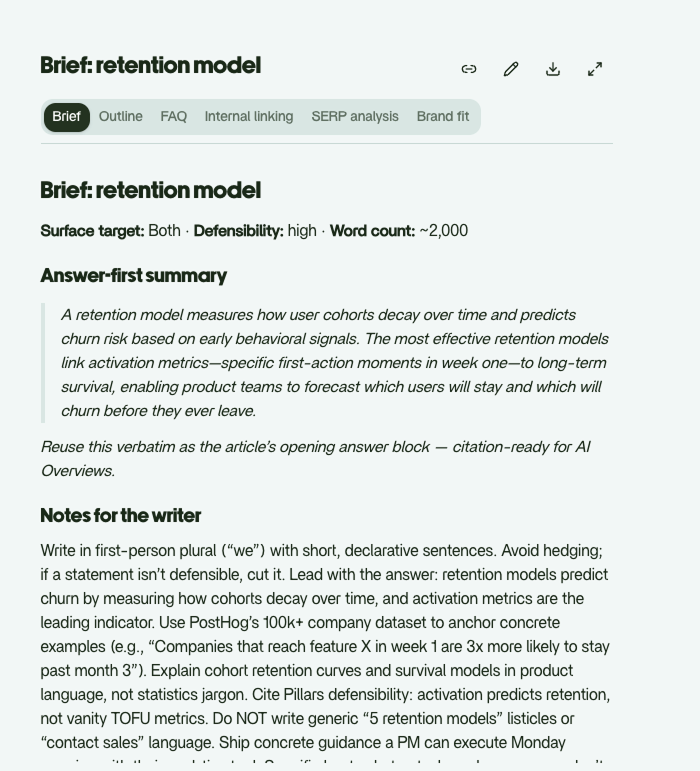
Map it before you write anything. One pillar per major pain. Under each pillar, one article per keyword variation of that pain. This is how you end up with a list of articles that you want to write and a list of articles that you do not want to write, instead of a random pile of posts loosely related to your brand.
Then test defensibility before you commit. Check search volume so the pain is common enough to matter. Check competitor density so you are not walking into a fight you can’t win. If the volume is there and the SERP is beatable, build it. If a competitor owns every result with stronger content, find the adjacent pain they ignored. Iterate on the data, not on the template. A pillar that loses on both volume and difficulty gets cut, and the budget moves to the one that wins.
This is the difference between isolated keyword work and an actual strategy. Keyword research without brand context produces one article. Brand-first pain mapping produces a pillar your competitors can’t copy, because they don’t have your customers’ words or your opinion.
FAQ
What are content pillars with examples?
Content pillars are the core topics your content clusters around. Real examples don’t come from a template: a B2B SaaS pillar might be “user onboarding retention,” a service business pillar “emergency drain repair near me,” a creator pillar “30-minute dinners for busy parents.” Each one emerges from keyword research and the audience pain behind the search.
How do you structure content pillars around keyword research?
Group your keywords by search intent first. Create one pillar per intent bucket, not one per topic you like. Then align each pillar to a specific audience pain so it answers a real problem. The keyword set under each pillar becomes your article list. Search intent decides the structure, because you cannot change what people type.
What’s the difference between content pillars and keyword clusters?
Clusters are tactical: groups of similar-meaning keywords that belong together. Pillars are strategic: themes that reflect your brand expertise and your audience’s pain. A cluster is the raw material. A pillar is the decision about which clusters are worth owning and which you skip because competitors dominate them.
Are content pillars still relevant for SEO?
Yes, more than before. Topical authority requires clustered content, and that signals to Google and to LLMs that you are an expert in a subject. Pillars organize the cluster by keyword intent and audience pain. Without that structure, your articles read as scattered one-offs, and scattered content does not build authority.