Strategic Fit in Keyword Research: How to Evaluate Which Keywords Your Brand Can Win
By Ben, Founder
Strategic fit assessment evaluates whether a keyword aligns with your brand’s expertise, audience, and competitive advantages. A keyword has strategic fit when you can defend your ranking with unique insights or first-party data, not just chase search volume. Examples include targeting ‘keyword gap analysis’ if you’ve built proprietary gap-detection methodology, or ‘retention cohort analysis’ if your product data differentiates you, but not generic terms where larger competitors own the answer.
Most founders pick keywords backwards. They open a tool, sort by volume, and start writing. Then the article never ranks, the content budget is gone, and nobody can say why this keyword was good or why this keyword was not good. This guide fixes the order. Before you run research, you decide which keywords your specific brand can actually defend.
The decision layer here sits on top of your brand-first keyword research framework. Research tells you what people type. Strategic fit tells you which of those terms are worth your time.
What Strategic Fit Means in Keyword Research
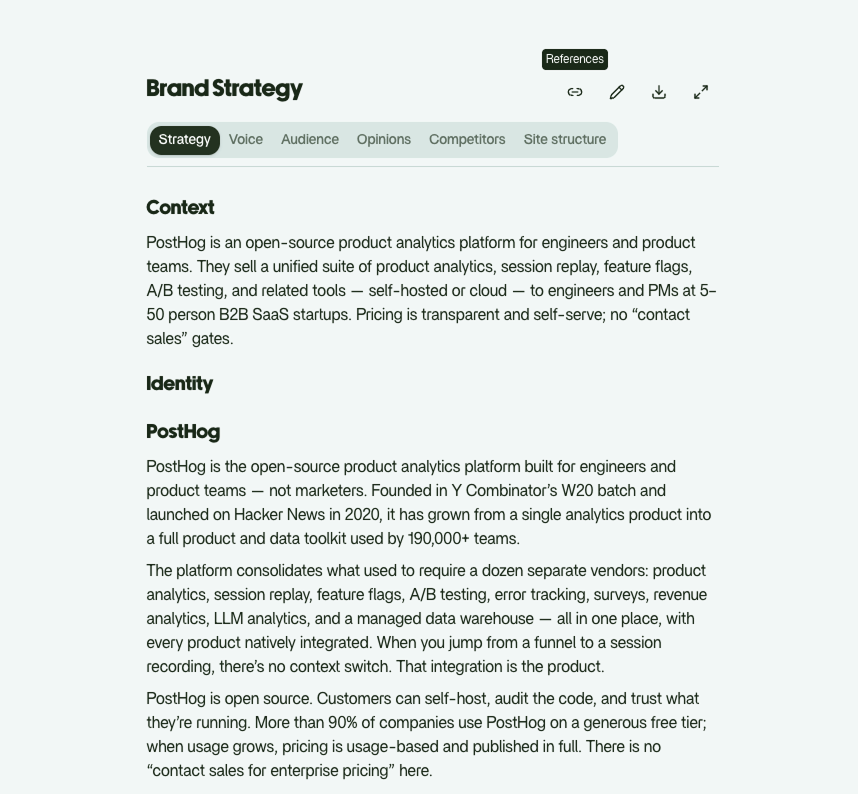
Strategic fit is the match between a keyword and three things your brand owns: your expertise, your audience, and your competitive advantages. A keyword fits when you can defend the ranking with something larger competitors do not have. It does not fit when you are only there because the volume looked good.
Here is the line that matters. A keyword with strategic fit is one your brand can defend with unique expertise, audience insights, or first-party data, not one you target because the volume looks good.
Some keywords are already owned. A bigger incumbent outranks everyone on domain authority. Or an AI Overview answers the query in full and cites only major brands. Backlinko frames this as keyword-brand fit: the alignment between keyword opportunity and brand expertise is the decision layer before any content investment. You check the fit first. You spend second.
Defensibility comes from a few real sources. Proprietary methodology you built. First-party data from your product or your customers. Niche expertise nobody else has lived through. Without one of those, you are writing the same article as everyone else, and in 2026 that is the article AI replaces. If you do not have a strong opinion, your content is going to be replaced by AI. Strategic fit is also where you catch search intent that misaligns with your brand positioning before it costs you a single draft.
How to Evaluate a Keyword’s Strategic Fit for Your Brand
Run every candidate keyword through four checks. Treat them as a sequence. If a keyword fails an early one, you can stop.
- Map it against what you know. Write down your real expertise areas and your competitive advantages. Does the keyword sit on top of one of them? If the term has nothing to do with what makes you different, the fit is already weak.
- Ask the defensibility question. Can we rank because we know something others don’t? Not because we want to rank. Because we genuinely hold knowledge, data, or a point of view a bigger competitor cannot copy. This is the whole game.
- Check for unique inputs. Do you have first-party data, customer insights, or a methodology you can put into the article? If yes, you have something to defend the ranking with. If no, you are bringing a generic page to a fight you will lose.
- Read the live SERP. Open the search results. Is the page owned by large incumbents who outrank on authority alone? Is the query fully answered by an AI Overview citing only Google’s own content and a few giants? Or is there open ground where a smaller, sharper page could win? I do this check across every brand I evaluate, and the SERP usually tells you the truth in thirty seconds.
This four-step pass is also how you find the openings competitors ignore. When you read enough SERPs, you start identifying keyword gaps your competitors miss, the terms where your expertise wins and theirs runs out. You cannot change what people are typing. You can only decide which of those searches you are equipped to answer better than anyone else.
Strategic Fit Examples: Defensible vs. Non-Defensible Keywords
Examples make this concrete. The same keyword can be a smart target for one brand and a waste for another. Context decides.
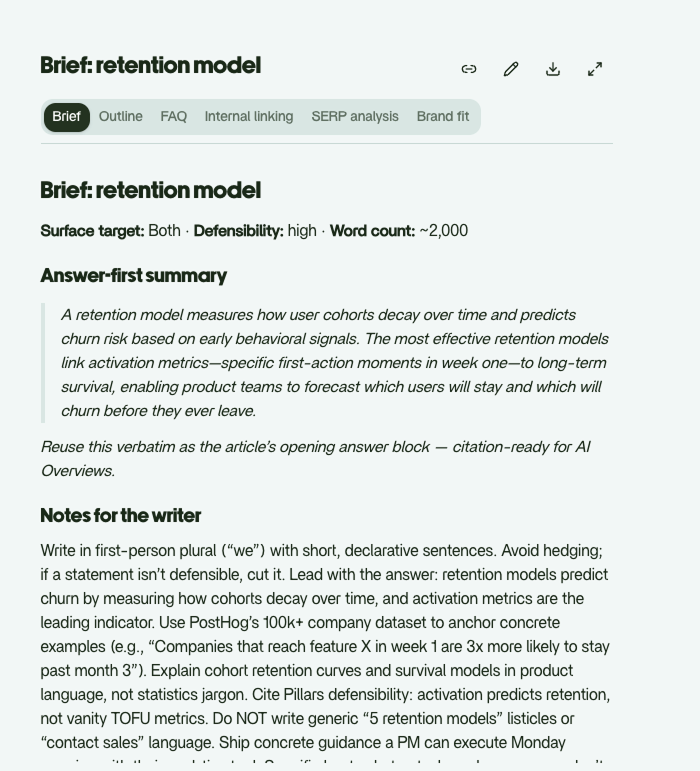
Defensible: “retention cohort analysis.” If you run a product that generates real usage data, you can write this with cohort numbers nobody else has. Your first-party data is the moat. A generic marketing blog cannot match a page built on actual retention curves, so you can defend the ranking even against bigger sites.
Defensible: “keyword gap analysis.” If you built a gap-detection tool with features competitors do not have, you have a proprietary methodology to explain. Reforge’s defensibility taxonomy calls this a defensible-informational keyword: informational intent, but ownable because your expertise is genuinely unique. You are not summarizing the topic. You are the source.
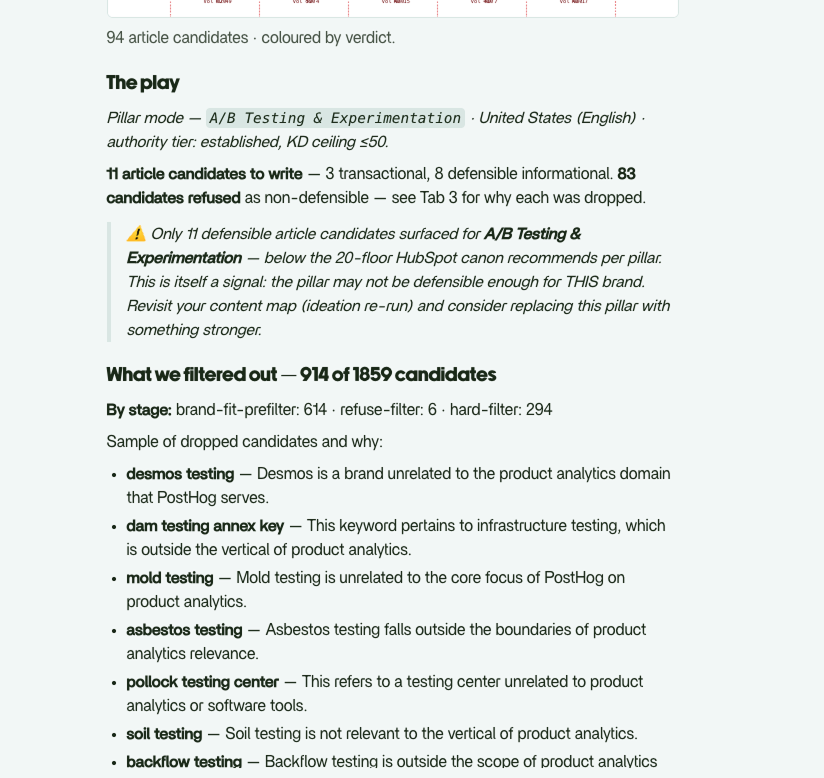
Non-defensible: “how to do market research.” This is owned by larger incumbents with more authority and a decade of backlinks. You bring nothing they lack. Ranking here is a domain-authority contest, and you lose it before you write a word.
Non-defensible: “what is marketing strategy.” AI Overviews answer this completely and cite only major brands. There is no opening. This is exactly the kind of non-defensible explainer you stop and prune, not write.
The lesson sits in the contrast. “Retention cohort analysis” is gold for a product company sitting on usage data and noise for a service agency with none. Run the fit test against your own context, every time. And remember that brand keywords have defensibility built in by default, because nobody can out-rank you on your own name and positioning.
When to Skip a Keyword Even If Volume Looks Good
The hardest discipline is walking away from a high-volume term. Volume is a temptation, not a strategy. Skip the keyword when any of these is true.
- Large competitors own the entire SERP. Every result is a site that outranks you on domain authority alone. You will not displace them with one article, no matter how good.
- AI Overviews answer the query in full. The box cites only incumbents or Google’s own content. There is no click left for you to win.
- You have no unique perspective. No proprietary data, no methodology, no niche expertise. If the page would be generic, do not build it.
- The audience is wrong. The keyword targets a broad crowd completely outside your customer profile. Traffic that never converts is not a win.
The rule is simple. Defensibility trumps volume. A defensible term with modest search beats a fat one you can never own.
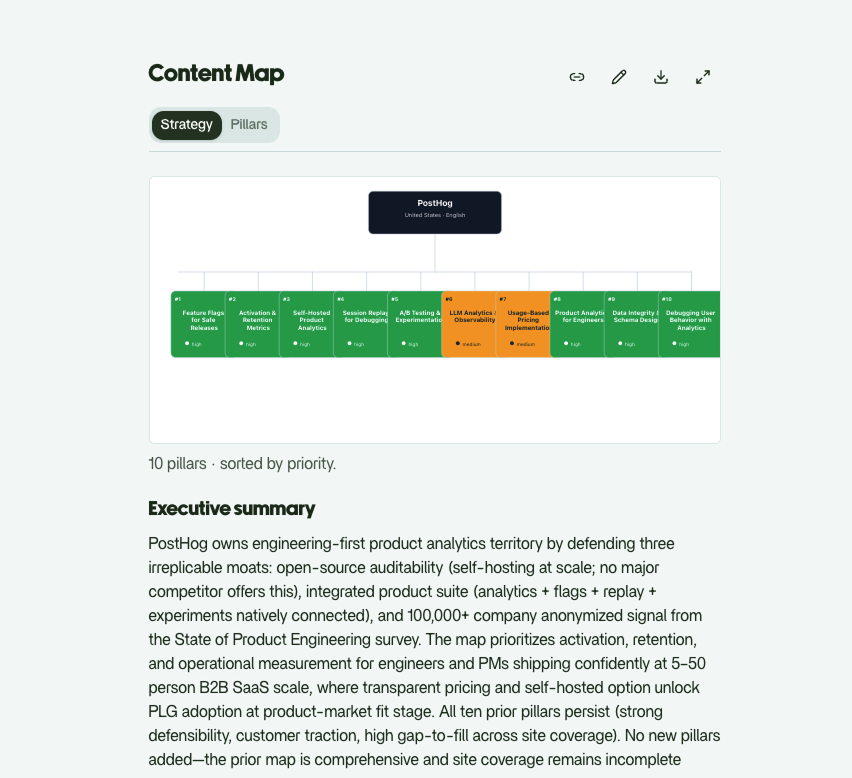
This is why the planning step produces two outputs, not one: a list of articles that you want to write and a list of articles that you do not want to write. The second list protects your budget. Strategic fit is also what lets you think in clusters and content pillars instead of chasing scattered terms, because every keyword you keep should ladder up to a pillar you can defend. That is the real work of mapping keywords to your content pillars: keeping the defensible terms, cutting the rest, and building topical authority where you actually have an edge.
FAQ
What is an example of a strategic fit?
A keyword has strategic fit when your brand has unique expertise or first-party data that larger competitors lack. “Retention cohort analysis” fits a product company sitting on real usage data, because the page can be built on numbers nobody else can publish. That data is the thing you defend the ranking with.
What’s the difference between strategic fit and keyword difficulty?
Difficulty measures how hard it is to rank: backlinks, authority, competition. Strategic fit measures whether your brand can actually win the ground if you do rank. A keyword can be low difficulty and still a bad fit, because you have nothing unique to say. Check both, but fit decides whether the ranking lasts.
Can a keyword have low strategic fit but high business potential?
Yes, and you should still skip it. If a high-value term sits in a SERP owned by bigger competitors and you have no proprietary angle, the business potential is theoretical. You will not rank, so you will not capture it. Spend that budget on defensible opportunities where you can win.
How do I know if I have enough expertise to rank for a keyword?
Map your expertise areas and your first-party data directly against the keyword. If you can point to a methodology, a dataset, or lived experience that makes your page genuinely different, you can defend it. If you cannot, do not target it. Everything starts by the search intent, and your job is to answer it with something only you can bring.