How to Choose Content Pillars for Your Brand: A Strategic Template
By Ben, Founder
Content pillar strategy starts by intersecting three forces: your brand’s demonstrable expertise, your audience’s deepest pains, and your competitive positioning. A defensible pillar is a broad topic where you own that intersection. Backlinko’s methodology and Reforge’s defensibility taxonomy provide the framework. Pick pillars you can credibly own, then cluster keyword research beneath them.
Most founders pick content topics backwards. They run keyword research first, find a few high-volume terms, and start writing. Then they wonder why the articles don’t rank and don’t convert. The problem isn’t the writing. It’s that nobody decided which topics the brand could actually own before the keyword work began. This template fixes that, and it gives you a decision tree you can run on your own brand today. If you want the bigger picture on how all of this fits together, read Andy’s SEO methodology, and for the structural side, here’s my comprehensive guide to pillar pages.
Why Pillar Selection Is Your First Strategic Decision
Keyword research feels like the starting line. It isn’t. Keyword research only becomes strategic after you decide which topics to research under. Run it first and you get a spreadsheet of terms with no way to judge why this keyword is good or why this keyword is not good for your brand specifically.
Pillar-first strategy prevents that waste. When you lock in the topics your brand can credibly own, every later decision filters through them. You stop chasing volume on subjects you have no right to teach.
Pillars also do the heavy lifting with the algorithms. When you think in clusters and content pillars, you signal to Google and to LLMs that you are an expert in a coherent theme, not a brand publishing random posts. A cluster of related articles under one pillar reads as depth. Five disconnected articles read as noise.
This is why Backlinko’s canonical 7-step SEO program puts pillar selection at the foundation. It’s the decision every other step depends on. Get it wrong and you optimize beautifully for the wrong things.
The Framework: Three Forces That Define Defensibility
Here is the rule the whole template rests on. Defensible pillars live at the intersection of your brand’s demonstrated expertise, your audience’s deepest pains, and your competitive positioning. Miss one force and the pillar collapses.
Force 1: Demonstrated expertise. What has your brand actually done? Case studies, results, shipped work, named clients, original data. Not “we care about this topic.” Proof. If you can’t point to evidence, you can’t teach the topic in a way that beats the competition.
Force 2: Audience pain. What is your audience’s deepest problem in this area? Search data tells you demand exists. Customer interviews tell you the problem is real and worth money. You need both. A topic with traffic but no pain produces readers who never convert.
Force 3: Competitive positioning. Who are you beating, and where do competitors fall short? You need a unique insight or capability the incumbents don’t have. If ten established brands already own a subject and you bring nothing new, that subject is a commodity, and commodities get absorbed by AI Overviews.
A defensible pillar lives at the intersection of all three forces, not just one or two. Two strong forces and one weak one is the trap. It feels close enough to commit to, and it costs you months. Reforge’s 4-bucket defensibility taxonomy exists for exactly this reason: it categorizes content by whether a brand can credibly own it, so you stop investing in topics you’ll lose.
How to Apply the Framework to Your Brand
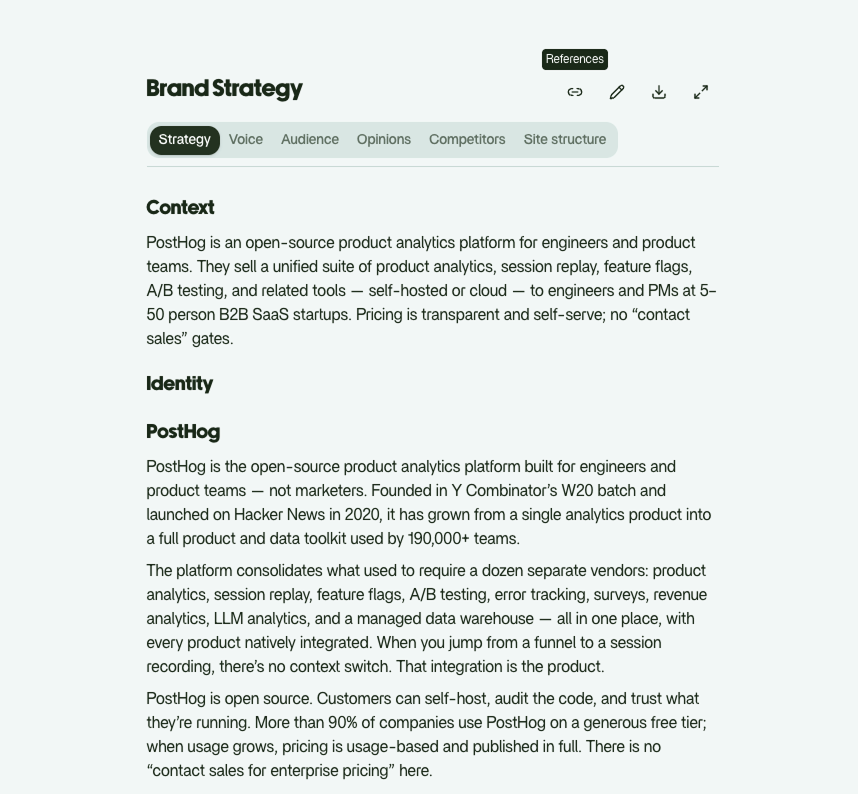
This is the part you can run today. Four steps, in order. At Andy, this is the same sequence our brand onboarding interviews follow. They map each client’s demonstrated expertise, audience pain, and competitive positioning to defensible pillars before a single keyword gets researched.
Step 1: Audit demonstrated expertise. List team backgrounds, past projects, case studies, published work, and any original data you sit on. Be honest about depth. A topic you’ve shipped real results in is a candidate. A topic you’ve only read about is not. Andy was built on years of hands-on SEO across owned and client businesses, so SEO strategy is a pillar I can defend. I would not write a pillar on tax law.
Step 2: Map audience pain points. Interview customers. Read support tickets. Analyze the queries people actually type. What problems do they have, in their words? Everything starts by the search intent, and you cannot change what people are typing. You can only build pillars around the pains they already bring to the search bar.
Step 3: Assess competitive positioning. Research the top brands in each candidate category. Where do they own the conversation? Where do they fall short? Look for the gap. If every competitor publishes the same generic “what is X” explainer, your unique insight or first-party data is the wedge that wins.
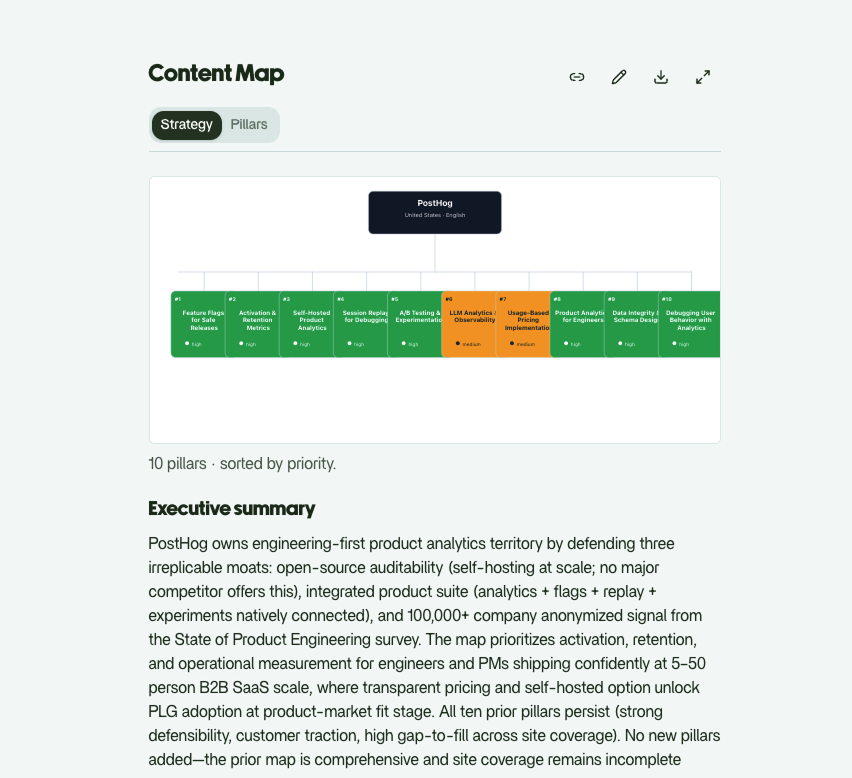
Step 4: Plot the intersections. For each potential pillar topic, score it against all three forces. Strong on all three? That’s a pillar. Strong on two and weak on one? It is not defensible yet, so park it and build the missing force first. To see this scoring in action, study these real-world examples of defensible pillars.
From Pillars to Keywords: The Strategic Workflow That Follows
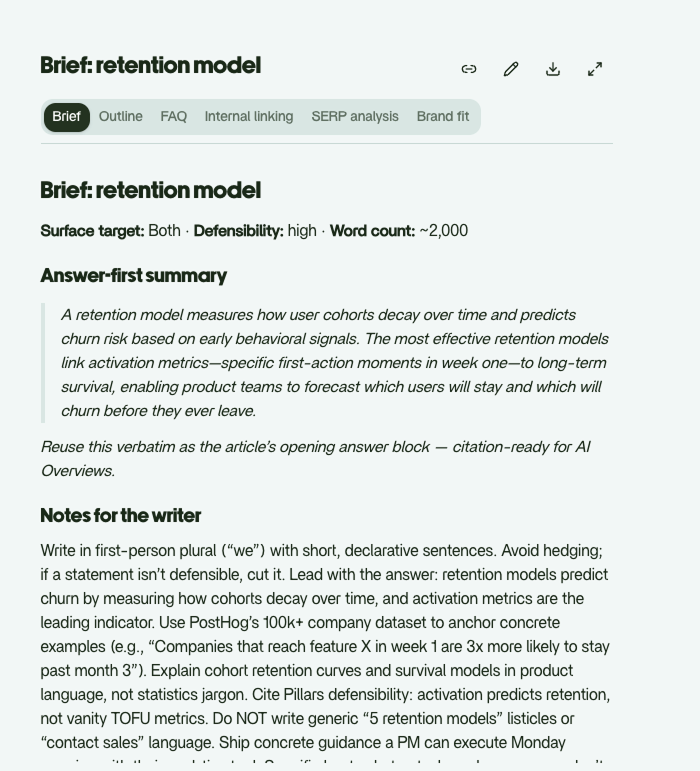
Once your pillars are locked in, keyword research stops being a hunt and becomes a filtering exercise. Every keyword you target must nest under an existing pillar you already own. If a keyword doesn’t fit a pillar, it doesn’t get written. Simple guardrail, huge savings.
This pillar-first order prevents the most expensive mistake in content SEO: optimizing for keywords that send readers to content your brand can’t credibly deliver on. You rank, they click, they bounce, and your authority drops. Worse, you’ve spent the budget.
Cluster articles flow straight from the pillar. Each article targets a related keyword and links back to the pillar page, which builds the topical depth the algorithms reward. This is the hub-and-spoke structure in practice. If the mechanics are new to you, here’s how the hub-and-spoke content model works.
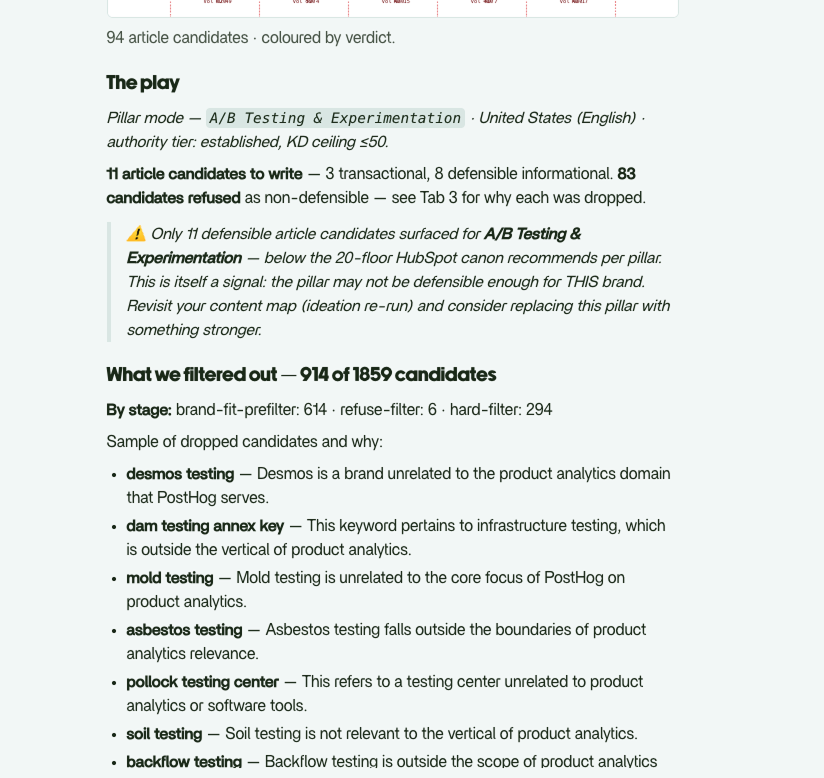
One more thing the framework forces you to do: decide what not to write. The output of good pillar selection is a list of articles that you want to write and a list of articles that you do not want to write. Reforge’s defensibility taxonomy keeps you building authority on topics where you can actually win, instead of competing on commodities that AI will reproduce for free. And remember why this matters now. If you do not have a strong opinion, your content is going to be replaced by AI. Your pillars are where that opinion lives.
That’s the template. Audit your expertise, map the pain, judge the competition, plot the intersections, then let keyword research filter beneath. When you’re ready for the next layer, dive deeper into topic selection strategy and start scoring your candidates.
Frequently Asked Questions
What’s the difference between a pillar and a keyword cluster?
A pillar is the strategic decision: which broad topic can your brand credibly own. A cluster is the content structure beneath it: the pillar page plus the related articles that link back to it. You choose the pillar first, then build the cluster to fill it out.
How do I know if a pillar is defensible for my brand?
Test the intersection of three forces. Does your brand demonstrate real expertise, does your audience actually ask about this problem, and can you beat the competitors who already cover it? All three must be true. Two out of three means the pillar isn’t defensible yet.
Can I change my pillars after I’ve published content around them?
You can, but it’s costly in time and lost authority, because you’ve already built links and signals around the old theme. Choose pillars deliberately upfront with this framework. Doing the thinking early prevents the expensive pivot later.
Do I need exactly 3-5 pillars?
No, that’s not a fixed rule. The framework decides defensibility, and the right pillar count depends on your brand size and how broad your proven expertise is. Too many pillars dilute your authority. Too few leave revenue on the table. Pick the number you can genuinely defend.
How does pillar selection affect keyword research?
It sets the boundary. Every keyword you target must nest under an existing pillar you already own. Pillar-first strategy is the guardrail that keeps keyword research from sprawling into topics your brand can’t credibly deliver on.