How to Select Pillar Topics for Your SEO Strategy
By Ben — Founder. Synthesized Backlinko and Reforge SEO frameworks into Andy’s product workflow. Multiple years of hands-on SEO experience across client engagements and multiple own businesses.
Choose pillar topics at the intersection of three forces: topics your brand has genuine expertise in, topics your audience actively needs solutions for, and topics where you can differentiate from competitors. The best pillar topics aren’t the ones with the most search volume—they’re the ones you can dominate because of your specific brand strengths and customer needs.
Most founders I talk to are stuck on the same question: which topics do we actually own? They have a blog with 50 scattered posts, no coherent theme, and nothing ranking. The fix is not more content. It is picking the right pillars first, which is exactly what this comprehensive guide to pillar page strategy is built to help you do.
Why Most Brands Pick Pillar Topics Wrong
Most brands pick pillar topics wrong. They open a keyword tool, sort by search volume, and pick the biggest number. That is the trap. A high-volume topic you cannot own is worthless for building authority. You will write into a wall of established competitors and never crack the top 20.
Volume feels safe because it is a number. But the number tells you nothing about whether your brand can win. Picking a 40,000-search topic you have no right to own is slower and more expensive than picking a 2,000-search topic you can dominate in six months.
Pillar topics do one job: they signal to Google and to LLMs that you are an expert. That signal only fires when the topic is defensible. Topic authority compounds over time, but only when it is organized around pillars you can actually own, not high-volume keywords you chase because they look impressive in a spreadsheet.
Here is the part that costs people years. If you do not have a strong opinion, your content is going to be replaced by AI, because AI can easily generate generic content. A pillar you picked for volume alone has no opinion behind it. It is filler, and filler gets absorbed by AI Overviews the moment it publishes.
The Three Dimensions of a Defensible Pillar Topic
Choose pillar topics at the intersection of expertise, audience pain, and competitive opportunity—not volume alone. Three dimensions. All three have to line up before a topic earns a place on your list.
Dimension 1: Brand Expertise. What is your team genuinely known for? Not what you wish you were known for. What you have actually shipped, sold, or solved. If your founders spent a decade in supply-chain software, that is a defensible pillar. If you read three blog posts about it last week, it is not. Expertise is the thing AI cannot fake on your behalf.
Dimension 2: Audience Pain. What real problems do your customers pay you to solve? A pillar topic has to map to a pain your buyer feels and searches for. Everything starts with the search intent and by the keyword the user typed in Google or ChatGPT. You cannot change what people type. You can only build pillars around the problems they already bring to the search bar.
Dimension 3: Competitive Opportunity. Where can you say something your rivals can’t or won’t? This is where your strong opinion lives. If ten competitors already own a topic with better domain authority and the same take, there is no gap. You need a position that is yours.
A topic only counts as a pillar when all three overlap. Expertise without audience pain is a hobby. Audience pain without expertise is a topic you will lose. Both without competitive opportunity is a crowded room you can’t get heard in.
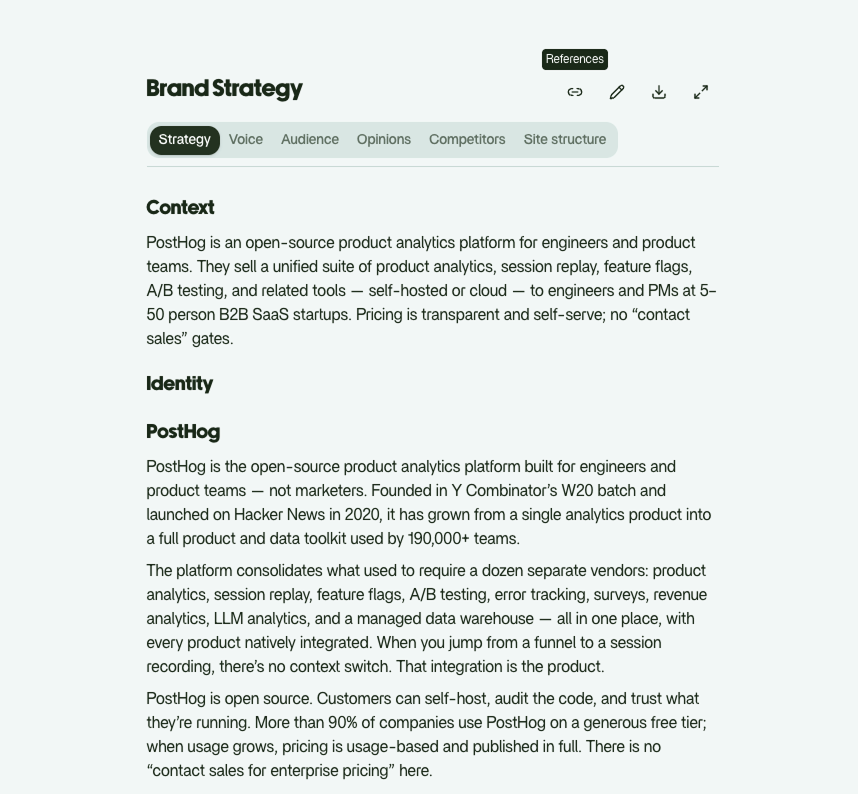
The way to validate each dimension is first-party data, not gut feel. Andy fetches live SERP data in real time for every keyword run to test competitive opportunity. It uses brand website crawl data from onboarding to map what you are actually expert in. And it pulls founder interview data to surface the pains your customers care about. This is the judgment most tools skip. They hand you data. They never tell you why this keyword is good or why this keyword is not good.
Selecting Your Pillar Topics: A Four-Step Process
Here is the process. Four steps. Do them in order, because each one feeds the next.
Step 1: Audit your brand expertise. Pull everything you have already published, your product pages, your case studies, and your team bios. Where does real depth show up? Start with your brand. Have a very strong understanding of what you believe in and what your strong opinion is. This audit is what Andy automates with crawl data during onboarding, mapping the topics where your site already demonstrates genuine experience.
Step 2: Interview your customers. Talk to the people who pay you. Ask what problem made them look for a solution, what they typed into Google or ChatGPT, and what almost stopped them from buying. Founder interviews surface pains no keyword tool will ever show you, because the pain comes before the search query. Write down the exact words they use. Those words are your topics.
Step 3: Analyze competitor SERP positioning. For each candidate topic, look at who currently ranks and who gets cited by LLMs. Note that most cited sources don’t even rank in Google’s top 20, so check both. You are hunting for gaps: questions answered badly, opinions nobody is willing to hold, angles left open. Andy runs this with live SERP data on every research pass.
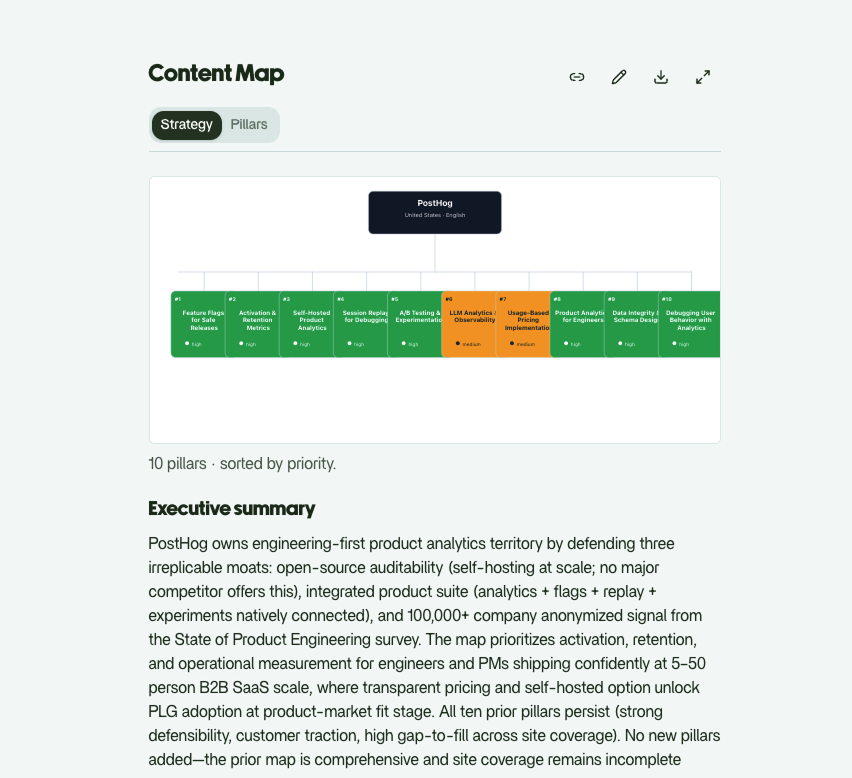
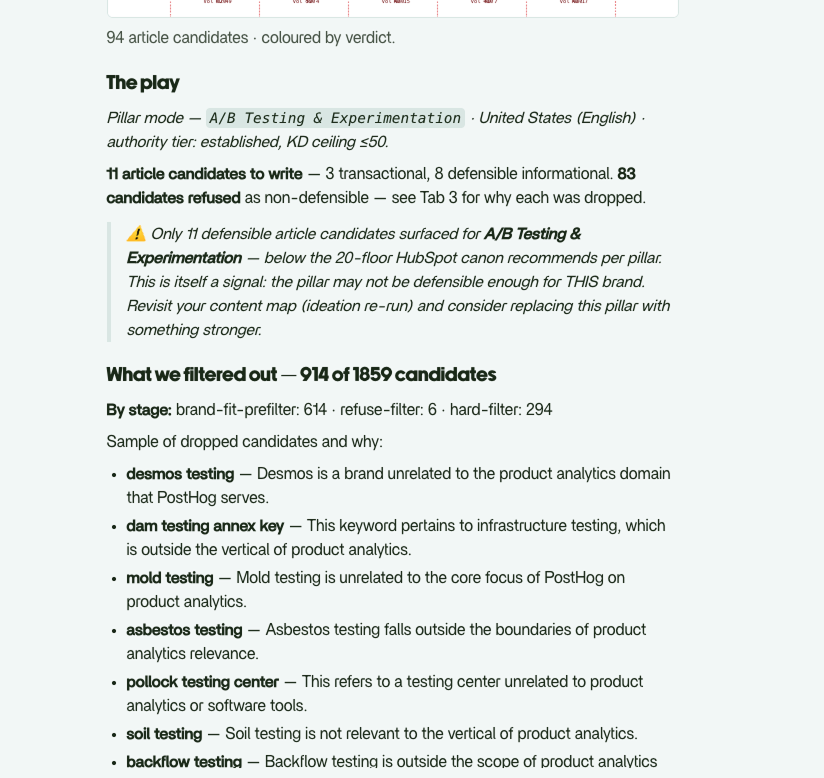
Step 4: Map the intersection. Put your candidate topics on a simple matrix. Score each one on the three dimensions. Keep only the topics that score high on all three. The result is two lists: a list of articles that you want to write and a list of articles that you do not want to write. The second list matters as much as the first.
Once your pillars are set, move from the broad topic to the questions beneath it. This is where you identify topical questions for your pillar and start mapping the cluster. To run the whole framework in one place, use this pillar strategy template, which walks you through scoring each candidate on expertise, pain, and opportunity.
This four-step approach is not something I invented in a vacuum. The methodology synthesizes Backlinko’s canonical 7-step SEO program with Reforge’s 2026 strategic framework, the two most rigorous public frameworks on how SEO actually works now that AI Overviews and LLM citations have reshaped search.
From Topic Selection to Topic Cluster Strategy
You picked your pillars. Now you build out from them. Think in clusters and content pillars. Each pillar is a broad page, and beneath it sit cluster articles that answer the specific questions your audience asks.
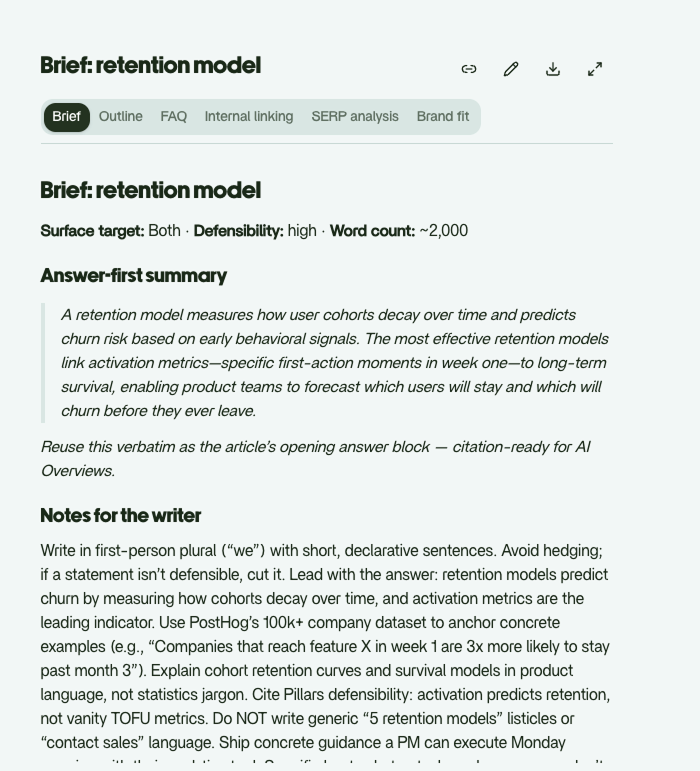
Start with sub-topic identification. Take each pillar and break it into the real questions buyers ask, ranked by topical relevance. These become your cluster articles. The transition from picking topics to executing on them runs through your keyword clustering strategy, which turns a single pillar into a structured set of articles that reinforce each other.
Internal linking is what makes the cluster work. Every cluster article links back to the pillar page, and the pillar links out to its clusters. This reinforces the thematic relationship for Google and for LLMs, and it concentrates authority on the page you most want to rank. A cluster with no internal links is just a pile of posts. A linked cluster is a topical authority signal.
Then you wait, and you measure. Topical authority compounds, but it takes time. Give a new cluster six to twelve months before you judge it. Track branded search volume and LLM citation count, not just raw traffic, because in 2026 those two KPIs tell you whether your pillar is actually becoming the source people and models trust. Keep adding cluster articles, keep linking them home, and the authority builds on itself.
Frequently Asked Questions
What are the 5 pillars of content strategy?
There is no standardized set of five pillars. That phrase is jargon people repeat without defining it. What matters is the framework you use to pick topics: brand expertise, audience pain, and competitive opportunity. A topic that scores high on all three is a defensible pillar. The number five is arbitrary.
How do I choose pillar topics for my specific industry?
Run the same four steps regardless of industry. Audit what your team is genuinely expert in, interview customers to surface the pains they actually pay to solve, analyze who ranks and who gets cited for each candidate topic, then keep only the topics where expertise, pain, and opportunity overlap. The industry changes the inputs, not the method.
What’s the difference between a pillar topic and a keyword?
A pillar topic is broad. A pillar page runs 3,000-plus words and sits above a cluster of supporting articles. A keyword is a narrow, specific query, usually a long-tail phrase someone types into Google or ChatGPT. You pick one pillar topic, then target dozens of keywords with the cluster articles beneath it.
How many pillar topics should my brand have?
Three to five for most brands. That range keeps your authority concentrated and your themes coherent. If you find yourself with ten or twelve pillars, you have a cohesion problem: you are spreading effort too thin and diluting the authority signal across topics you cannot all own. Fewer, deeper pillars beat many shallow ones.