Hub and Spoke in Content Strategy: Building Topical Authority
By Ben — Founder
In content strategy, hub-and-spoke mirrors a pillar page (the hub) connected to keyword-clustered satellite articles (the spokes). Each spoke targets a specific long-tail keyword or related query while the hub provides the comprehensive topic overview. This architecture signals topical authority to search engines and LLMs by demonstrating your brand owns a topic deeply.
Most founders I talk to are scattering articles across a domain and hoping something ranks. It doesn’t work, because Google and LLMs don’t reward isolated pages. They reward brands that own a topic. Hub-and-spoke is the shape that ownership takes, and it sits at the center of any real content pillar strategy.
What Hub and Spoke Really Is
Picture a bicycle wheel. One hub in the middle, spokes radiating out to the rim. The hub holds everything together. The spokes give the wheel its reach. Take away either one and the wheel collapses.
The pattern came from network topology before it ever touched content. Airlines run it: a few central airports connect to dozens of smaller destinations, so you fly through Atlanta or Frankfurt to get almost anywhere. Telecommunications and data centers use the same layout, routing traffic through central nodes instead of wiring every point to every other point. It’s efficient because the hub does the heavy coordinating.
Here is why it matters for content. Search engines and LLMs evaluate your site roughly the way that network routes traffic. They look for a strong central node and the connected pieces around it. A pile of unconnected articles reads as noise. A hub with deliberate spokes reads as expertise. The topology is the strategy.
Hub and Spoke Applied to SEO Content
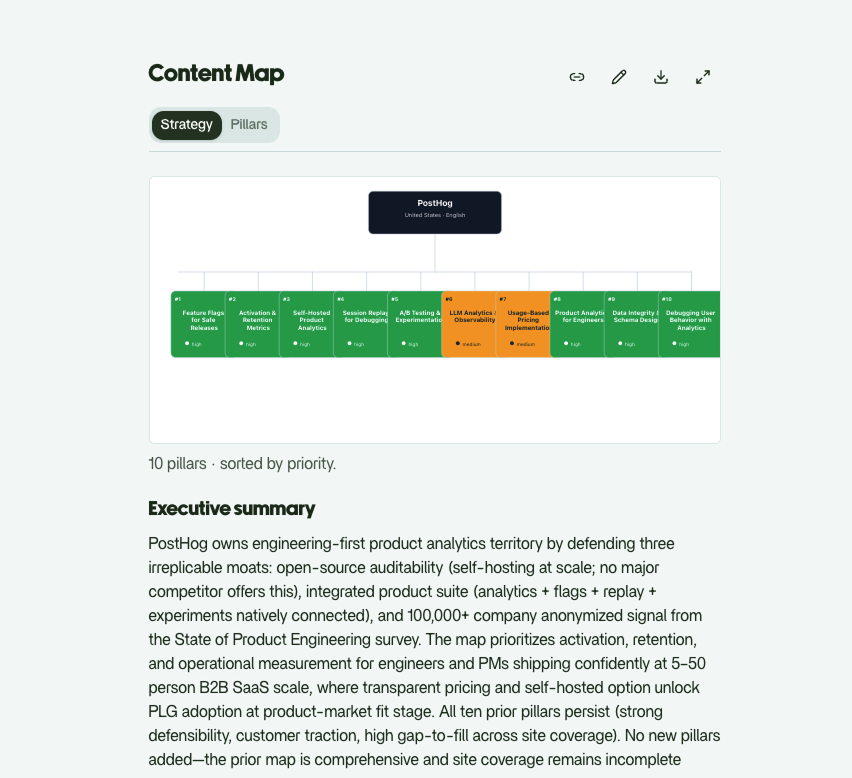
Now drop the wheel onto your site map. The hub is your pillar page, a single comprehensive page on a broad topic like “content strategy for SaaS.” The spokes are satellite articles, each one targeting a specific long-tail keyword inside that same topic cluster. The pillar gives the wide overview. Each spoke goes deep on one slice.
The connection between them is what does the work. Every spoke links back to the pillar. The pillar links out to every spoke. That internal linking, plus the semantic relevance between the pages, is how you signal to Google and to LLMs that you are an expert on the whole topic, not just one corner of it. To build those spokes well, you cluster keywords into spoke articles so each one earns its own query instead of cannibalizing the others.
Here is the quotable version. Hub-and-spoke in SEO content mirrors network topology: a pillar page (hub) connected to keyword-clustered satellite articles (spokes) signals topical authority to Google and LLMs.
The ranking impact is direct. Clustered, interconnected content outranks isolated articles, because the cluster tells the algorithm your brand covers the topic comprehensively. This is Andy’s whole approach, and it isn’t a hunch. The methodology synthesizes Backlinko’s 7-step canonical SEO program with Reforge’s 2026 strategic framework, the two most rigorous public frameworks on how SEO works now. Both land on the same conclusion: topical authority is built through cluster-based content architecture, not individual scattered articles. Before you write a single spoke, get clear on how to choose pillar topics for your brand.
Real Examples of Pillar Pages and Spokes
Let’s make this concrete. Say you sell software to other SaaS companies. Your hub is a comprehensive guide titled “SEO for SaaS.” It covers the full topic at a high level: what SaaS SEO is, why it differs from ecommerce, the main levers, where to start.
Then come the spokes. Each one takes a long-tail keyword the hub only mentions in passing and gives it a full article:
- “Keyword research for SaaS”
- “SaaS technical SEO”
- “Content clusters for SaaS applications”
Notice it’s three here, but a strong hub might carry eight or fifteen. The number follows the topic, not a template.
The connection pattern is the part people skip. Each spoke links back to the “SEO for SaaS” pillar near the top, where it fits naturally. The pillar links out to all three spokes, usually from a section that previews each subtopic. Now you have a closed loop of relevance.
The result: Google starts recognizing your brand as the topical authority on “SaaS SEO.” Not a brand that wrote one decent post. A brand that owns the subject. If you want to see the pattern across different industries, study real pillar page and spoke examples and copy the structure, not the topic.
Why This Pattern Works for Topical Authority
The hub-and-spoke layout sends two signals at once, and both matter more in 2026 than they did three years ago.
To Google, it says: this brand owns the topic comprehensively. You are not scattering loosely related articles and praying. You built a deliberate cluster, and the internal links prove the pieces belong together. That coherence is exactly what topical authority is made of.
To LLMs, it says something slightly different. Interconnected content is more reliable and more citable than isolated pieces, because the model can see the supporting context around any single claim. This matters because LLM citations are the new rank. Most cited sources don’t even rank in Google’s top 20. If you want to get pulled into an AI answer, a tight cluster beats a lonely article every time.
There’s a scalability payoff too. Once the hub is strong, every new spoke you add plugs into existing authority and performs better on day one. The wheel gets easier to extend the bigger it gets. And readers benefit directly: they land on one spoke, see the related subtopics through your internal links, and move through your cluster instead of bouncing back to search.
One caveat I’ll repeat until people listen. This only works if your content carries your strong opinion. If you do not have a strong opinion, your content is going to be replaced by AI, because AI can easily generate the generic version. So start with your brand, think in clusters and content pillars, and put a real point of view into every spoke. That’s the part the topology can’t do for you. It’s also why Andy’s product workflow forces every brand analysis through a pillar-selection process that maps your expertise to audience pain and competitive positioning before any keyword gets picked. The structure is only as good as the brand behind it.
FAQ
How is hub and spoke used in content strategy?
Pillar pages act as hubs covering a broad topic. Clustered articles targeting related keywords act as spokes. You connect them with internal links and keep them semantically related, which signals topical authority to Google and LLMs.
What are examples of hub and spoke in SEO?
A pillar page on “content strategy” is the hub. Articles on “keyword research,” “content clustering,” and “internal linking” are the spokes. Each spoke targets a related query and links back to the hub, while the hub links out to all of them.
Why is hub and spoke relevant for SEO?
Google and LLMs recognize topical authority through linked clusters. A hub-and-spoke structure shows you own a topic comprehensively instead of scatter-writing. In 2026, where LLM citations matter as much as rankings, that coherence is what gets you cited.
How do you create spokes around a pillar page?
Cluster keywords around your pillar topic using keyword research. Each keyword cluster becomes one spoke article targeting a specific long-tail keyword or related query. Link every spoke back to the pillar, and link the pillar out to every spoke.