How to Build Internal Linking Strategy That Signals Topical Authority
By Ben, Founder
Strategic internal linking connects related pages on your site to signal topical authority to Google and LLMs. In a pillar-cluster content strategy, satellite articles explicitly link back to a central hub page, demonstrating comprehensive topic coverage. The specific anchor text, placement, and direction of each link tell search engines which pages are most important and how your topics relate to one another.
Most founders treat internal linking as a cleanup task. You finish an article, you sprinkle a few links to other pages, you move on. That approach wastes the single strongest on-page tool you have for proving you own a topic. This guide shows you how to build internal linking as a deliberate part of your content strategy, with concrete steps and real cluster examples you can copy today.
Why Internal Linking Matters for Topical Authority
Internal links are how you tell Google which pages matter most. When ten of your articles all point back to one hub page, you are sending a clear signal: this hub is the center of the topic, and everything around it supports it. Google reads that hierarchy. It uses linking patterns to decide whether you comprehensively own a topic or just brushed against it once.
Topical authority is built through intentional clustering of related content around pillar topics. The links are the wiring that connects the cluster. Without them, Google sees ten separate pages. With them, Google sees one expert covering a subject from every angle. This is why you have to think in clusters and content pillars before you write a word, not after.
There is a second audience now. LLMs cite linked clusters of content more frequently than scattered individual pages, making cluster coherence a citation signal. A coherent, interlinked cluster reads as authoritative to the models pulling sources into AI answers. Scattered pages read as noise. The wiring matters to both readers of your work: Google and the LLMs.
How Pillar-Cluster Linking Differs from Traditional Internal Linking
Traditional internal linking is reactive. You link to a page because it happens to be relevant to the sentence you just wrote. Each page is an isolated node. The links form whenever two topics brush against each other. It works, sort of, but it does not build anything on purpose.
Pillar-cluster linking is the opposite. It is intentional. Satellites explicitly link back to a central hub to prove comprehensive topic ownership. The hub is your topical authority reference point, and every supporting article reinforces it by pointing to it. You decide the structure first, then the links follow the structure.
Here is the difference in one line. A cohesive internal linking strategy that connects satellite articles back to a pillar hub tells Google and LLMs that you comprehensively own that topic. Random relevance links do not say that. They say “these two pages share a word.”
When I run a live SERP analysis for this keyword, almost every competing guide treats internal linking as an isolated tactic. Link to related pages. Use good anchor text. None of them frame it as the execution mechanism for a pillar strategy. That gap is exactly where the topical authority signal lives. Strategic internal linking distributes authority and relevance signals from pillar hubs to satellite content, and the direction of that flow is the whole point.
Step-by-Step: Building Your Internal Linking Strategy
You do not need a tool to start. You need a plan and discipline. Here is the sequence I use across client work, and it consistently outperforms scattered linking for topical authority.
Step 1: Identify your pillar topic and central hub page. This is the anchor for the entire cluster. It should be a broad, high-value topic your brand can credibly own. Start with your brand. What do you actually have a strong opinion about? That opinion is the topic you can defend, and the topic you can defend is the one worth building a pillar around.
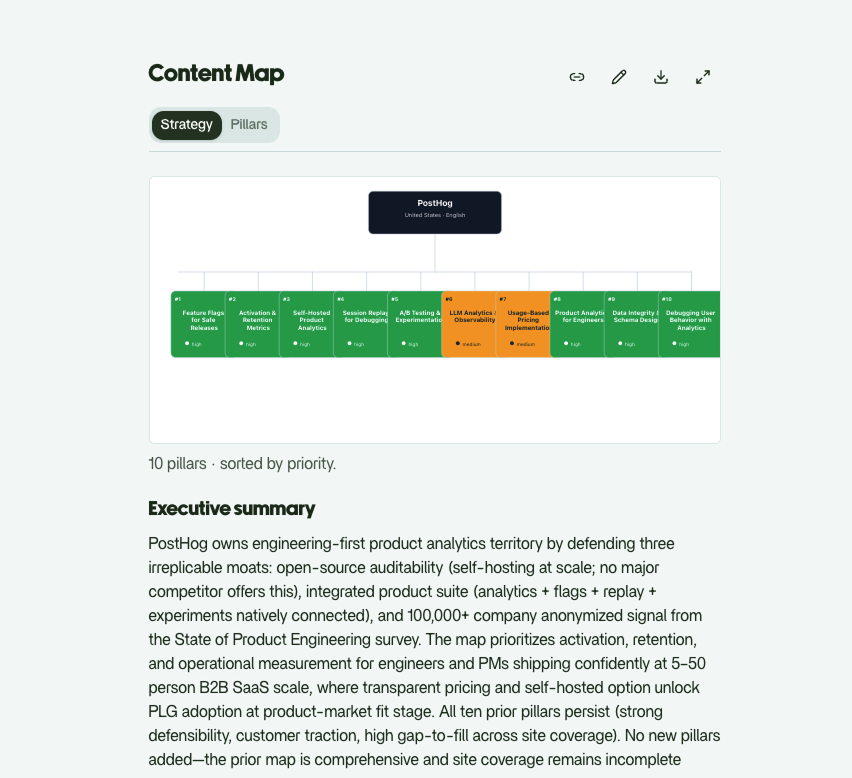
Step 2: Map the satellite articles that support the pillar. Use keyword research and topic clustering to define which articles belong inside the cluster and which do not. This is where you map your topic clusters so you are not guessing. Everything starts with the search intent and the keyword the user typed in Google or ChatGPT. Each satellite targets a specific intent that ladders up to the pillar theme. If you want a structure to copy, build a pillar template first, then fill it.
Step 3: Decide which satellites link back to the hub. Not every page deserves a link to the pillar. Prioritize the high-intent articles that directly support the pillar theme. A buyer-intent satellite pointing to the hub is worth more than a tangential post doing the same.
Step 4: Choose placement. Contextual links inside the article body are far stronger signals than navigation or footer links. A link sitting right after you introduce a concept carries real topical weight. A link buried in the footer is structural furniture.
Step 5: Write anchor text that describes the linked page. Tell the reader and Google what they will find. Avoid exact-match keyword stuffing, and vary your anchors across the cluster. Ten identical anchors look manufactured. Ten descriptive, slightly different anchors look like a person wrote them.
Real Examples: Internal Linking Within a Content Cluster
Theory is cheap. Here is what this looks like in practice. If you want more structures to model, study these real pillar examples and notice how the links run in one consistent direction.
Take a pillar called “Content Pillar Strategy.” Its satellites might include “Keyword Clustering” and “Topical Authority.” Both satellites link back to the hub using contextual anchors inside the body, near the point where each concept gets introduced. The hub does not need to link down to every satellite in return. The upward flow is what concentrates authority on the hub and tells Google the hub is the center of gravity.
Now link sideways where it makes sense. Within the cluster, related topics like “Keyword Clustering” and “Semantic Topic Clustering” can link to each other. These sibling links reinforce the topical relationship and show Google the cluster is interconnected, not a hub with lonely spokes. Do not force them. Link siblings only when a reader would genuinely benefit.
Anchor text carries the relationship. “Learn more about topic clustering” tells the reader and Google how the two pages connect, which beats a bare “click here” every time. Vary it. One satellite can anchor on “how keyword clustering works,” another on “grouping keywords by intent.” Same destination, different phrasing, natural pattern.
Placement decides weight. A contextual link placed early, right after you introduce a concept, carries more signal than the same link dropped in a footer. So put your most important hub link high in the body, where the topic is fresh and the reader is most likely to follow it. Footer links still have a job. They just are not where your topical authority gets built.
One more thing on why this matters in 2026. If you do not have a strong opinion, your content is going to be replaced by AI, and the same is true of your cluster. A pile of generic explainers linked together is still a pile of generic explainers. The linking architecture amplifies authority. It does not manufacture it. Build the cluster on content and a strong opinion worth citing, then wire it to signal to Google and to LLMs that you are an expert.
FAQ
What is internal linking with an example?
Internal links connect pages on the same website. Example: a pillar page on “Content Pillar Strategy” gets links from satellite articles like “Keyword Clustering” and “Topical Authority,” each pointing back to the hub. That pattern signals comprehensive topic coverage to Google.
How does internal linking signal topical authority?
A cohesive cluster of linked content tells Google you own a topic end to end. When satellites consistently point to one hub, the linking pattern proves both the breadth and the depth of your coverage, which a few scattered pages can never do.
What is the difference between contextual and structural internal links?
Structural links are site navigation: menus, footers, sidebars. Contextual links sit inside the article body, next to relevant content. Contextual links carry stronger topical weight inside a cluster because they show Google a real relationship between the two pages.
How do you choose which pages to link in a content strategy?
Link your satellites back to the pillar hub first. Then add sibling links between closely related satellites where a reader benefits. Prioritize links that strengthen the cluster’s topical relevance, and skip the ones that only share a passing keyword.