How to Do Keyword Clustering: A Strategic Approach
By Ben, Founder
Keyword clustering groups search queries around shared intent and topical authority. Start by listing keywords related to your niche, identify their search intent, then group them into clusters where a single page can address multiple keywords. The key is clustering around what your brand can uniquely own. This builds topical authority faster than treating each keyword separately.
You write articles. They don’t rank. The reason is almost always the same: the keyword research never happened first. And when you finally pull a keyword list, it runs hundreds of rows deep and you have no idea which ones deserve a page. This guide fixes that. It shows you how to group keywords into clusters that build topical authority, so you write fewer articles and rank for more.
What Is Keyword Clustering (and Why Topical Authority Matters)
Keyword clustering is grouping searches that share the same intent and topic into one set. A cluster becomes one page. That’s the simple definition. The strategic part is what you cluster around.
Most tools cluster by semantic similarity, or by how much the search results overlap. That’s a starting point, not a strategy. (If you want to compare approaches, see semantic clustering examples.) Matching words that look alike is not the goal. The goal is topical authority. You want to signal to Google and to LLMs that you are an expert on a specific niche.
Here is the rule that changes everything. Cluster by topical authority and brand positioning, not just semantic similarity, to prevent wasted content.
Each cluster maps to a subtopic inside a content pillar. One cluster, one focused article, one slot in your pillar hub. Clustering is not keyword stuffing. You are not cramming forty keywords onto a page. You are grouping searches that honestly belong to the same topic.
How to Build Your Keyword Clusters in 5 Steps
Start with your brand. Before you touch a keyword list, know what your brand believes and what it can credibly own. Then run these five steps.
- Build a comprehensive keyword list. Pull every keyword relevant to your niche or business area. Wide first, narrow later.
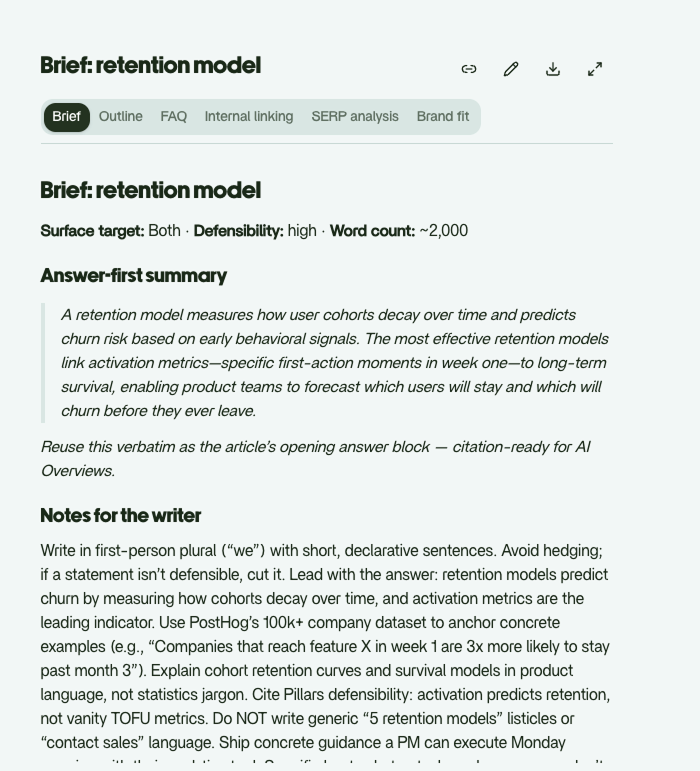
- Analyze search intent for each keyword. Everything starts by the search intent. Sort each one: definition, how-to, tool, comparison, or buying signal. Andy reads live SERP data fetched in real-time for every keyword to confirm what Google already rewards for that query.
- Group keywords with identical intent together. Keep different intents in separate piles. Two keywords can look alike and want completely different pages.
- Name each cluster’s core topic. Then check that one page can answer every keyword inside it. If it can’t, the cluster is two clusters.
- Validate each cluster against your content pillar strategy. A cluster that fits no pillar is an orphan. Drop it or reshape it.
This methodology synthesizes Backlinko’s pillar-page approach with Reforge’s topical authority framework. Want to go deeper? Read these deeper clustering strategy techniques, or grab a clustering template you can use today.
Why Clustering Prevents Content Waste and Cannibalization
Keyword cannibalization happens when two of your pages chase the same search. Google can’t decide which to rank, so both lose. Clustering kills this at the source. Related searches land on one page, not five competing ones.
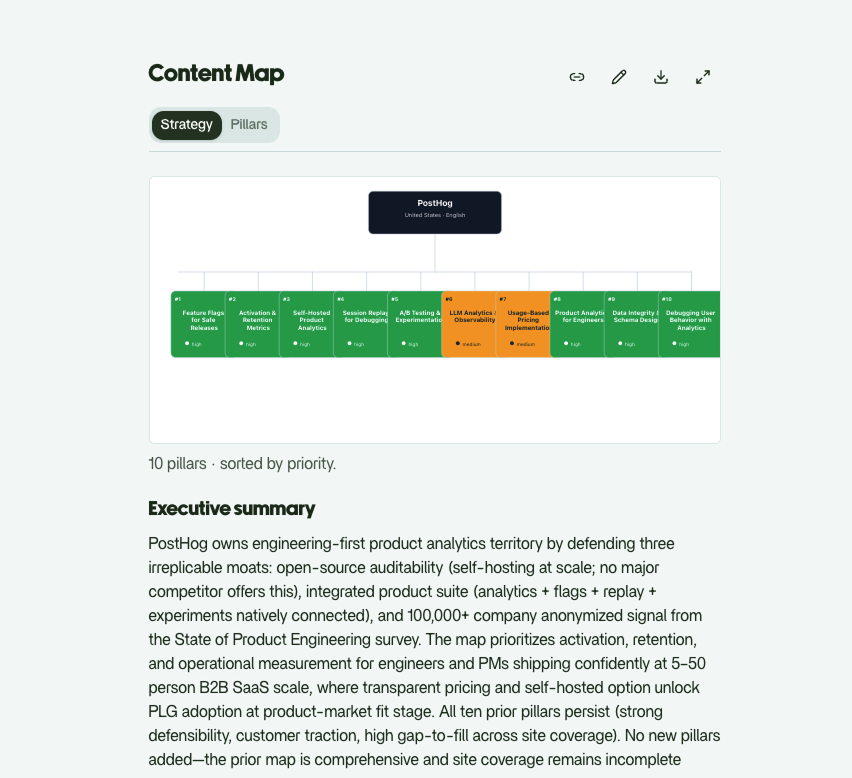
There is a ranking upside too. A single cohesive page covering a tight topic ranks faster than scattered posts targeting overlapping terms. Google reads the focus as authority. So do the LLMs. This is the hub-and-spoke structure your clusters serve: each clustered article is a spoke pointing back to the pillar hub.
The efficiency math is the real win. Fewer pages, more search captured. You write one strong article instead of six thin ones, and that article holds a stronger position for its primary keyword. Each cluster then becomes a subtopic article inside your pillar. Less to write. Less to maintain. Stronger rankings per page. That is the whole point of thinking in clusters and content pillars.
Mistakes Brands Make When Clustering Keywords
Over-clustering is the most common one. Twenty keywords with five different intents jammed into one cluster dilutes the page until it ranks for nothing. Tighter clusters win.
Ignoring intent is the next trap. “Keyword clustering tool” and “what is keyword clustering” share words, but one wants software and one wants a definition. Cluster by intent, not by how similar the strings look.
Then there is volume-first clustering. Founders pick clusters by search volume and skip the question that matters: does this fit my brand and my pillar? You cannot change what people are typing. You can only decide which searches your brand deserves to own.
The quiet killer is clustering in isolation. Build clusters without tying them to a pillar and you throw away the topical authority signal entirely. Keyword research without brand context produces one article, not a strategy. Andy starts from brand interview data pulled from your live website crawl and onboarding, so every cluster connects to what you actually stand for. Last mistake: skipping validation. If a cluster can’t collapse into one coherent page, it isn’t a cluster yet.
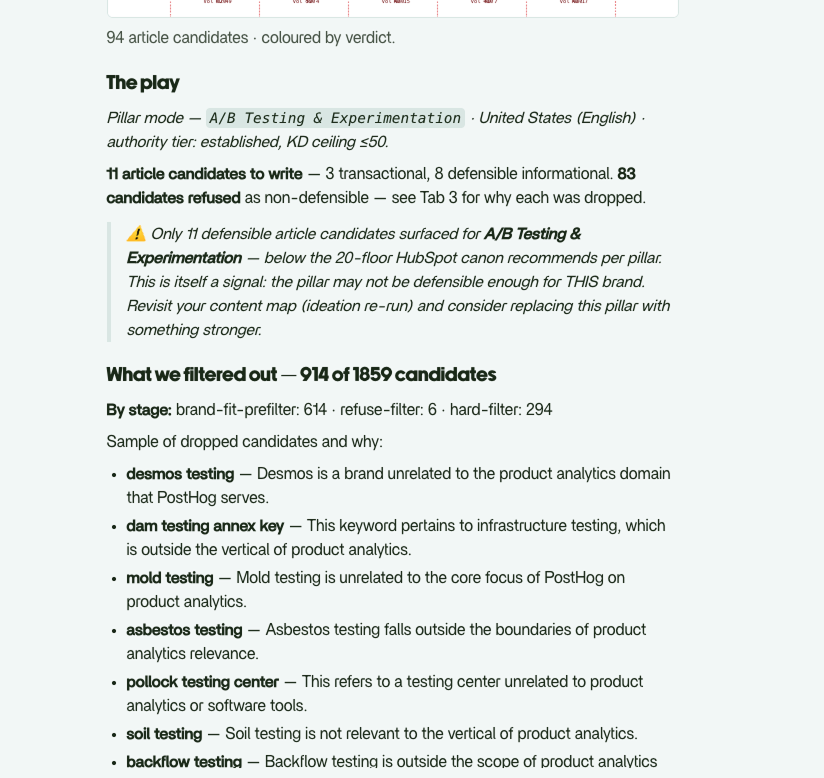
Done right, clustering hands you a list of articles that you want to write and a list of articles that you do not want to write. Clustering is the foundation of a real content pillar strategy, not a side task. Map your clusters to pillars first, then write. If you want a head start, use a pillar strategy template and slot each validated cluster into its hub.
FAQ
How do you actually do a keyword cluster?
Map the intent behind each keyword, group the ones that share the same search meaning, then assign one page per group. If a single page can satisfy every keyword in the group, you have a real cluster.
What are the main types of keyword clustering?
Three: semantic similarity, search intent, and topical authority. Most brands should cluster by topical authority, because that is what signals expertise to Google and to LLMs.
What’s the difference between keyword clustering and keyword mapping?
Clustering organizes keywords into related groups. Mapping assigns those groups to specific pages on your site. You cluster first, then map.
How many keywords should be in each cluster?
Quality beats quantity. Three to fifteen keywords is a healthy range, but the number depends on the depth of the topic, not the length of the page. If keywords pull the page in different directions, split the cluster.
Can I use ChatGPT or AI tools for keyword clustering?
ChatGPT handles the first grouping pass well. It still needs human judgment on search intent and brand fit, because a model groups by language patterns, not by what your brand can credibly own.