Keyword Gap Analysis: What It Is and Which Gaps to Actually Target
By Ben — Founder, Andy
A keyword gap is a keyword your competitors rank for that your site does not. Keyword gap analysis surfaces these missing terms by comparing your domain against competitors. The strategic mistake most brands make: treating every gap as an opportunity. Gaps are only worth targeting when they fit inside a content pillar your brand can defend with genuine expertise. Without that filter, gap analysis produces a list of things to write, not a reason to write them.
You ran a tool. It handed you 400 keywords your competitors rank for and you don’t. Now what? Most founders I talk to are stuck here, sitting on a list with no framework for what to publish next. This article fixes that. Gap analysis is one step inside a brand-first keyword research workflow, not the whole strategy, and the order you do things in changes everything.
What a keyword gap actually is (and what it isn’t)
A keyword gap is a specific query your competitors rank for that you don’t. A tool finds it by comparing your domain’s ranking keywords against theirs and showing you the difference. That’s the whole mechanic. Simple diagnosis.
A content gap is broader. That’s a topic your audience searches for where no page on your site says anything at all. Keyword gap works at the query level (“keyword gap tool”). Content gap works at the topic level (“competitor research for SEO”). Same diagnosis, different zoom level.
Here is where the tool vendors lose you. They show you a gap and call it an opportunity. A gap is not an opportunity. A gap is a signal to investigate. Your competitor ranking for something tells you they decided to write about it. It does not tell you they were right to, and it definitely does not tell you that you should. The number on the screen is data. What that data means for your brand is a separate question, and the tool won’t answer it.
The standard keyword gap analysis process
Every gap tool runs roughly the same three steps. Worth knowing them before I explain what they leave out.
- Pick 3 to 5 true competitors. Not the industry giant with a domain authority of 90 and a ten-year head start. Your actual SERP rivals, sitting at roughly your domain authority, fighting for the same results you can realistically win.
- Run their domains through the gap tool. It returns every keyword they rank for that you don’t. This is the raw list, and it will be long.
- Filter by volume and difficulty. Cut anything above your authority ceiling and anything with no search demand. Now the list is shorter and looks workable.
This is the part people mistake for the finish line. It isn’t. Step 3 surfaces candidates, not decisions. You have a cleaner list of things your competitors write about. You still have no reason attached to any of them. The decision layer comes next, and it’s the part almost every gap analysis skips.
The filter most gap analyses skip: brand fit and pillar alignment
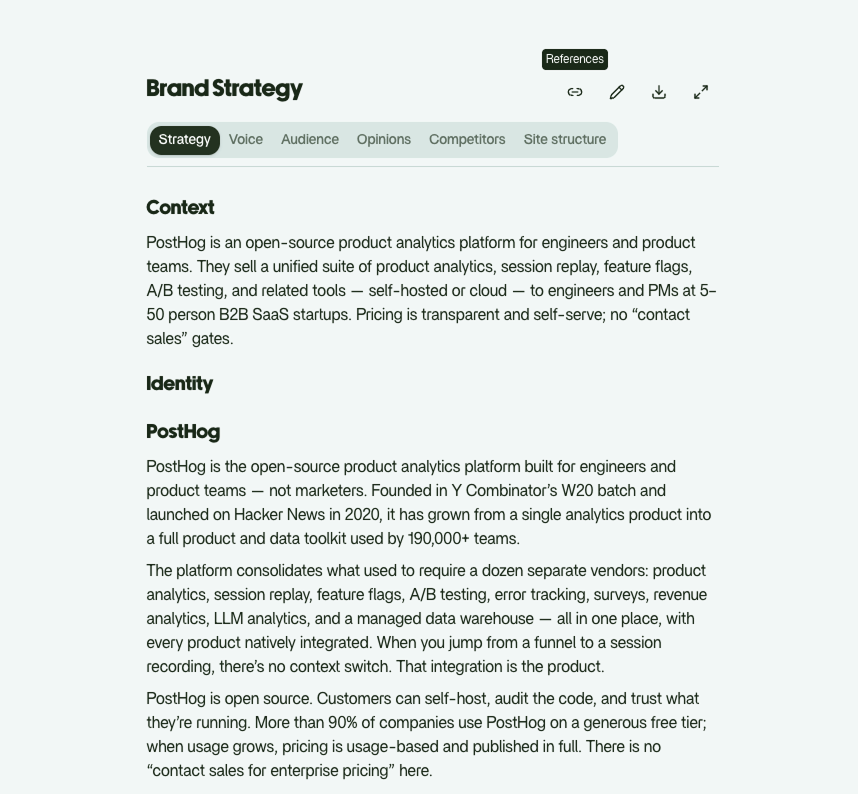
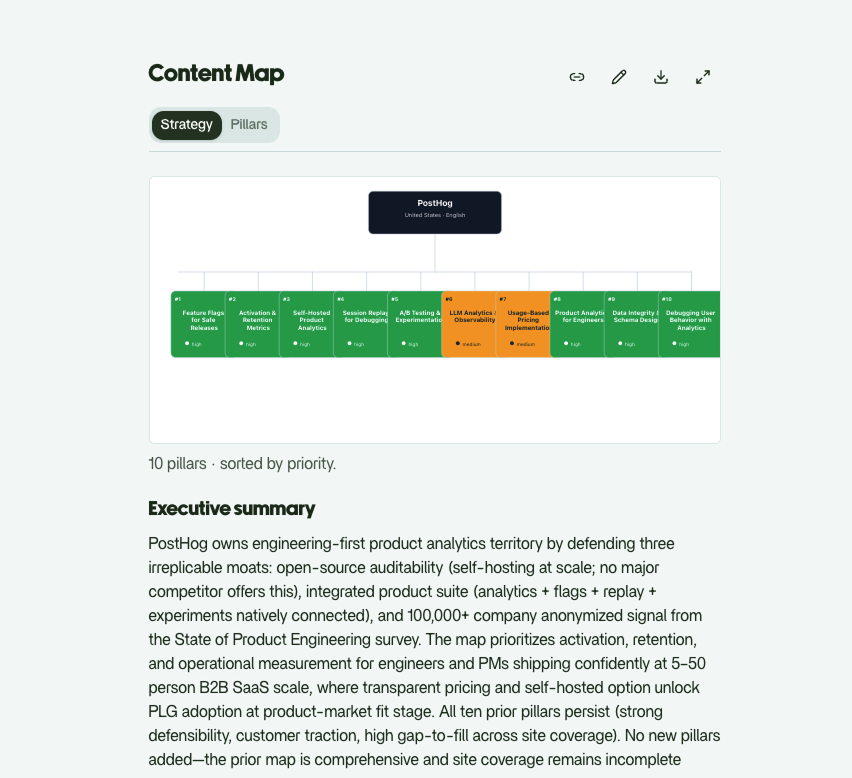
Here is the inversion. Standard gap analysis treats competitor keywords as a discovery engine: find what they have, go get it. Andy’s brand-first framework runs the other way. You start with your content pillar, then use gaps to confirm where your coverage has holes. Gap analysis validates your pillar strategy. It does not generate it.
The line I keep coming back to: a keyword gap without a content pillar to validate against is just a list of things your competitors write about. A gap keyword that falls outside your pillar is a distraction, no matter how good the volume looks. This isn’t a hunch. The methodology behind it synthesizes Backlinko’s canonical 7-step SEO program with Reforge’s 2026 strategic framework, the two most rigorous public frameworks on how SEO works now, plus my own years running SEO across client accounts and several of my own businesses.
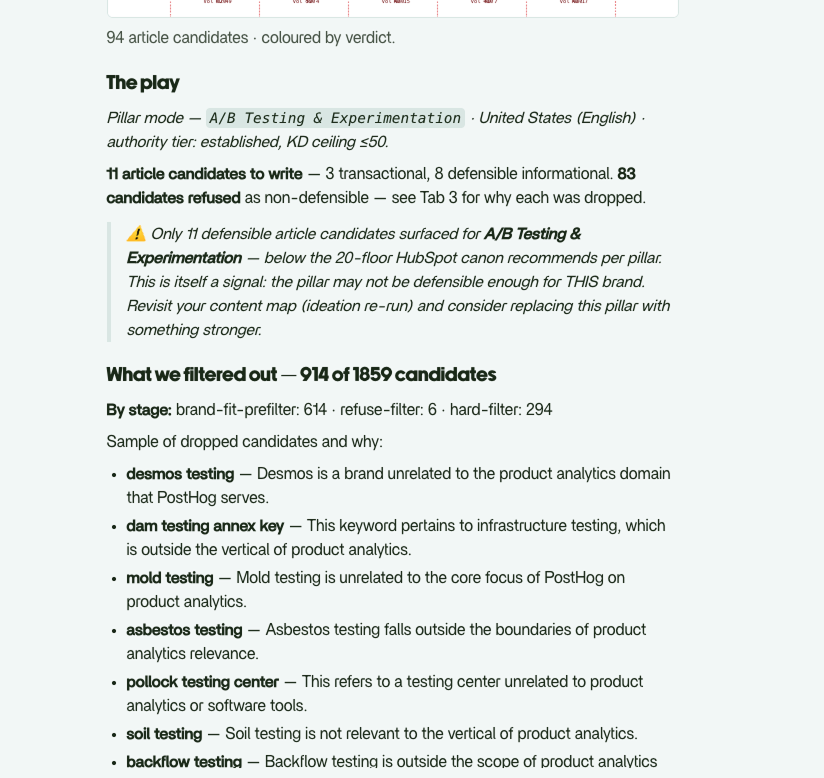
So before any gap earns a brief, it passes three disqualifiers:
- Intent mismatch. The keyword’s search intent doesn’t match what your page can offer. Someone typing it wants a thing you don’t sell or don’t have.
- Outside your E-E-A-T zone. You have no real experience, data, or opinion on the topic. You’d be guessing, and so would your reader.
- AI Overview owns it at scale. It’s a generic “what is X” query that AI Overviews already answer in full. You’d be writing content that gets absorbed and never clicked.
A concrete example. Say you sell project management software and the gap tool surfaces “best free Gantt chart template,” 18,000 searches a month, medium difficulty. The numbers scream go. Skip it. The intent is for a downloadable template, not your product, the SERP is owned by template farms with thousands of free downloads, and you have no defensible angle. You’d spend a brief to rank third on a page that converts no one. Volume is not fit.
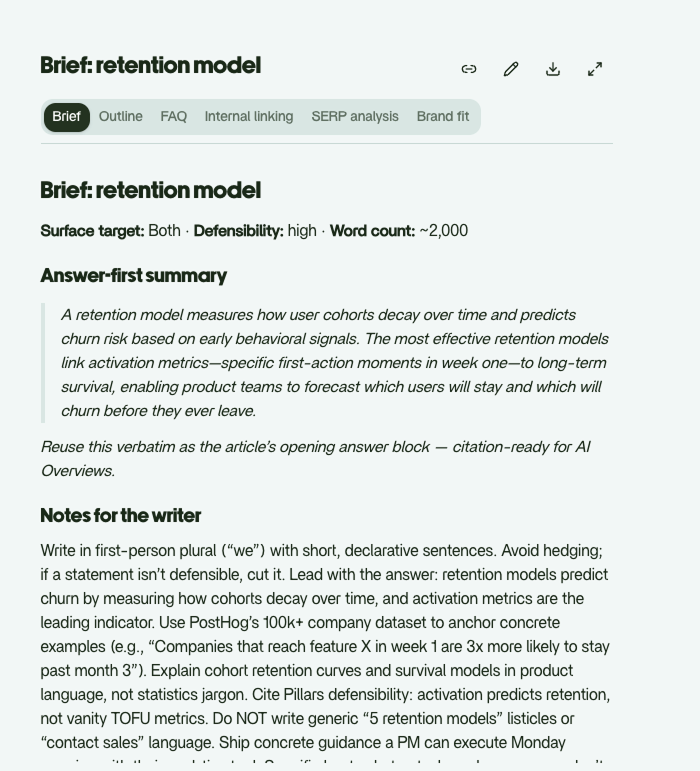
The reason Andy can apply this filter automatically is the inputs it starts from: live SERP data fetched in real time for every keyword (volume, difficulty, search intent) and brand interview data pulled from your website crawl and onboarding. It knows your brand position and the SERP reality at the same time, which is exactly what the filter needs.
How to decide which gaps to act on
Once a gap survives the disqualifiers, you rank what’s left. Three checks, in order.
First, does the gap fall inside an existing content pillar cluster where you already have coverage? Without a pillar, gap results feel arbitrary, because they are. The pillar is the frame of reference that turns a random keyword into a coverage hole worth filling. No pillar, no filter, no signal.
Second, does your brand have something competitors’ content lacks? A specific opinion, a data point, a first-hand experience. This is the part that matters most in 2026. If you do not have a strong opinion, your content is going to be replaced by AI, because AI can easily generate the generic version. Your content and your strong opinion are the moat. Original data and first-party experience are the only informational content worth investing in.
Third, is this a long-tail variant of a keyword you already rank for, or entirely new territory? Variants inside a cluster you already own are easy wins. New territory needs a bigger commitment and a real reason.
The output is a shortlist: gaps that are also cluster coverage holes. Those are the only ones worth briefing. For the deeper version of this scoring, see how to evaluate strategic fit for a keyword.
When gap analysis goes wrong
Three mistakes, over and over.
Running gap analysis before defining pillars. This is the big one. Gaps without a pillar filter are noise. You get a list, you feel productive, you publish a scattered pile of articles that signal topical authority on nothing. Start with your brand, build your pillars, then run gaps against them.
Targeting high-volume gaps regardless of difficulty. The overwhelmed default. A tool surfaces 400 gaps and you reach for the biggest numbers. High volume above your authority ceiling is a keyword you will not rank for. You burn briefs chasing traffic you can’t win.
Treating a competitor’s keyword list as your content calendar. Your competitors are not a strategy committee. They target bad keywords too. Intent mismatch is the disqualifier that catches most of this, and it’s worth understanding on its own: intent mismatch errors that make gaps worthless. Copying their list copies their mistakes.
Gap analysis is one step in a keyword research workflow, not the whole thing. It confirms coverage holes inside a strategy you already have. It does not hand you the strategy. Andy runs this with live SERP data and brand-first analysis so the filter happens automatically, but the principle holds whatever you use: pillar first, gaps second.
FAQ
How to conduct a keyword gap analysis?
Pull 3 to 5 true competitor domains into a gap tool, then filter the results by pillar fit and E-E-A-T match before anything else. Prioritize what’s left by keyword difficulty and intent alignment. The filter is the work, not the export.
What is the difference between a keyword gap and a content gap?
A keyword gap is a specific ranking term your competitors have and you don’t. A content gap is a whole topic your audience searches for that no page on your site addresses. Same diagnosis, different scope: one is query-level, one is topic-level.
Which keyword gaps should I ignore?
Skip gaps where the intent is transactional for something you don’t sell, where an AI Overview already owns the answer at scale, or where the topic sits outside your E-E-A-T. High volume doesn’t override any of these. Fit beats traffic.
Do I need a paid tool to do keyword gap analysis?
No. Free options exist, including Rank Tracker and a limited Semrush tier. Paid tools give you volume, difficulty, and intent data in one view, which saves time. Andy adds the filter layer on top, deciding which gaps actually fit your brand.
How does keyword gap analysis fit into a content strategy?
Run it after your content pillars are defined, not before. Gaps confirm where your cluster coverage has holes. They don’t replace the pillar-first decision about what your brand should be known for.