Best Keyword Clustering Strategy: Intent-First, Pillar-Anchored
By Ben, Founder. Multiple years doing SEO for clients and my own businesses. I synthesized Backlinko’s canonical 7-step SEO program and Reforge’s 2026 strategic framework into Andy’s product workflow, which is where this clustering method comes from.
The best keyword clustering strategy groups keywords by search intent first, then refines clusters by semantic similarity. Start with a topic your brand can credibly own, pull a broad keyword list, sort by what the searcher actually wants (not just word overlap), and assign each cluster to one page. This prevents cannibalization, concentrates topical authority, and gives Google and LLMs a clear signal about what your site covers.
You have a long keyword list. What you do not have is a rule for deciding which keywords share a page and which ones need their own. That gap is where cannibalization creeps in and where topical authority leaks away. This article gives you the rule, the five-step process to apply it, and the reason behind every step.
Why most clustering advice misses the strategic question
Most clustering guides treat the job as sorting. Dump keywords into a tool, group by similarity score, ship the clusters. That answers “how do I group these words” and skips the only question that matters first: which clusters are worth building at all?
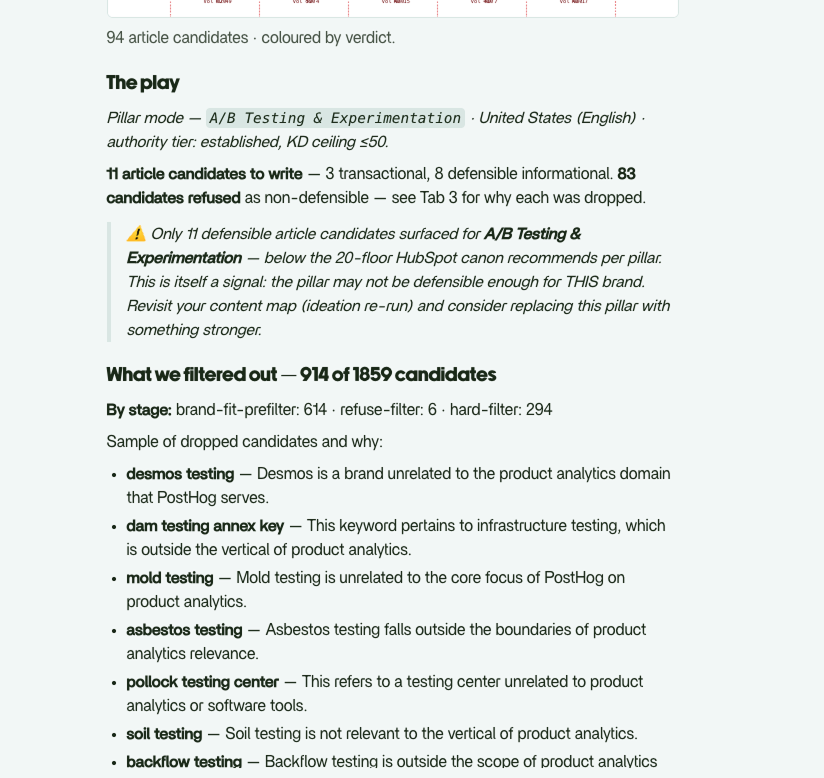
A cluster your brand cannot credibly own will not build authority, no matter how clean the grouping is. This is the defensibility filter. Before you sort a single keyword, ask whether your brand has real expertise, a strong opinion, or first-party data on the topic. If the honest answer is no, that cluster is a waste. In 2026, if you do not have a strong opinion, your content is going to be replaced by AI, because AI can easily generate the generic version.
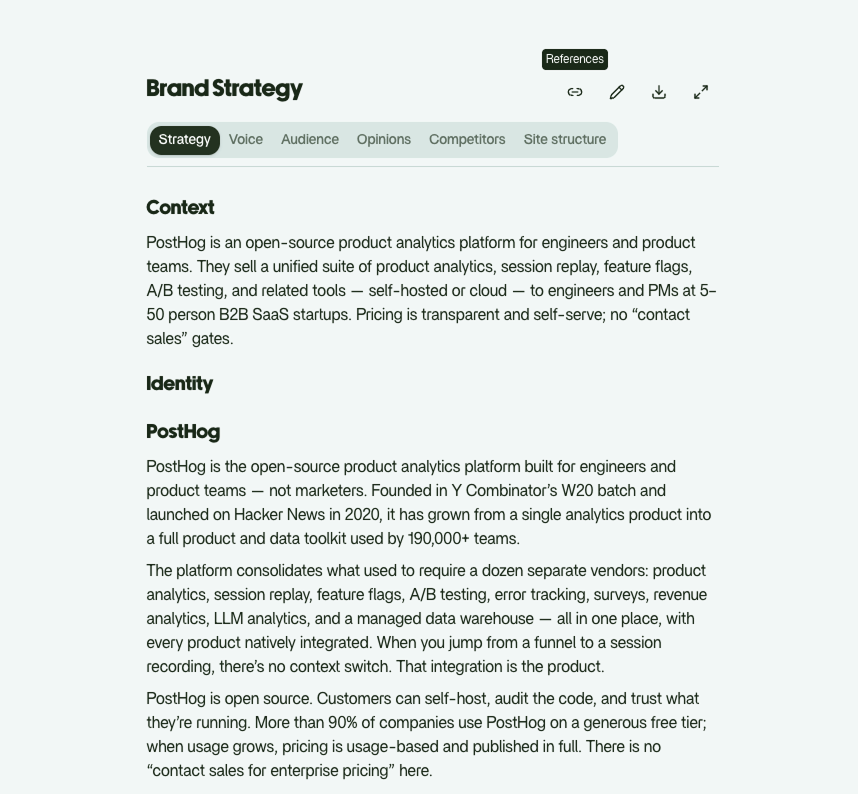
This framing comes from how I built Andy’s method: Backlinko’s pillar architecture for the structure, Reforge’s 2026 strategic frame for the brand-defensibility lens. The two most rigorous public frameworks, fused into one filter.
So clustering starts upstream. You decide which topics your brand should own, then you cluster inside those. That upstream call is its own decision, covered in picking the right pillar topics before you cluster. Get it wrong and even perfect clusters point at the wrong target.
Intent-based vs. semantic clustering: which method to use first
There are two ways to group keywords, and the order you apply them changes the result.
Intent-based clustering groups by what the searcher wants to do: learn something, buy something, compare options, or find a specific page. This is your primary method. Everything starts by the search intent and by the keyword the user typed in Google or ChatGPT. You cannot change what people are typing. You can only build the right page for it.
Semantic clustering groups by meaning and word co-occurrence. Two keywords land together because they share vocabulary or show up in similar contexts. Useful, but as a second pass, not the foundation.
Here is the ruling. Start with intent. Run semantic clustering afterward as a refinement, to catch related variations you would otherwise miss. Clustering by search intent, not word similarity, cuts cannibalization risk and concentrates topical authority on fewer, stronger pages.
A concrete example. “Best keyword clustering strategy” and “keyword clustering examples” both serve someone learning the topic. Same informational intent, same page. But “keyword clustering tool” signals commercial intent. That searcher wants to evaluate software, not read theory. It needs its own page, even though the words overlap heavily. Pure semantic grouping would wrongly merge all three. Intent splits them correctly. For more on the second-pass refinement, see real semantic clustering examples.
How to build your keyword clusters: the five-step process
Five steps. Run them in order. Each one earns its place.
Step 1: Pull a broad keyword list around a topic your brand can credibly own. Start wide. Seed keywords, autocomplete, related searches, competitor terms. Do not pre-filter yet. The only filter at this stage is the defensibility filter from the first section: stay inside topics where your brand has a real opinion or real data.
Step 2: Group by dominant intent. Sort every keyword into informational, commercial, transactional, or navigational. Each intent group is one cluster candidate. A keyword that asks “how to” is not the same job as one that asks “best tool for.” Keep them apart.
Step 3: SERP-check each group’s primary keyword. Search the main keyword and read the top 10. If the results are all guides, the intent is consistent. If you see a mix of guides, product pages, and category listings competing, that is a split cluster wearing one name. Break it in two. This is where live SERP data does the work no assumption can: real volume, real difficulty, real intent for the keyword as it ranks today.
Step 4: Size check. Five to twenty keywords per cluster is the practical range. Fewer than five often signals a marginal topic that may not deserve its own page. More than twenty usually means you have two subtopics fighting inside one cluster, so split it. Intent consistency matters more than the count, but the range keeps you honest.
Step 5: Assign one target URL per cluster. One cluster, one page. This is the step that prevents keyword cannibalization. The moment two pages chase the same intent, they compete with each other, and Google has to guess which one to rank. Stop guessing for it.
For the granular execution detail behind each of these steps, here is the full tactical breakdown of keyword clustering.
Mapping clusters to your pillar architecture
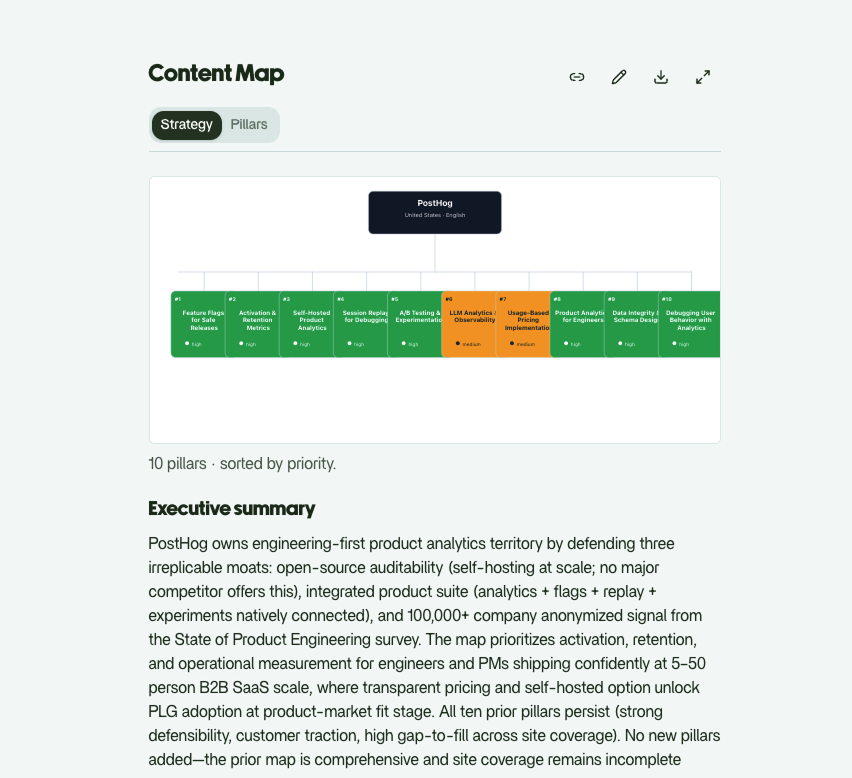
Clusters are not a flat list. They snap into a structure. Each cluster becomes one article inside a content pillar. The pillar page links out to every cluster article, and each article links back to the hub. This is the hub-and-spoke shape that turns scattered posts into a system. The mechanics are covered in your pillar page architecture.
The division of labor is simple. The pillar page targets the broad head term and stays wide. The cluster articles go deep, one subtopic each. The pillar tells Google and LLMs what the whole site covers; the clusters prove the depth underneath that claim.
The internal linking is the part most people skip, and it is the part that does the heavy lifting. Links between the hub and its clusters are what convert a pile of individual articles into a topical authority signal. Think in clusters and content pillars. That is how you signal to Google and to LLMs that you are an expert.
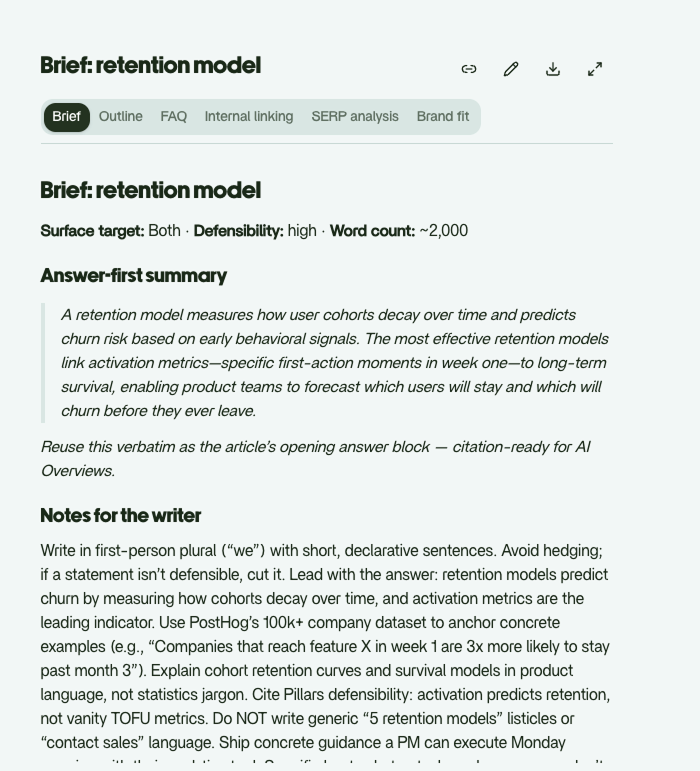
This is exactly what Andy automates. Every cluster surfaced during keyword research is assigned to a pillar before any content brief is written. The mapping is not an afterthought you bolt on later. It is the structure the briefs are built from, so brand strategy, pillars, clusters, and articles all connect by design.
FAQ
What is the difference between intent-based and semantic keyword clustering?
Intent clustering groups keywords by what the searcher wants to accomplish. Semantic clustering groups them by word similarity and shared meaning. For deciding which keywords share a page, intent wins, because two keywords with similar words can still want completely different pages.
How many keywords should be in a cluster?
Five to twenty is the practical range. Below five, the topic may be too thin to justify its own page. Above twenty, you probably have two subtopics that should split. Intent consistency matters more than hitting any specific number.
Can you do keyword clustering without a paid tool?
Yes. Search each keyword, read the top 10 results, and group keywords whose SERPs look the same. Manual SERP comparison catches intent overlap reliably. It is slower than software, but accurate enough for a small list and it teaches you what the intent actually is.
How does keyword clustering connect to pillar pages?
Each cluster maps to one article, and the pillar page links all those articles into a single hub. The pillar covers the broad term; the clusters cover the depth. Together they form the topical authority structure search engines and LLMs reward.
Does keyword clustering prevent keyword cannibalization?
Yes, when you follow the one-cluster-one-page rule. Cannibalization happens when two pages target the same query and compete with each other. Assigning a single URL to each cluster removes that competition before it starts.
Clustering is a brand decision before it is a sorting task. Decide what you can own, group by intent, refine by meaning, and give each cluster one page. That is the strategy. If you want the clustering-to-brief pipeline to run end to end, with each cluster mapped to a pillar and turned into a brief automatically, that is Andy’s end-to-end SEO workflow.