How to Conduct Competitive Content Analysis (and Assess Defensibility)
Ben — Founder. Years of hands-on SEO experience for clients and my own businesses. I synthesized Reforge’s 4-bucket defensibility framework into Andy’s content brief methodology.
Competitive content analysis is the systematic review of top-ranking content for your target keywords to identify gaps and defensibility opportunities. The goal is to determine which keywords you can realistically rank for and which are already dominated by aggregators, established sites, or AI Overviews. This analysis becomes the foundation for your content brief. It answers the question every writer should ask before starting: is this keyword worth defending, or should we target something else?
If you run SEO for multiple clients, you already know the bottleneck. Doing this analysis by hand for every keyword eats your week, and the findings rarely make it into the brief in a way a writer can act on. This article fixes both. I’ll walk through how I audit competitors, how I score each keyword with a four-bucket defensibility framework, and how I turn that into brief instructions a writer can follow without guessing.
Why Competitive Content Analysis Is the Foundation of Your Brief
A brief written without looking at the SERP is a guess. You’re telling a writer to produce 1,800 words on a keyword without knowing what already ranks, why it ranks, or whether your client has any shot at beating it. That’s how briefs set writers up to fail.
Competitive analysis answers two things at once. It shows you what’s winning the keyword right now. And it tells you why those pages win: depth, original data, author credibility, backlinks, or freshness. Once you see the why, you can decide whether your client can match it or whether you’re walking into a fight you can’t win.
Here’s the part most teams skip. Competitive analysis without defensibility assessment produces briefs that fail: writers targeting keywords already owned by AI Overviews, aggregators, or dominant incumbents. The audit alone is not the deliverable. The decision is. You need to come out the other side with why this keyword is good or why this keyword is not good, written down, before a single word gets drafted.
That decision is what makes the brief strategic instead of a content order form. See how the analysis feeds the rest of the document in our content brief framework.
How to Audit Your Top Competitors’ Content
Start with the SERP. For each target keyword, pull the top 5 to 10 ranking pages. Those are your real competitors for that query, not the brands your client thinks of as rivals in the market. The SERP decides who you’re up against.
Then audit each page on the same dimensions, every time:
- Structure and format: H1, the H2 outline, word count, and whether it’s a listicle, how-to, or explainer.
- Depth and angle: what they cover well, and the obvious gaps. Missing subtopics, thin explanations, outdated stats, no original data.
- Authority signals: named author, credentials, first-party experience, citations.
- Technical and off-page: domain authority, backlink profile, estimated traffic, and freshness (last updated date).
Record competitor strengths and gaps side by side. A page can be comprehensive and still leave a clear opening, like covering the what and the how but never the decision criteria. That gap is your angle.
You also want to understand what each competitor is actually targeting. Two pages ranking for the same query can serve different intents, and that changes your play entirely. So break down search intent for each competitor’s target keywords before you decide how to position your own piece. Everything starts by the search intent, and you cannot change what people are typing. You only adapt your content around it.
Doing this from scratch each time doesn’t scale across clients. Standardize it with our competitive content analysis template so every audit captures the same fields.
Assess Defensibility Using the 4-Bucket Framework
This is the step that turns auditing into strategy. I score every keyword against Reforge’s 4-bucket taxonomy. The bucket decides whether the keyword goes in the brief or gets cut.
Defensible-informational. The ranking pages have real gaps, and your client has unique data or a genuine point of view to fill them. This is where original data and first-party experience win. If you do not have a strong opinion, your content is going to be replaced by AI, so this bucket only pays off when your brand brings something the SERP doesn’t already have. Target it.
Defensible-transactional. Competitors chase the buying intent but lack the full solution, the proof, or the user trust to close it. Comparison pages, alternatives, use-case queries. Your client can own these by being more complete and more credible. Target it.
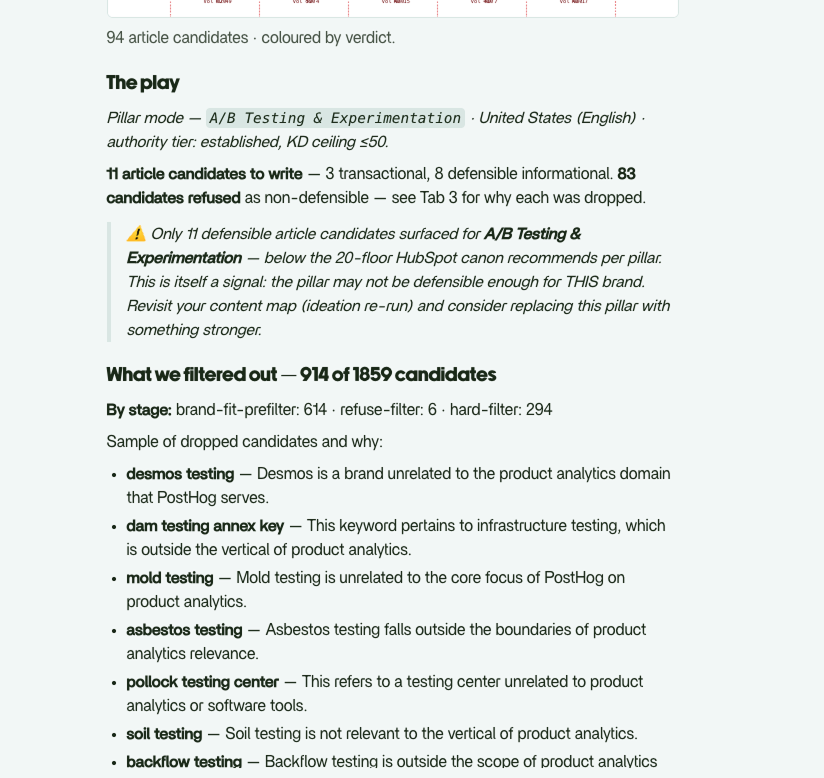
Non-defensible commodity. Aggregators, Wikipedia, or AI Overviews already own the result. Think raw “what is X” definitions. Your content will never rank here, and the click is gone before it reaches a website anyway. Skip this keyword.
Non-defensible high-authority. An entrenched incumbent holds the query with a brand moat, massive domain authority, and intent that’s locked to their name. You can write the best page on the internet and still lose. Not worth the writer effort. Skip it.
The output of this step is a flag on every keyword: defend or skip. That flag is the whole point. It’s how you produce a list of articles that you want to write and a list of articles that you do not want to write, instead of a keyword dump with no judgment attached. Don’t soften the call. A “maybe” keyword wastes a writer’s day.
Turn Analysis Into Brief Instructions
A defensibility score sitting in a spreadsheet helps nobody. The writer needs instructions. So translate every finding into something concrete they can execute.
Convert gaps into claims. Instead of “make it comprehensive,” write the specific move: “Your competitor covers X but misses Y. Our angle: [specific claim or data].” That single line does more for a writer than a 500-word strategy memo, because it tells them exactly where to win.
Let defensibility set the scope of the whole brief. Only defensible-informational and defensible-transactional keywords get briefs. The other two buckets don’t get written, and the brief should say why, so the writer understands the reasoning instead of wondering why a high-volume keyword got dropped.
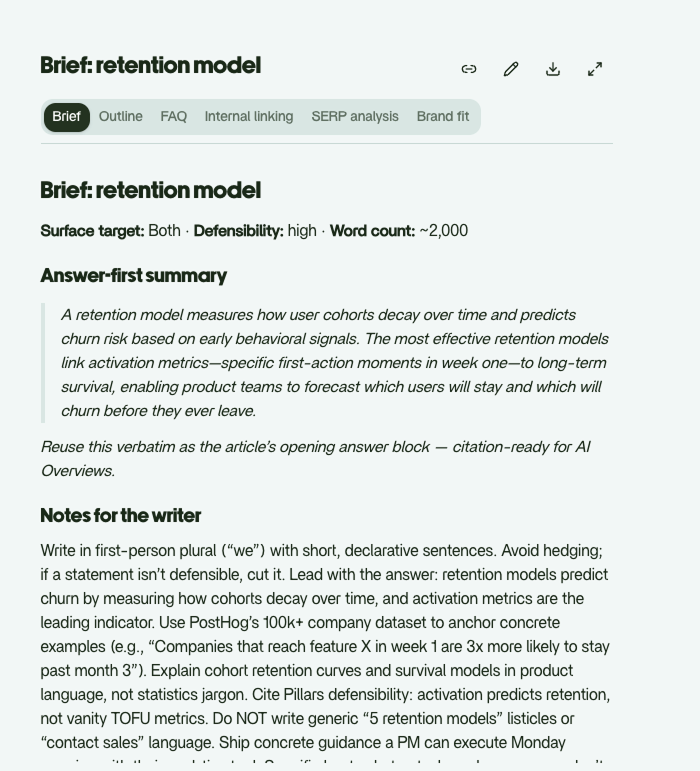
Push competitive findings into the brief’s FAQ section too. Note which questions competitors answer well and which they ignore. The unanswered questions are free wins, and clustering your content around them helps signal to Google and to LLMs that you are an expert on the topic.
Finally, use the audit to justify internal linking. Decide which existing client pages support the new article and where it links back to the pillar. That’s how a single article becomes part of a cluster instead of an orphan. If you want to see finished briefs built this way, look at these strategy brief examples.
Frequently Asked Questions
What are the 5 steps of competitive content analysis?
Identify your SERP competitors for the keyword. Audit their content for structure, depth, and gaps. Extract the SEO factors that explain why they rank. Assess defensibility with the four-bucket framework. Then brief your writers with specific, data-backed instructions. The fourth step is the one most teams skip, and it’s the one that decides whether the brief is worth writing.
What types of competitors should I analyze for SEO?
Three kinds: SERP competitors (whoever ranks in the top 10 for your exact keyword), topical competitors (sites that own the broader subject), and brand competitors (your client’s market rivals). Prioritize the SERP competitors. They’re the ones standing between your client and the ranking, regardless of who the client considers a rival.
What does a competitive content analysis look like in practice?
You pull the top 5 to 10 ranking pages for a keyword and audit each on the same fields: structure, word count, format, author authority, and backlink profile. You note where each page is strong and where it leaves gaps. Then you score the keyword’s defensibility and decide whether it earns a brief. Concrete in, concrete out.
Can I use a template to speed up competitive analysis?
Yes, and you should if you’re handling more than one client. Build a template with columns for URL, title, word count, format, key claims, defensibility score, and gaps. A fixed template keeps the audit consistent across keywords and clients, which is the only way this work scales without scaling your hours.