Search Intent Breakdown: How to Categorize Keywords for Content Briefs
By Ben — Founder
Search intent breakdown categorizes keywords by user goal: transactional (buy now), navigational (find a place), commercial (research), or informational (learn). Andy’s approach ties intent to keyword defensibility. Transactional keywords are defensible. Many informational keywords are commodity plays not worth writing. Importantly, AI-era search intent diverges from Google SERP intent, requiring agencies to track both separately when planning content strategy.
If you run briefs across five or ten clients, you already know the trap: a clean keyword list with volume and difficulty, zero strategic logic about which keywords actually earn an article. Intent breakdown fixes that. Done right, it tells you whether a keyword is worth defending or a commodity play to skip, and it feeds straight into the SEO content brief you hand your writers. Everything starts by the search intent.
The 4 Types of Search Intent and Their Defensibility
Most intent guides stop at four labels. That is the part that helps nobody. The label only matters once you map it to defensibility, which is the synthesis underneath Andy’s method, drawn from Backlinko’s canonical 7-step SEO program and Reforge’s 2026 strategic framework.
Here is the quotable version, and it should sit at the center of every brief decision you make: search intent breakdown determines keyword defensibility. Some informational keywords are worth defending, others are pure commodity plays.
- Transactional (buy now): always defensible. The competitor set is fixed and your brand can participate directly. Product, pricing, and signup pages live here.
- Navigational (find a place): defensible for your own branded terms. Chasing a competitor’s branded navigation is a waste. You will never own “[competitor] login.”
- Commercial (research before buying): defensible only when the brand has data, a perspective, or expertise the competition lacks. No edge, no article.
- Informational (learn): split it. Defensible-informational means you hold a real advantage. Commodity informational (“what is X” explainers) gets pruned, not written. This is where most agency content quietly dies, and where strong E-E-A-T signals separate a defensible piece from filler AI will absorb.
If you do not have a strong opinion, your content is going to be replaced by AI.
How to Analyze Search Intent for a Keyword
You cannot change what people are typing. So you read the signals they leave and build the brief around them. Four moves, fast.
Study the SERP first. The dominant content format is the loudest signal. Listicles mean users want the fastest answer. Long guides mean they want comprehensive explanation. Review roundups mean commercial comparison. The format that dominates tells your writer what structure to ship.
Read the query language. “How to” signals a process. “Best [noun]” signals commercial research. “What is” signals informational, and usually commodity. The words carry the goal.
Use your tools, then overrule them. Semrush, Ahrefs, and SE Ranking label intent automatically from SERP patterns. Treat those labels as a draft, not a verdict. Andy pulls live SERP data in real time on every keyword research run (volume, difficulty, search intent), which is the same raw input you want before you commit a writer’s hours.
Then reverse-engineer the competitors. The format winning the SERP reveals what users already expect. That expectation is your brief skeleton. You can see this play out across real strategy brief examples, where the SERP read directly shapes the outline.
AI-Era Search Intent: Why Agencies Must Track LLM Intent Separately
Here is the shift most briefs ignore. Google SERP intent and LLM citation intent diverge, sharply. Profound’s ChatGPT study found prompts skew 37.5% generative versus 32% informational on Google. Different surfaces, different goals.
Generative intent is climbing on LLM surfaces while navigational intent collapses. In the same Profound study, navigational intent fell away while transactional intent jumped 9x in ChatGPT prompts compared to the Google SERP. So the exact keyword can behave one way on Google and a completely different way inside ChatGPT.
That breaks the one-brief-per-keyword habit. The same topic may need two briefs: one tuned to rank on Google, one tuned to earn an AI Overview citation. LLM citations are the new rank, and most cited sources do not even crack Google’s top 20.
For an agency scaling across clients, this is now a tracking problem, not a footnote. Log SERP intent and LLM intent as separate signals in your research. When they agree, one brief covers it. When they diverge, you brief twice or you lose one surface entirely.
Using Intent Breakdown in Your Content Brief
This is where the analysis pays rent. Four decisions, every brief.
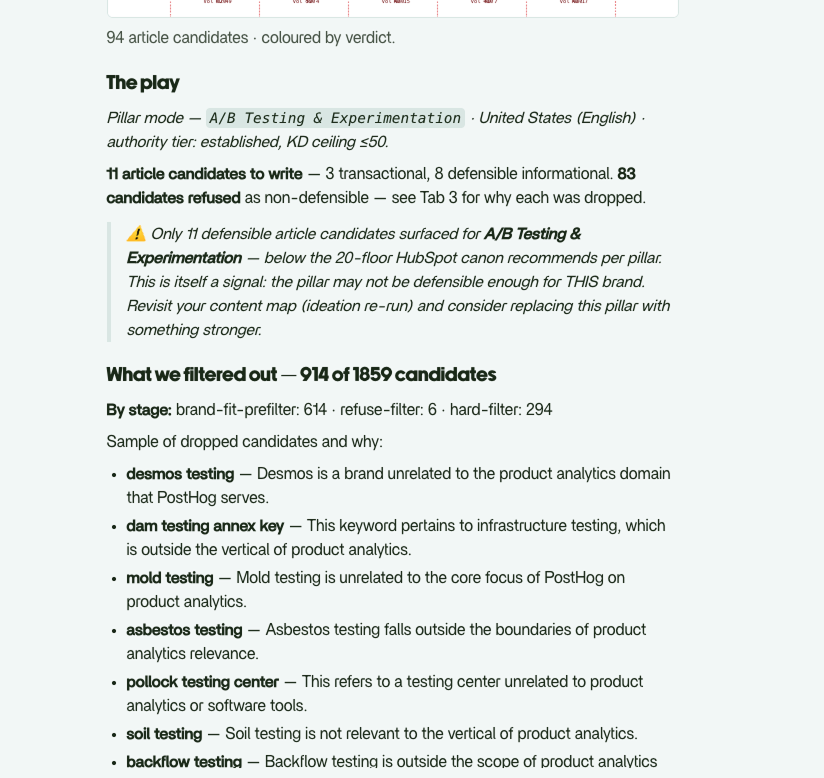
Make the defensibility call. Does the brand own this intent, or is it commodity? Intent analysis answers it on the spot. This is the difference between a list of articles that you want to write and a list of articles that you do not want to write. Commodity informational? Kill it before a writer touches it.
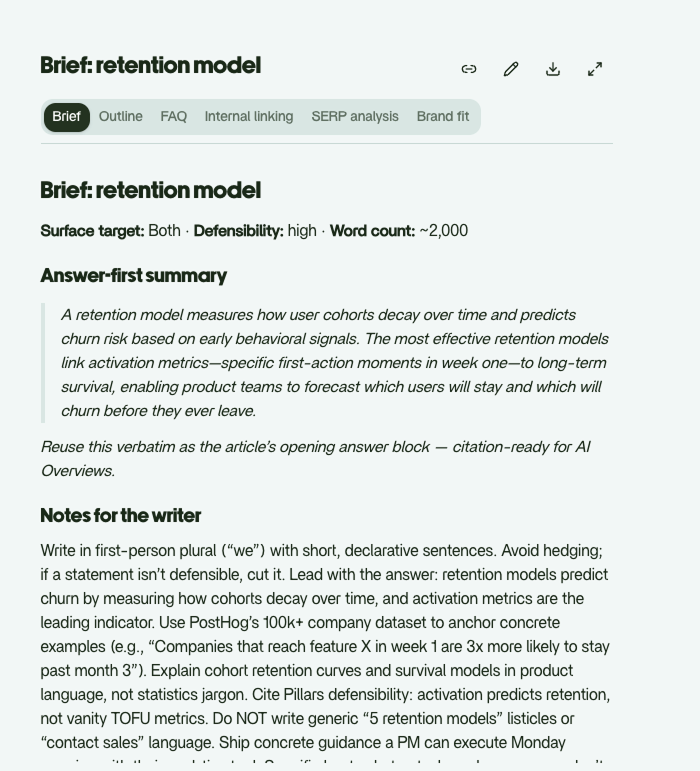
Pick the structure from the intent. Process intent gets a how-to. Commercial comparison gets a listicle. Comprehensive learning gets a guide. Don’t guess the format. Let the intent dictate it, and lock it into your content brief template.
Frame the reader’s pain from the search. The query reveals the actual problem behind the click. That framing is what your writer needs to write something real, not generic. When you hand off, this is the core of briefing writers on intent: tell them the goal behind the keyword, not just the keyword.
Plan internal links by intent. Intent reveals what the reader wants next: a related problem, a next step, a deeper dive. Map links to that path. Think in clusters and content pillars, because that is how you signal to Google and to LLMs that you are an expert.
FAQ
What are the 4 types of search intent?
Transactional (buy now), navigational (find a place), commercial (research), and informational (learn). Andy ties each to defensibility: transactional is always defensible, while commercial and informational only earn an article when the brand holds a real advantage competitors lack.
How do you determine search intent from a keyword?
Study the SERP, since the dominant content format signals the goal. Read the query language (“how to” versus “best” versus “what is”), check your keyword tool’s intent label, then reverse-engineer the competitor content that already ranks to confirm what users expect.
How does AI search intent differ from Google search intent?
They diverge. Profound’s data shows ChatGPT prompts run 37.5% generative versus 32% informational on Google, and transactional intent jumped 9x in ChatGPT while navigational intent collapsed. LLM surfaces favor generative intent, Google favors informational, so agencies must track both as separate signals.
Why does search intent matter for content briefs?
Intent decides four things: whether the keyword is defensible enough to write, which structure the brief needs (how-to, listicle, or guide), how you frame the reader’s real pain, and which internal links the reader wants next. It is the strategic foundation of every brief.