The Content Brief Template That Includes Strategy (Not Just Structure)
Ben, Founder. Built Andy’s content brief framework by synthesizing Backlinko’s 7-step SEO program with Reforge’s 2026 strategic framework, refined across dozens of real client projects.
A content brief is a strategic document that guides writers on what to include (and exclude) in a piece of content. It typically covers the primary keyword, target audience, key points, outline structure, and SEO requirements. The best briefs also answer strategic questions before the writer starts: Is this keyword defensible (can we win it) or do competitors already own it? What’s the search intent? Which E-E-A-T signals matter here? These layers separate briefs that save time from ones that direct writers toward wasted effort.
You manage several client accounts. You need to ship briefs fast, but every brief still has to be strategically sound, or your writers produce content that reads fine and ranks nowhere. The gap between those two outcomes is not structure. It’s the strategic layer most templates skip. This guide shows you the template I use, the three layers that make it work, and how to adapt it per client without rebuilding it each time.
What a Content Brief Actually Does
A brief is the bridge between keyword research and the writer’s blank page. The research told you a keyword is worth something. The brief tells the writer what to do about it. Without that bridge, you hand a writer a keyword and a word count, and you get back generic content that could have come from anyone. For the full mechanics, here’s my comprehensive guide to content briefs.
The job of a good brief is to answer the strategic questions before the writer types a word. Can we win this keyword? What is the person actually searching for? What proof do we need to show to be believed? Answer those up front and the writer spends their time writing, not guessing.
This is also where commodity content dies. A writer working from a thin template defaults to the safe, undifferentiated version of the topic. A brief that names the angle, the opinion, and the proof points stops that before it starts. If you do not have a strong opinion, your content is going to be replaced by AI, because AI can easily generate the generic version for free.
The 3 Strategic Layers Your Brief Should Have
Most templates give you fields. These three layers give you decisions. They’re what separate a brief that saves time from one that sends a writer down a dead end.
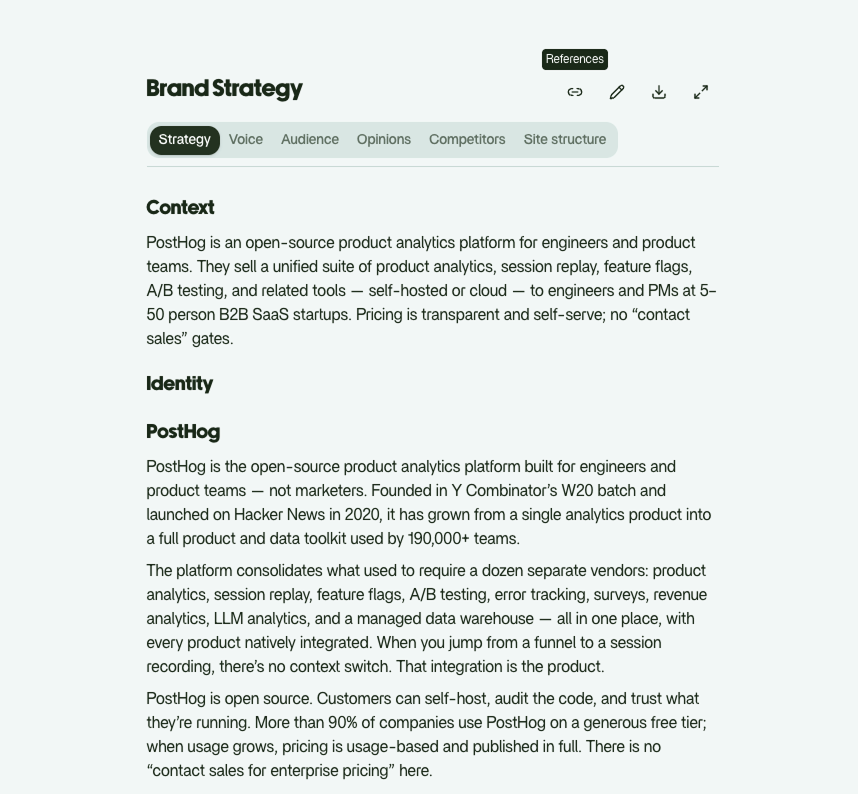
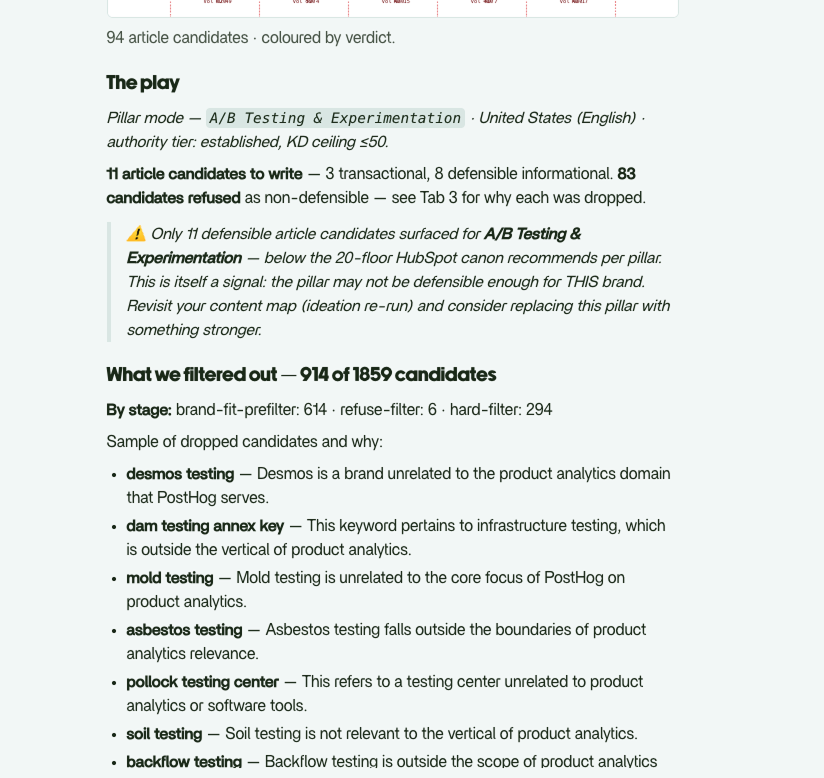
Layer 1: the defensibility call. Before anything else, classify the keyword. I use the Reforge four-bucket taxonomy: is this transactional, defensible-informational, or non-defensible? Transactional keywords (people ready to act) are usually winnable. Defensible-informational content is backed by original data or first-party experience, the only informational content worth investing in. Non-defensible content is the “what is X” explainer that AI Overviews absorb and never cite back. A brief that skips the defensibility call often directs writers toward keywords competitors already own. That’s wasted effort. Andy’s framework starts with a defensibility verdict. This is the layer that decides why this keyword is good or why this keyword is not good.
Layer 2: the search intent breakdown. Everything starts by the search intent. You cannot change what people are typing, so the brief has to name it: navigational, informational, or transactional, plus what’s actually ranking on the current SERP. Tell the writer what the top results look like and where they’re weak. That’s the opening. Here’s how to understand your target search intent and turn it into a brief field.
Layer 3: the E-E-A-T signals. Name the specific credibility signals this keyword demands. A YMYL health query needs author credentials and citations. A tooling comparison needs hands-on testing and screenshots. List the exact signals so the writer builds them in, not bolts them on. These are the signals to Google and to LLMs that you are an expert. Pick the right ones for E-E-A-T signals for your niche.
Each layer kills a different kind of waste. Layer 1 stops you briefing keywords you can’t win. Layer 2 stops content that misreads what the searcher wants. Layer 3 stops content that’s correct but unconvincing. Skip any one and the writer can do everything right and still lose.
Our Template: Step-by-Step
Here’s the structure, field by field. The point isn’t the fields. It’s the reasoning behind each one.
- Primary keyword plus defensibility call. The keyword, then the one-line verdict: transactional, defensible-informational, or non-defensible, and why. If it’s non-defensible, the brief either gets killed or pivots to a secondary intent angle. No verdict, no brief.
- Target audience. Who reads this, what they already know, what they’re stuck on. Intermediate readers don’t need jargon defined. Beginners do. The writer calibrates vocabulary from this field alone.
- Search intent plus SERP observations. The intent type, plus three to five notes on what currently ranks and where it’s thin. This is the writer’s wedge. Give them the gap, not just the keyword.
- E-E-A-T signals. The specific signals to build in: author expertise, original data, citations, first-hand testing. Name them so they’re written in from the first draft.
- Outline structure. H1, the H2 sections in order, and the FAQ list. The writer follows it. They don’t reinvent the shape.
- Internal link plan. Exact anchor text and target URLs. This is how you think in clusters and content pillars instead of publishing orphan articles.
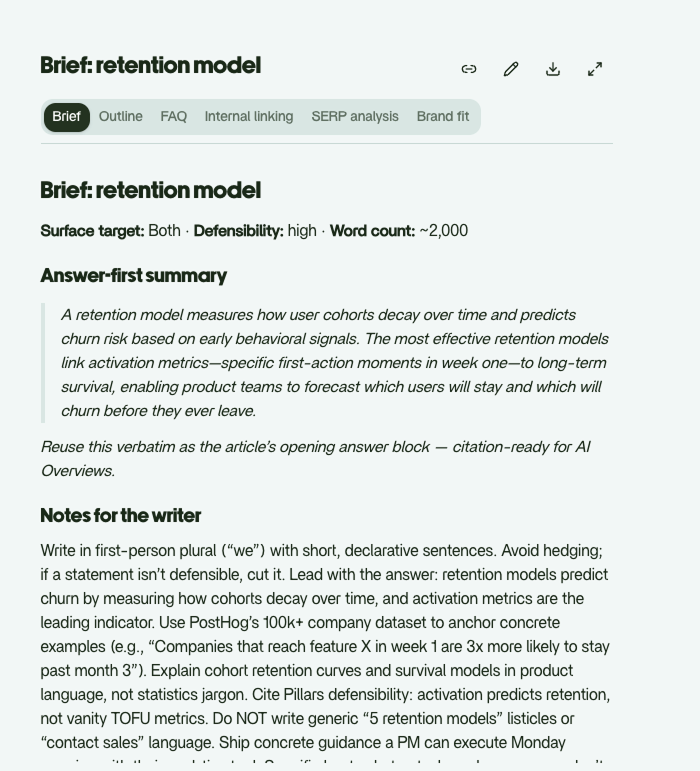
Here’s a compressed excerpt. Keyword: “freelance invoicing software.” Defensibility: transactional, defensible, comparison intent, we can win with hands-on testing. Intent: transactional, top results are thin affiliate roundups with no real usage. E-E-A-T: screenshots from actual accounts, a pricing table we built, a byline from someone who’s used three of these tools. That single block tells the writer what to do and why. See more real brief examples.
The reasoning matters more than the field. A template tells a writer to fill a box. A brief tells them why the box exists. That’s the difference between output and strategy.
How to Adapt the Template for Your Clients
You cannot run the same brief across every client. Defensibility calls, intent, and E-E-A-T signals shift with the niche and the competitive landscape. The structure stays. The strategic layers get customized.
Some fields are non-negotiable. Defensibility, search intent, and audience ship in every brief, for every client, every time. Cut those and you’re back to a generic template that produces commodity content. These three are the strategy.
Some fields compress. For a small client on a tight budget, trim the outline to H2 headers only and cap the FAQ at three questions. The writer fills the gaps. The strategic layers stay full, because that’s where the ranking comes from, not the field count.
Adjust the shape to the content type. A how-to needs numbered steps and a tools list. An explainer needs definitions and examples. A comparison needs a criteria table and a verdict. Set the format in the outline field so the writer builds the right structure from the start.
Then there’s the handoff. A brief only works if the writer reads it and acts on it. Walk them through the defensibility call out loud the first few times, so they understand why this keyword is good or why this keyword is not good, not just that it’s on the list. A writer who gets the reasoning defends the angle on their own. Here’s more on how freelancers use briefs so they actually use them.
Done right, your brief library becomes a list of articles that you want to write and a list of articles that you do not want to write. That’s the real output. Not faster typing. Better decisions about what’s worth typing at all.
FAQ
What should a content brief include?
Primary keyword, defensibility call, target audience, search intent breakdown, E-E-A-T signals, outline structure, and internal links. The first six fields are standard. The strategic layers (defensibility, intent, E-E-A-T) are what separate a useful brief from a template anyone could copy.
How do I know if a keyword is worth briefing?
Make the defensibility call. Is it transactional, where you can realistically win, or non-defensible, where competitors already own the SERP? Skip non-defensible keywords unless you’re chasing a secondary intent angle they’ve left open. The verdict comes before the brief, not after.
What’s the difference between a template and a strategic brief?
A template gives you structure: fields to fill, boxes to check. A strategic brief adds the reasoning: why this keyword, why this audience, why this angle. The reasoning is what stops a writer from producing content that reads fine and ranks nowhere.
Can I use the same brief template for all my clients?
No. The structure carries across clients, but the strategic layers don’t. Defensibility calls, intent breakdowns, and E-E-A-T signals change with every niche and competitive landscape. Reuse the skeleton. Customize the strategy for each client, every time.