Strategy Brief Examples: What a Defensible Brief Actually Looks Like
By Ben, Founder. Ben has multiple years of hands-on SEO experience across client engagements and his own businesses, and refined Andy’s brief format through dozens of real projects.
A strategy brief is a structured document that turns a business objective into a clear creative or content direction. Strong examples share four elements: a defined problem, a specific audience, a defensible angle (why this brand can win this topic), and measurable success criteria. In SEO, that defensibility field is what separates a strategic brief from a keyword checklist. Most brief examples skip it entirely.
Search “strategy brief examples” and you get a mess. Half the results are advertising creative briefs. The other half are blank templates with no fields filled in. If you run client accounts, neither one helps you. You need a worked SEO brief you can copy, adapt, and hand to a writer without rewriting it. This article gives you four, plus the one field that decides whether a brief is strategy or just a checklist. For the bigger picture on what makes a content brief truly strategic, the short version is below.
Strategy brief vs. creative brief: the distinction the SERP gets wrong
Two documents wear the same name. They do opposite jobs.
An advertising creative brief tells a designer or copywriter how to execute a campaign: the visual direction, the tone, the tagline, the channels. It’s a direction for making something. An SEO strategy brief tells a writer what to publish and why it will rank: the keyword, the search intent, the angle, the proof to cite. It translates a keyword opportunity into specific marching orders.
The SERP conflates them because “brief” is a shared word and advertising owned it first. So someone searching for SEO briefs lands on Pollard-style creative brief examples, reads about mood boards, and leaves. Wrong document, wrong reader.
Here’s what every generic template and advertising example leaves out: a reason the brand can win. A defensibility rationale. Plain language on why this specific brand, with its data and its credentials, beats the pages already ranking. Without that field, a brief lists what to cover and stays silent on whether it stands a chance.
4 strategy brief examples with defensibility rationale
I built these formats across dozens of real client projects. Every field is filled in. The defensibility line is the one no competing page shows you.
Example 1: B2B SaaS
- Primary keyword: “API rate limiting best practices” (KD 14, ~900 searches/mo, informational)
- Search intent: a backend engineer wants implementation patterns, not a definition. They already know what rate limiting is.
- Defensibility rationale: our platform processes 4 billion API calls a month. We can publish the actual throttling thresholds we run in production. No competitor on page one has first-party numbers. That’s the moat.
- E-E-A-T signals: name the staff engineer who owns the gateway, cite the production config, show one real incident postmortem.
- Internal link targets: links to the pricing page and the “webhook retries” article; receives a link from the API pillar.
- Writer notes: assume the reader codes. Skip the 101 intro. Lead with the thresholds.
Example 2: E-commerce
- Primary keyword: “merino wool base layer temperature rating” (KD 22, ~1,400 searches/mo, commercial)
- Search intent: a buyer comparing layers before a cold trip wants numbers, not a brand story.
- Defensibility rationale: we sell 30 merino SKUs and have return-reason data on which weights customers found too warm or too cold. The angle narrows to the one category we own. We don’t write about wool in general. We write about our weights, tested.
- E-E-A-T signals: cite internal return data, name the product line, show field photos.
- Internal link targets: links to the merino collection page; receives links from three product pages.
- Writer notes: this is a buying-stage page. Every claim ties to a specific weight we stock.
Example 3: Agency client brief
- Primary keyword: “payroll software for restaurants” (KD 18, ~700 searches/mo, commercial)
- Search intent: an owner of two or three locations wants software built for tip handling and shift work.
- Defensibility rationale: the client has 600 restaurant accounts and case studies with named owners. The win is vertical specificity. Generic payroll pages can’t claim restaurant-only proof.
- E-E-A-T signals: two named customer quotes, tip-credit feature screenshots.
- Internal link targets: links to the restaurant case study hub.
- Writer notes: this client’s voice is warm and plain. No jargon. Same template, different brand. The defensibility logic carries over; the tone does not.
Example 4: Pillar-page brief
- Primary keyword: “content marketing strategy” (KD 41, ~12,000 searches/mo, informational)
- Search intent: broad. The reader wants a complete map and will click into sub-topics.
- Defensibility rationale: we don’t out-authority HubSpot on the head term. We win by being the hub that links to 14 defensible cluster articles, each with its own first-party angle. The pillar’s job is topical authority across the cluster, not a single-page win.
- E-E-A-T signals: link to every cluster piece, each carrying its own data.
- Internal link targets: links out to 14 cluster articles; receives links from all 14.
- Writer notes: structure over depth here. The pillar frames; the clusters defend.
Once you’ve seen the fields filled in, you’ll want a ready-to-use content brief template to apply the format to your own accounts.
The 5 fields every SEO strategy brief must include
Strip a brief to what actually drives the article and you get five fields. Skip any one and a writer fills the gap with guesswork.
- Search intent. What the reader wants when they type this query: informational, commercial, transactional, or navigational. Everything starts by the search intent, and you cannot change what people are typing. You adapt the article around it. For the full method, see breaking down search intent before writing a single word.
- Defensibility rationale. Why this brand can win this keyword. Cite first-party data, author credentials, or a unique angle. A strategy brief without a defensibility rationale is a content checklist. It tells the writer what to cover, not why the brand can win the keyword.
- E-E-A-T signals. The exact proof points, data, and credentials to name in the body. Not “add authority.” The specific engineer, the specific number, the specific case study. This is how you signal to Google and to LLMs that you are an expert.
- Internal link targets. The exact pages this article links to and receives links from. This is where you think in clusters and content pillars instead of one orphan article at a time.
- Writer notes. Voice reminders, claims to make, claims to avoid. Brand-specific, not generic SEO tips. The reminder that this brand holds a strong opinion the article must carry, because if you do not have a strong opinion, your content is going to be replaced by AI.
How to build strategy briefs at scale without each one becoming a one-off
Here’s the agency problem. The strategist writes a sharp brief, hands it to a junior writer, and the quality drops. Why? Because the strategic thinking lived in the strategist’s head, not in the document. The writer got a keyword and a word count, not the reasoning.
The fix is structural. Lock the brief format so the thinking is encoded in the template itself. When the defensibility field is mandatory, a junior writer can’t skip the “why we win” step, because the form won’t let them. The strategy stops being tribal knowledge and becomes a repeatable deliverable. That’s also the difference between a brief a freelancer can run with and one that bounces back. More on the handoff in handing strategy briefs off to freelance writers.
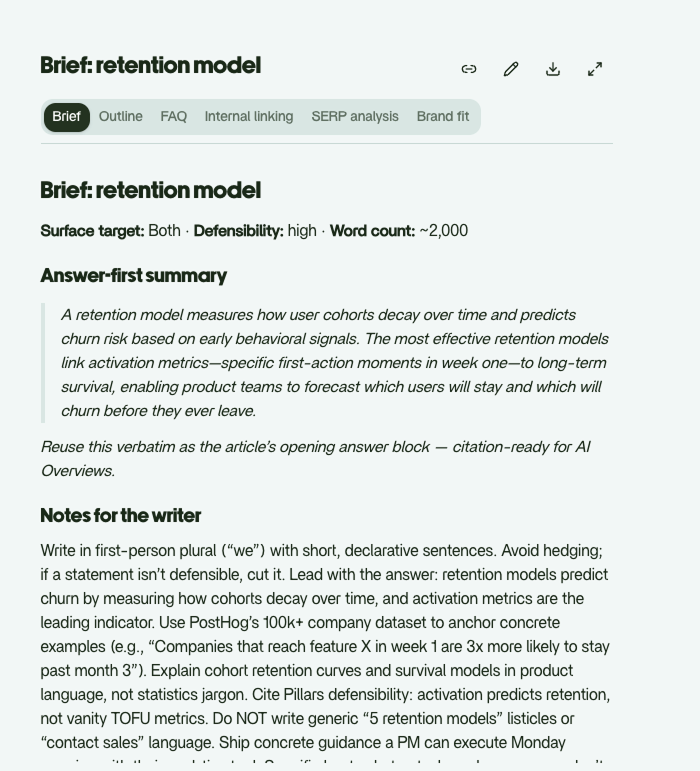
Doing this by hand still costs time per client. This is where Andy generates strategy briefs from live client data automatically. It pulls brand interview data from each client’s live website crawl and onboarding session, then fetches real-time SERP data per keyword (volume, difficulty, intent) on every research run. The method synthesizes Backlinko’s canonical 7-step SEO program with Reforge’s 2026 strategic framework. The brief comes out filled in, defensibility field included, ready to hand off. This is not just a tool. This is really an app that does not only the execution but also the strategy.
FAQ
How do you write a strategy brief?
Fill five fields: the problem statement, the audience, the defensibility rationale (why this brand wins), the content specs, and the success metrics. The defensibility field is the one most people skip and the one that turns a checklist into a strategy.
What is the difference between a creative brief and a strategy brief?
A creative brief directs execution: visuals, copy tone, channels. A strategy brief defines the why and the who: the objective, the audience, and the reason this brand can win the topic. One says how to make it. The other says whether it’s worth making.
What should a strategy brief include for SEO content?
Five things: search intent, a defensibility rationale, the E-E-A-T signals to cite, the internal link targets, and writer notes specific to the brand. Generic SEO best practices don’t belong in the notes. Brand-specific claims do.
What are some examples of a successful strategy brief?
The four worked examples above (B2B SaaS, e-commerce, agency client, and pillar page) each show every field filled in. What makes them successful is the defensibility rationale: the plain-language reason the brand beats the pages already ranking. That’s the field no competing template includes.
How long should a strategy brief be?
A brand or campaign brief fits on one page. An SEO content brief runs 500 to 1,000 words because the structured fields (intent, defensibility, E-E-A-T, links, notes) each need real detail. Shorter than that and the writer is guessing.