Free Content Brief Template: Download and Field Guide
By Ben — Founder. Multiple years doing SEO for clients and my own businesses, with Andy’s brief methodology built from Backlinko’s and Reforge’s frameworks and refined through real client projects.
Andy’s free content brief template covers Backlinko’s canonical 8 fields: primary keyword, secondary keywords, estimated word count, competing URLs, SERP observations, internal link suggestions, reader profile, and writer notes. It also includes three fields generic templates skip: defensibility classification, search intent breakdown, and E-E-A-T signal requirements. Download it in Google Docs, Word, or PDF. Fill it in 20 minutes.
You manage 3 to 10 client accounts and you need one brief template that holds up across industries without rewriting every field from scratch. You also need enough strategic context in the brief that your writers execute without a follow-up email for every article. This guide hands you the template, then walks each field with a one-line note on why it exists, so you can judge in two minutes whether it is worth adapting to your content brief methodology.
Download the Free Content Brief Template
Grab it here in the format your team already works in: Google Docs (make a copy), Word (.docx), or PDF for reference. Same fields in all three, so a writer on Docs and a client on Word see the identical brief.
This is not a blank form with a “keyword” box and a word count. It carries the full Backlinko 8-field structure plus three strategic fields that decide whether an article is worth writing at all. Every competing free brief template omits defensibility classification, search intent breakdown, and E-E-A-T signals: the three fields that determine whether an article is worth writing.
Built for SEO agencies and freelancers briefing writers across multiple clients, and for founders who want a writer to execute without a dozen questions. I refined it through real client brief production, not by stitching together SEO blog posts.
The 8 Core Fields Every Content Brief Needs
These eight come straight from Backlinko’s canonical program. Each one removes a decision the writer would otherwise guess at.
- Primary keyword. The ranking target, not a loose topic label. “content brief template free” is a target. “content briefs” is a vibe. One field, one keyword.
- Secondary keywords. 3 to 15 supporting terms, each meant to appear once. They tell the writer the subtopics to cover, not phrases to stuff.
- Estimated word count. Set from competitor analysis, never gut feel. If the top results run 1,800 words, a 600-word draft loses before it ships.
- Competing URLs. The 3 to 10 pages already ranking, each tagged with its format (listicle, how-to, explainer) and a note on what it misses.
- SERP observations. Format mix, AI Overview presence, content depth, and the dominant gap nobody filled. This is where the article’s angle comes from.
- Internal link suggestions. The exact pages to link, with anchor text, decided before drafting so links are structural, not sprinkled on after.
- Reader profile. Persona, knowledge level, challenges, and how they read. An intermediate agency owner needs different vocabulary than a first-time founder.
- Writer notes. The catch-all for voice, must-include proof points, and anything that does not fit a field above.
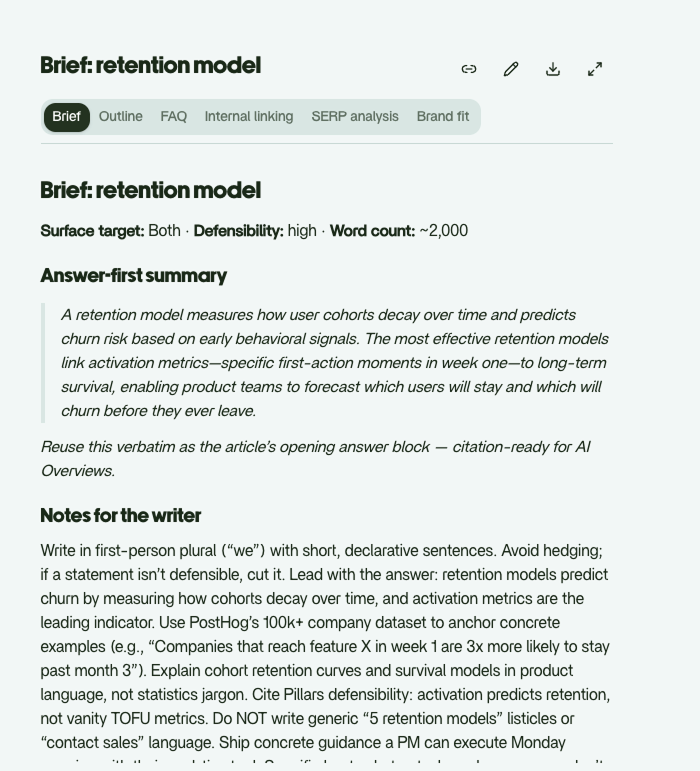
Want to see these filled rather than described? Here is a fully completed brief example.
The 3 Strategic Fields Generic Templates Leave Blank
Here is the core argument. Everything starts with the search intent, and by the keyword the user typed in Google or ChatGPT. The eight fields above tell a writer how to execute. These three tell you whether to execute at all. Skip them and you produce one article. Include them and you produce a strategy.
Defensibility classification. Before anything else, ask: is this keyword worth writing for, or will AI Overviews simply absorb the answer? Generic “what is X” explainers get eaten. Pieces backed by original data and first-party experience get cited. If you do not have a strong opinion, your content is going to be replaced by AI, because AI can easily generate content. This field forces the call up front.
Search intent breakdown. Transactional, informational, or commercial, and the structure changes with the answer. A transactional reader wants the download in the first scroll. An informational reader wants the method. You cannot change what people are typing. You build the article around it. Here is the search intent classification I use to make the call.
E-E-A-T signal requirements. Which author credentials, first-party data, and proof points this specific article must cite. Naming the byline, the experience, and the evidence in the brief means the writer signals to Google and to LLMs that you are an expert, instead of producing one more interchangeable post.
How to Complete the Template in 20 Minutes
Work in this order and the fields fill themselves. Out of sequence, you double back.
- Primary keyword, then SERP analysis. Lock the one keyword. Run the search. Read what already ranks before you write a single other field. Everything downstream depends on what you see here.
- Pull competing URLs. List the top 3 to 10. Word count target and SERP observations fall out of this read for free, because you are already looking at the pages.
- Make the defensibility call. Two minutes with Reforge’s four-bucket framework: is this defensible with your opinion and data, or will AI absorb it? If it gets absorbed, this is one of the articles you do not want to write.
- Set intent, reader profile, and E-E-A-T. Three quick fields once the SERP is in front of you.
- Writer notes last. They summarize everything above into voice guidance the writer can act on. Done well, this is what makes handing the brief to a freelance writer a clean handoff instead of a thread of questions.
Scaling Brief-Writing Across Multiple Client Accounts
Across 3 to 10 accounts, the win is knowing what stays put and what moves. The SERP methodology and the field structure stay constant: every brief, every client, same skeleton. The reader profile and E-E-A-T specifics change per client. So you adapt two sections, not twelve.
Adapting for a new brand voice starts with the brand, not the keyword. Have a very global understanding first of your brand: what it does, the strong opinion it holds, the key differences from competitors. Capture that once per client, drop it into writer notes, and the base template carries to a new industry without a rebuild. Keyword research without that brand context is isolated work. It produces one article, not a strategy.
This is the manual version of what Andy does. It runs the SERP read, classifies defensibility, and populates each brief field from a live website crawl and brand interview, so the strategic rationale is built into every field instead of left blank. Andy generates and populates briefs like this automatically.
Frequently Asked Questions
What should a content brief template include?
Backlinko’s 8 fields: primary keyword, secondary keywords, word count, competing URLs, SERP observations, internal links, reader profile, and writer notes. Add three strategic fields most templates skip: a defensibility call, search intent, and E-E-A-T signal requirements. The first eight tell a writer how to execute. The last three tell you whether to execute at all.
How is Andy’s free template different from a generic SEO brief template?
Generic templates are blank forms. This one has strategic rationale built into the fields, refined through real client brief production rather than assembled from blog posts. The defensibility, intent, and E-E-A-T fields are the difference between a form and a decision tool.
Can I use this template to brief freelance writers?
Yes, that is what it is for. The writer notes field plus the reader profile give a freelancer enough context to execute without follow-up questions. Fill those two well and the handoff is clean.
How long should a content brief be?
For a medium article, outline 4 to 5 sections and keep the brief itself to 400 to 700 words. Long enough to remove guesswork, short enough that the writer reads it in one sitting. The brief is the plan, not the article.
Does the template work for content formats beyond blog posts?
Yes. A structureType field handles landing pages, pillar pages, and comparison posts. You change that one field and the rest of the structure holds, because the strategic fields apply whatever the format.