Content Clustering Template: Build Strategic Clusters for Topical Authority
By Ben — Founder
A content clustering template groups related keywords and content topics around a pillar page, signaling topical authority to Google and LLMs. Andy’s template operationalizes Backlinko’s methodology with three strategic questions: Does this topic align with your core expertise? Is it defensible versus competitors? Will it drive qualified audience traffic? This moves clustering from semantic grouping to strategic positioning.
You have published a pile of articles, and none of them talk to each other. Search engines read that pile as noise, not expertise. This template fixes that by forcing a brand-positioning decision into every cluster you build, so each article reinforces a content pillar strategy instead of floating alone.
Why Strategic Clustering Matters (and Why Semantic Grouping Isn’t Enough)
Most clustering tools group keywords that look alike. “Content cluster”, “content clustering example”, “topic cluster template”: same vocabulary, so they land in the same bucket. That is semantic grouping. It is also why so much clustered content still ranks for nothing.
Clustering for topical authority means grouping by strategic relevance to your brand, not semantic similarity alone, and that distinction is what signals expertise to Google and makes your content citable to LLMs.
Google rewards brands that prove depth on a topic, not brands that repeat the same phrase across ten thin pages. That proof comes from a well-structured cluster: a pillar page claiming the broad topic, supported by child articles that each cover a real subtopic with a real opinion. This is Backlinko’s canonical pillar-page and topic-cluster methodology, applied at the architecture level instead of the keyword level.
Here is the part the commodity approach misses. If you cluster around your actual expertise, every article carries your strong opinion. And if you do not have a strong opinion, your content is going to be replaced by AI, because AI can easily generate the generic version.
The Template Fields: What Each One Does
Every field below forces a strategic decision. None of them is a semantic bucket.
- Pillar topic name and primary keyword. The broad topic you are claiming expertise in. One pillar, one primary keyword. If you cannot say why your brand owns this topic, stop here.
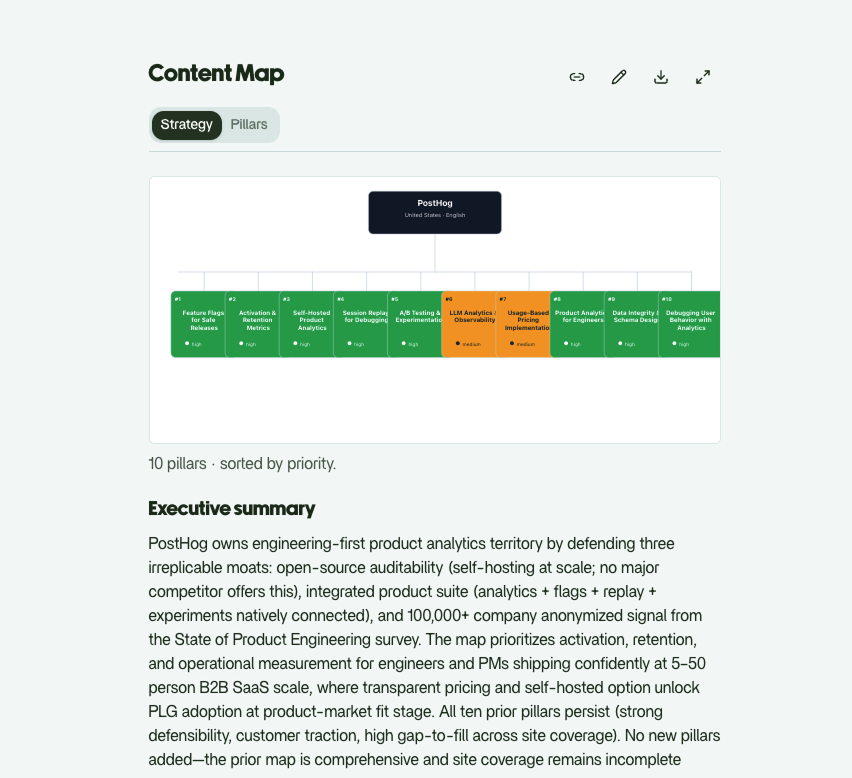
- Cluster articles (3 to 8 child articles). The specific subtopics and long-tail keywords that hang off the pillar. Fewer than three is not a cluster. More than eight usually means you are stacking two pillars into one.
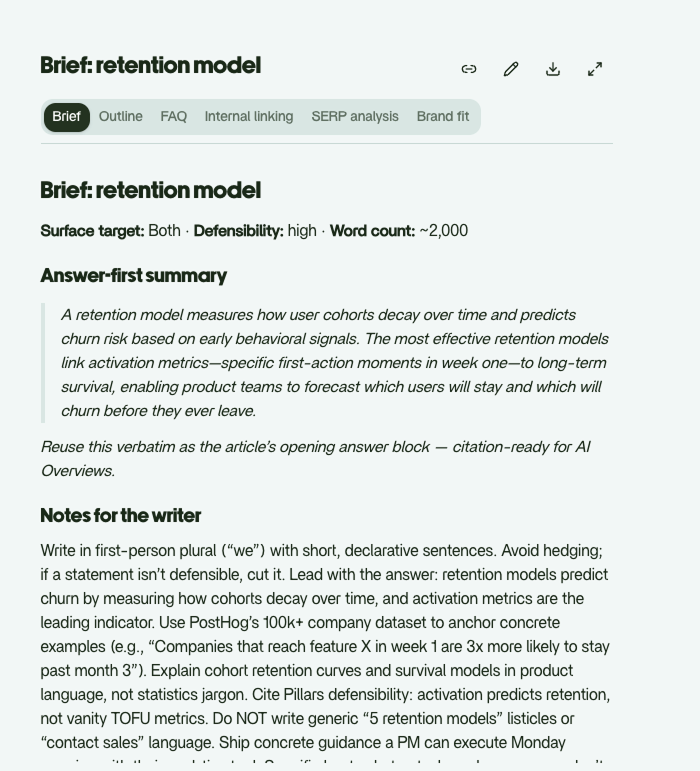
- Keywords and search intent per cluster article. What each article targets, and what the reader actually wants. Everything starts with search intent. You cannot change what people are typing, only adapt your content around it.
- Competitive positioning. The hard question: are we defensible here? Do we have a credible angle, original data, or first-party experience the top results lack?
- Internal linking plan. How the pillar and clusters connect. Pillar links down to every child; every child links back up to the pillar.
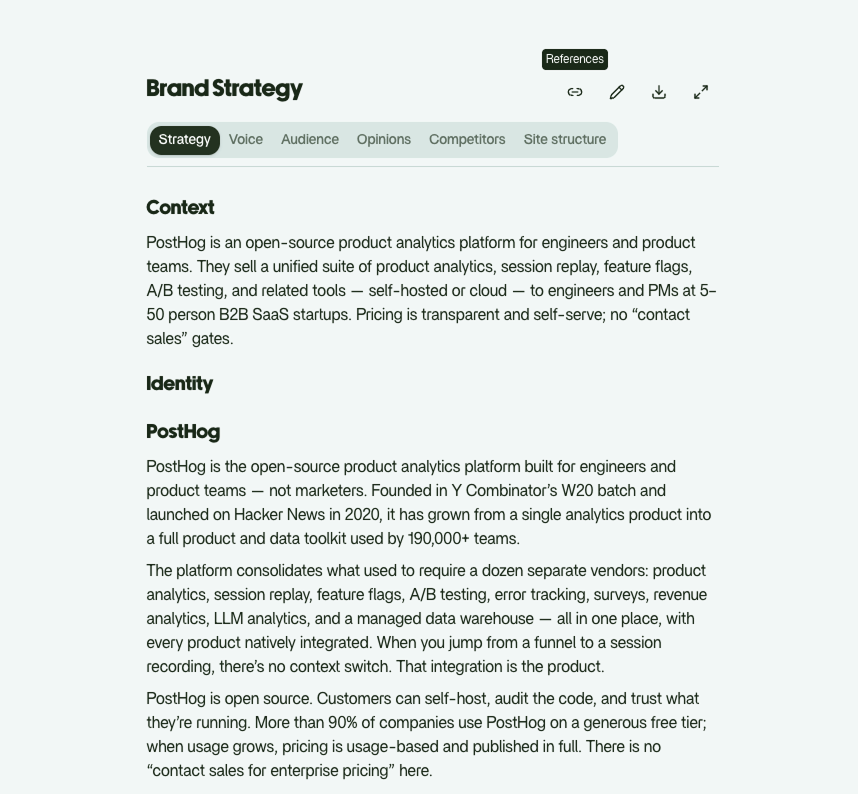
That positioning field is the one most templates skip, and it is the whole point. Andy’s product workflow enforces pillar selection and strategic brand analysis before any clustering happens, because keyword research without brand context produces one article, not a strategy. Once your fields are filled, you can learn how to execute keyword clustering at the keyword level.
Building Your First Cluster: A Worked Example
Take a pillar: Content Pillar Strategy for SEO. Primary keyword: “content pillar strategy”. Your brand claims this topic because you do it for clients every week. That is the expertise check, passed.
Now map the child articles, each with a keyword and an intent:
- “content clustering template” (intent: do it now, needs a fillable framework)
- “topic clusters and pillar pages” (intent: understand the relationship)
- “semantic topic clustering examples” (intent: see it done before copying it)
- “how to do keyword clustering” (intent: execute the keyword-level step)
- “topical relevance” (intent: judge whether a cluster is worth it)
Five children, five distinct intents, zero overlap. Run each through the defensibility check: do you own the expertise, can you beat the current top results, will the traffic be qualified? The template idea cluster passes all three because you have a method and a worked example competitors do not. You can see real-world clustering examples to pressure-test your own build before publishing.
The linking structure is simple. The pillar article links out to all five children. Each child links back to the pillar with descriptive anchor text. That loop is what tells Google these pages are one body of expertise, not five strangers.
Evaluating Your Clusters for Defensibility
Before a cluster earns a slot on your calendar, run three checks.
Does your brand own this expertise? If the answer is “sort of”, the cluster will read generic, and generic content has no future. Can you win versus competitors? Pull the live SERP and look at who ranks and whether an AI Overview already answers the query. Will it drive qualified traffic? Volume with the wrong intent is worse than no volume, because it costs you the same effort.
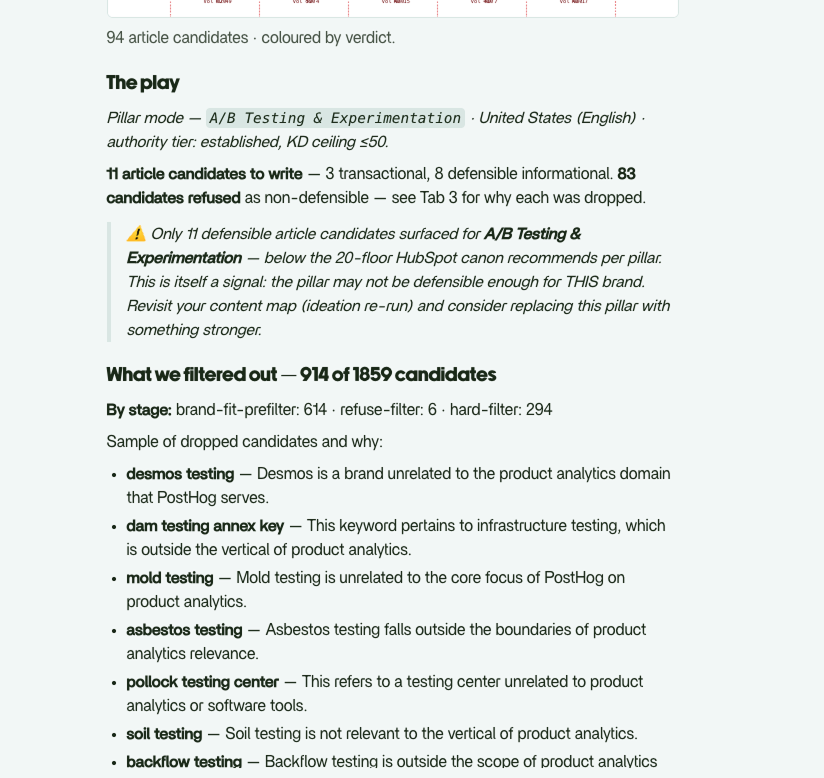
The red flags are loud once you look for them. Weak expertise, a crowded field of stronger publishers, or pure “what is X” intent that AI Overviews absorb whole. Those last ones are non-defensible informational content. Stop them and prune them, do not write them. For a deeper read on this, understand topical relevance in cluster defensibility.
A cluster is ready when all three checks pass, the internal linking plan is clear, and the first article is outlined. This is the same logic Reforge’s 2026 strategic SEO framework applies to the AI era, where LLM citations behave like the new rank and most cited sources do not even sit in Google’s top 20. Andy fetches live SERP data for every keyword run, capturing volume, intent, and AI Overview presence, and pairs it with brand interview data from onboarding to flag which clusters your brand can actually defend.
FAQ
How do I create a content cluster?
Start with a pillar topic, list related keywords by search intent, map each keyword to a cluster article, then link them all back to the pillar. The pillar is the hub. The children are the spokes. The links are what make it a cluster instead of a list.
What’s the difference between a content cluster and a pillar page?
Pillar pages target broad topics. Cluster articles target long-tail variations and specific questions. Both belong to the same cluster, but the pillar is the strategic hub every child article points back to.
What should a content clustering template include?
Fields for pillar topic, cluster articles, target keywords, search intent, competitive positioning, and an internal linking plan. The positioning and intent fields are the ones that force strategic decisions instead of semantic bucketing.
How do I know if my content clusters are defensible?
Ask three questions. Does this cluster align with our expertise? Are we defensible versus competitors who already rank? Does it target a qualified audience pain? If any answer is no, the cluster is not ready.
Can I use Excel or Notion for content clustering?
Yes. Any spreadsheet works. What matters is not the tool. It is whether your template forces brand fit, defensibility, and traffic potential into every row, instead of grouping keywords that simply look alike.